



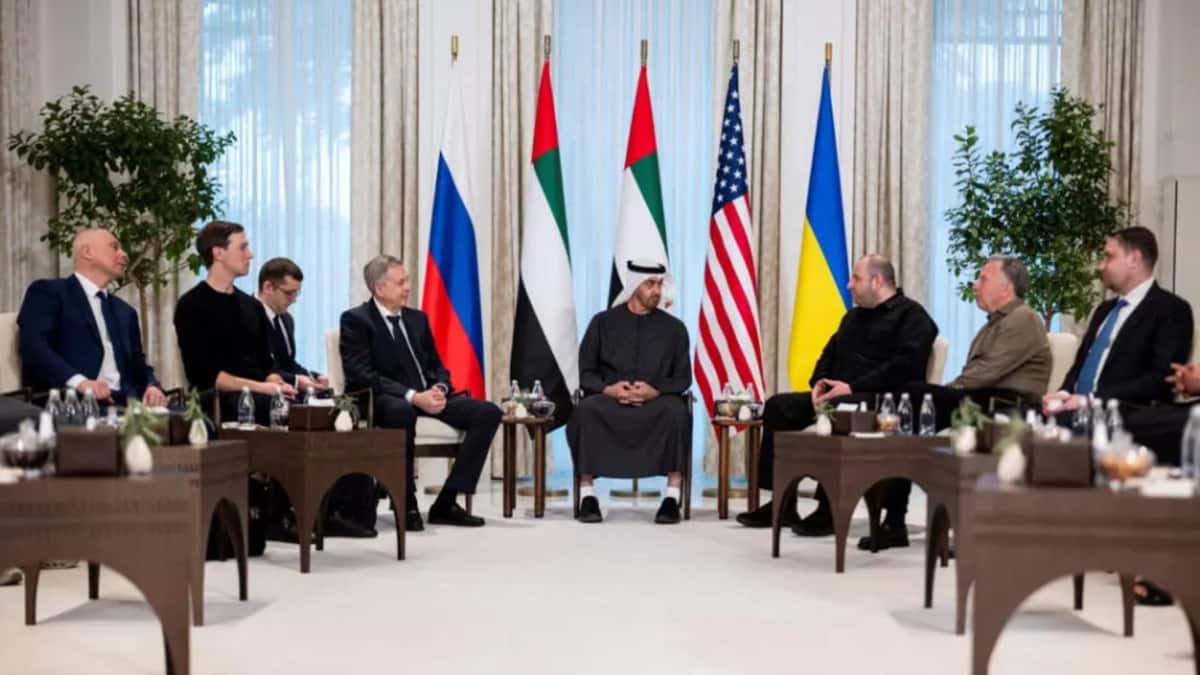
For the first time since Russia’s 2022 invasion, the US, Russia and Ukraine have launched high-level trilateral talks in Abu Dhabi, set to continue on February 1, combining rare diplomatic momentum with entrenched deadlock on core issues
The United Arab Emirates (UAE) recently hosted trilateral talks between the United States, Russia and Ukraine in Abu Dhabi on January 23 and 24, 2026. The discussions were part of ongoing efforts to find a diplomatic solution to the nearly four-year Russia-Ukraine conflict.
The agenda focused on potential parameters for ending the war, the future status of the Donbas region, and security guarantees. The UAE government stated that the sessions focused on “outstanding elements” of a US-proposed peace framework and served as a critical step toward identifying political solutions.
The talks facilitated rare direct engagement between high-level Ukrainian and Russian representatives on a US-proposed peace framework. Participants included US envoys Steve Witkoff and Jared Kushner, Ukrainian intelligence chief Kyrylo Budanov, and Russian intelligence director Igor Kostyukov. Officials from all sides described the discussions as “constructive” and “positive”, leading to an agreement to hold a follow-up meeting next week.
US officials hailed the two-day summit in Abu Dhabi for making “substantial progress” toward a peace framework and expressed optimism that they have narrowed gaps regarding key sticking points, particularly territorial control in eastern Ukraine. One US official characterised the event as a “historic couple of days”. While no concrete agreements were announced immediately after the first round, all parties agreed to report back to their respective capitals and continue negotiations.
Despite the positive atmosphere, territorial control remains the most difficult and unresolved issue. Russia continues to demand control over areas it has failed to fully capture on the battlefield, primarily focusing on the Donetsk, Luhansk, Kherson, and Zaporizhzhia regions. Despite formally declaring these four regions as part of Russia in September 2022, Moscow does not have full control over them, particularly in the Donbas (Donetsk and Luhansk) and southern Ukraine.
On the other side, President Volodymyr Zelenskyy remains adamant that Ukraine’s “red lines” on sovereignty will not be crossed. Significant differences persist over territorial demands, specifically Russia’s insistence that Ukraine withdraw from the Donbas region (Donetsk and Luhansk), which President Zelenskyy has repeatedly rejected as a violation of sovereignty. Even after years of intense, attritional warfare, Ukrainian forces maintain control over strategic cities in the Donetsk region.
The talks were marred by continued military action. While the talks proceeded, both sides noted that military actions continued, with Ukraine describing a barrage of strikes during the negotiation period as a factor that could undermine trust. A large-scale Russian drone and missile attack on Kyiv and Kharkiv occurred during the negotiations, leading Ukrainian officials to characterise it as a “strike against the negotiation table” and accuse Russia of “cynically” undermining the diplomatic process.
Russia also reportedly rejected versions of the peace framework that include the stationing of European peacekeepers in Ukraine. Russian officials have reiterated that such a move would be considered a direct act of intervention and a threat to Russian security. Moscow specifically criticised plans for a “Coalition of the Willing” (led by the UK and France) to deploy troops to monitor a ceasefire, labelling the initiative “dangerous” and “destructive”.
The Russian Foreign Ministry declared that any European or Western peacekeeping units/facilities stationed in Ukraine would be deemed “legitimate military targets” for the Russian Armed Forces. Instead of Western peacekeepers, Moscow has demanded “ironclad” guarantees that include Ukraine’s neutral status and the exclusion of Ukraine from Nato membership. These rejections have complicated international efforts to negotiate an end to the war, particularly as European nations have sought to provide security guarantees to Kyiv.
The hosting of these talks solidified the UAE’s position as a “trusted mediator”. This success follows the UAE’s long-standing humanitarian role in the conflict, which includes facilitating 17 successful prisoner exchange mediation efforts resulting in the release of 4,641 detainees and providing sustained relief, including food, medical supplies, and power generators, to Ukraine and its neighbouring countries.
The US is exerting significant pressure on both Russia and Ukraine to finalise a peace deal. The US has exerted heightened pressure on Ukraine to make concessions and has pushed Kyiv to consider ceding parts of the eastern Donbas region to reach a settlement. The 2026 US defence bill authorises only $400 million for Ukraine—a massive reduction from the billions provided in previous years—signalling a move away from long-term financial support for the resistance. President Trump has reportedly characterised the refusal to reach a deal as “stupid” and has previously suspended intelligence sharing to maintain leverage over Kyiv.
At the same time, to exert more pressure on Russia, President Trump recently ‘greenlit’ the “Sanctioning Russia Act 2025”, which authorises 500 per cent tariffs on countries buying Russian energy to further choke Moscow’s war machine. It is a major bipartisan legislative initiative in the US Congress designed to escalate economic pressure on Russia and its global trading partners. Despite US efforts, Russia remains resistant to key components of the current peace proposal and continues to insist on full control of the Donbas region as a non-negotiable condition.
Summing up, for the first time since the 2022 Russian invasion, high-level trilateral negotiations involving the US, Russia, and Ukraine got underway in Abu Dhabi and are scheduled to continue on February 1. The outlook for the peace talks is characterised by unprecedented diplomatic momentum coupled with deep-seated deadlock on fundamental issues.
The US has succeeded in bringing both sides to the negotiating table, but if these talks fail, Russia is prepared to continue its war of attrition to seize its remaining territorial objectives by force. The situation remains a “grinding contest of attrition” where Russia uses military pressure to force compliance with its territorial claims, despite the inability of its forces to secure those areas on the ground.
(The writer is a retired Indian diplomat and had previously served as Ambassador in Kuwait and Morocco and as Consul General in New York. Views expressed in the above piece are personal and solely those of the author. They do not necessarily reflect Firstpost’s views.)
End of Article
