



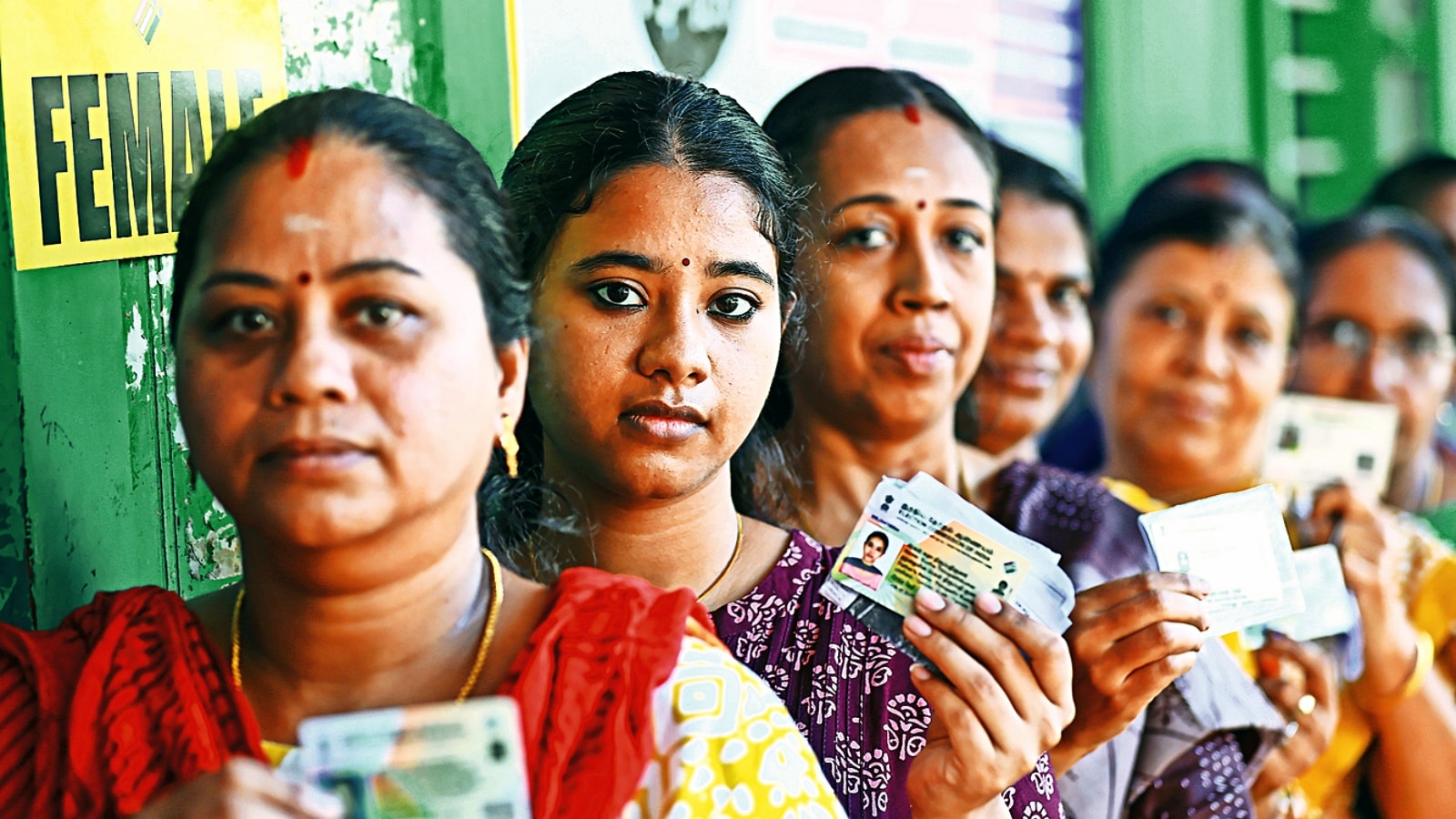
I n contemporary Indian politics, women voters are often discussed through the language of schemes: cash transfers, subsidised gas cylinders, bicycles, free bus travel, self-help loans, nutrition support. Campaign strategists speak of “women beneficiaries” as if they were a newly discovered electoral category.
Tamil Nadu knew better, and knew earlier. Long before political consultants turned women into spreadsheets and welfare into branding, the state had been treating women not merely as dependents inside a household, but as political stakeholders in their own right. Their votes were courted, organised, symbolised and, over time, empowered through one of India’s longest experiments in social welfare politics.

The story begins, in part, with food. In the 1960s and 1970s, the Dravidian movement reshaped Tamil Nadu politics through language pride, caste mobility and anti-Centre sentiment. But it also understood the politics of domestic life. Rising prices, ration shops, school access, nutrition and household dignity mattered profoundly to women, even when public politics remained male-dominated.
By the time M G Ramachandran (MGR), the matinee idol-turned-Chief Minister, expanded the noon-meal programme in schools in the early 1980s, the political significance was unmistakable.
What began as a modest feeding programme had evolved, over decades and through successive governments, into one of India’s most elaborate school nutrition systems. K Kamaraj revived the Madras-era meal scheme in the 1950s; M Karunanidhi broadened it in the early 1970s; MGR scaled it statewide in the 1980s; and in 1989, eggs were added to the menu under the DMK. The programme kept growing thereafter — from one egg a week to two, then three a week in 2007, and by 2010, to eggs on all five school days, with bananas for children who did not eat eggs. By 2021, the menu included rice, sambar, pulses, fortified salt, potatoes on Fridays and sweet pongal on special occasions, reaching more than 5.5 million children through over 43,000 meal centres.
Stalin’s Chief Minister’s Breakfast Scheme provided morning meals to primary school children. These were child welfare schemes, but their emotional beneficiaries included mothers who were content in the knowledge that their children were fed well.
Political scientists have long noted that welfare schemes tied to everyday survival can create durable loyalties, especially among women voters who often manage household scarcity more directly than men.
If MGR introduced the grammar of welfare directed at women, Jayalalithaa sharpened the syntax. Her years in office saw an expansive set of programmes that often addressed women through practical relief: marriage assistance, maternity support, women’s self-help groups, subsidised essentials, and later, the “Amma” brand ecosystem — canteens, salt, water, pharmacies, cement.
To critics, these were freebies. To millions of women, they were infrastructure.
Economists in the Amartya Sen-Jean Drèze tradition have argued that welfare cannot be measured only in cash. A scheme that saves a woman two hours of travel, lowers the burden of cooking, or allows her to seek work, may create as much value as money in hand.
The current administration’s free bus travel for women on state-run buses altered mobility at scale. Then, in September 2023, came the Kalaignar Magalir Urimai Thittam: Rs 1,000 monthly transferred to eligible women heads of households. Many women use the KMUT money to buy rice and vegetables every month, or even to pay for blood pressure and diabetes drugs.
What makes Tamil Nadu distinct is not merely the number of schemes, but the historical sequencing. Women here were gradually treated as citizens whose support had to be earned repeatedly across generations.
Tamil Nadu’s women are not only decisive voters; they are also among the most sought-after workers in the state’s high-precision manufacturing economy. In the assembly lines of electronics giants such as Foxconn and Samsung, as well as in auto-components, textiles and semiconductor-linked supply chains, Tamil women are often preferred for their consistency, dexterity, lower attrition and ability to adapt quickly to exacting production standards, thanks to their relatively better operative knowledge in English.
This election, as in many before it, every major party speaks to women in one register or another. The DMK defends its welfare model. The AIADMK invokes its Amma legacy. New entrants promise safety, anti-corruption and household relief.
But the deeper truth predates all of them. Tamil Nadu did not wait for the age of direct benefit transfers to understand women as political agents. It learned that lesson in ration queues, school kitchens, bus stops, maternity wards, self-help meetings and polling booths.
The writer is Deputy Associate Editor, The Indian Express
