



The Sahara is often imagined as an endless expanse of sand, a landscape so harsh that permanent human settlement seems almost impossible. Yet the desert seen today is only a recent version of a much older place. Thousands of years ago, vast stretches of North Africa looked entirely different. Grasslands spread across regions that are now barren. Lakes occupied low-lying basins, wildlife moved through open savannah, and human communities established themselves in areas that would later become some of the driest places on Earth.Fragments of that vanished world continue to surface from caves and rock shelters scattered across the desert. Sometimes they appear as stone tools or animal bones. Far more rarely, they emerge as human remains. A recent genetic investigation of two naturally preserved individuals from southwestern Libya has done more than reveal details about their lives. It has exposed evidence of a human population that remained hidden from science for decades, surviving only as a faint signal buried within modern DNA.
The DNA evidence that finally revealed a missing human lineage
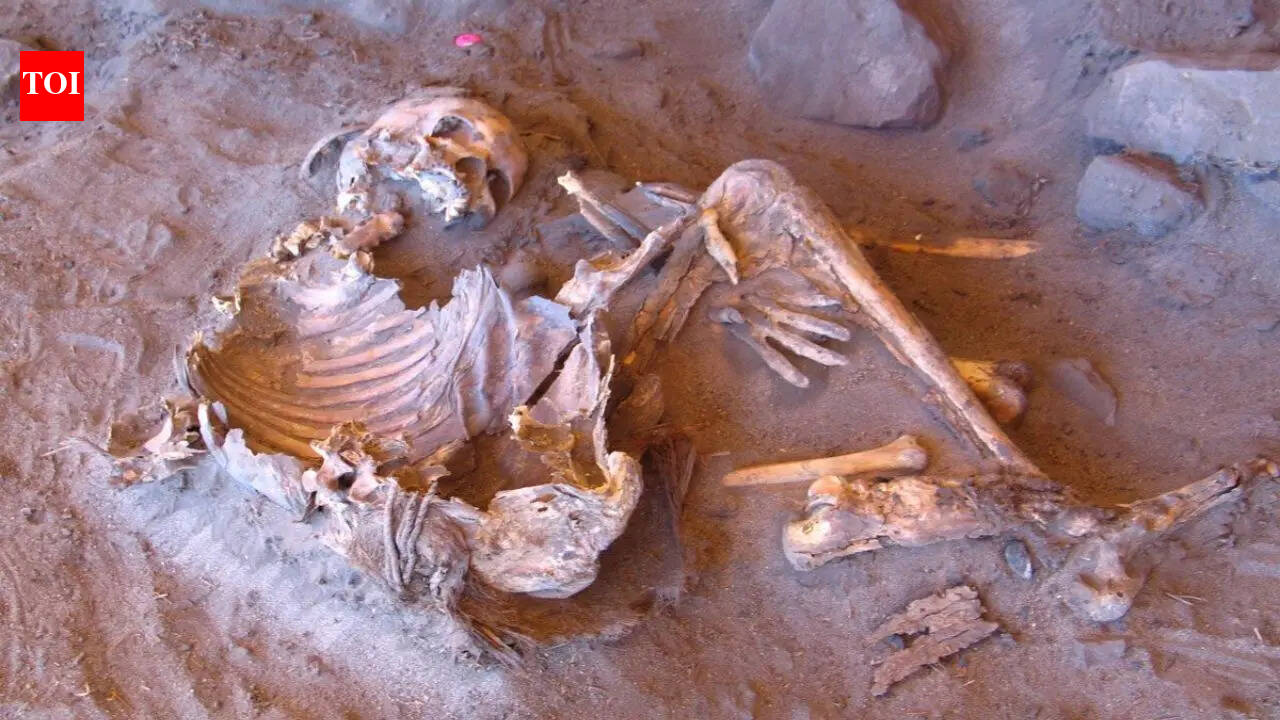
For years, population geneticists suspected that traces of an unknown ancient group lingered within the genetic makeup of people living in parts of Africa and neighbouring regions. The problem was that no physical remains had ever been linked directly to that ancestry.The Libyan mummies changed that. As reported by Science, recovered from the Takarkori rock shelter, the remains date back roughly 7,000 years, a period when the Sahara was still benefiting from wetter climatic conditions. Advances in genetic sequencing allowed scientists to examine far more than the small fragments of inherited DNA studied in earlier work. This time, they were able to investigate large portions of the individuals’ complete genomes.What emerged was unexpected. The women belonged to a population that appears to have separated from other African lineages tens of thousands of years earlier and then remained remarkably distinct.
The surprising story of a population that stayed apart
Human populations rarely remain isolated for very long. Migration, trade, marriage and conflict tend to create connections between neighbouring groups, gradually blending genetic histories over generations. The people represented by the Takarkori remains seem to have followed a different path.Genetic evidence suggests their ancestors diverged from populations further south around 50,000 years ago, as reported by Science. After that split, very little appears to have changed. While other human groups moved across continents, mixed with neighbouring communities and adapted to shifting environments, this lineage retained an unusual degree of separation.The striking part is the timing. These individuals lived only 7,000 years ago, yet their genetic profile resembles something that might be expected from a much older archaeological period. In evolutionary terms, they appear to have preserved an ancient ancestry long after many comparable lineages had disappeared or been absorbed into larger populations.
Ancient DNA challenges assumptions about the Green Sahara
The discovery also complicates long-standing assumptions about movement across North Africa. When people hear about the so-called Green Sahara, they often imagine a vast corridor connecting regions north and south of the desert. During wetter periods, lakes expanded, vegetation spread and animal populations flourished. Such conditions seem ideal for human migration. Although the environment may have become easier to inhabit, it did not necessarily encourage large-scale population mixing. The Takarkori individuals show surprisingly limited evidence of genetic exchange with communities living beyond their immediate region.
Traces of contact with distant populations
The genomes indicate that some interaction occurred with populations living further north. Those contacts left small genetic traces, including ancestry linked indirectly to ancient Neanderthal admixture. Compared with populations outside Africa, whose genomes contain comparatively larger proportions of Neanderthal-derived DNA, the Takarkori people carried only a limited signal.The finding hints at occasional contact rather than sustained migration. Individuals or small groups may have moved across regions, exchanging partners, goods or knowledge without fundamentally reshaping the local population’s genetic identity.
