




NEW DELHI: Within days of Ukrainian President Volodymyr Zelenskyy’s meetings with leaders of the Group of Seven (G7) nations in France, Ukraine launched one of its biggest long-range drone campaigns since Russia’s full-scale invasion began in February 2022. The strikes reached hundreds of kilometres inside Russian territory, hitting oil refineries, fuel depots, defence industries, communications facilities and military logistics hubs, including sites near Moscow.The attacks marked a major escalation in Kyiv’s strategy of taking the war beyond the front lines and into the infrastructure that sustains Russia’s military campaign. Coming immediately after fresh commitments by G7 leaders to strengthen Ukraine’s air defences, defence industry and economic resilience, the timing has fuelled questions over whether the summit gave Kyiv greater confidence to intensify pressure on Moscow.The latest offensive also comes as Russia faces mounting pressure on its fuel supply network. Russian President Vladimir Putin acknowledged on Sunday that repeated Ukrainian strikes on oil infrastructure had caused fuel shortages in several regions, although he described them as “temporary” and insisted Moscow would continue pursuing its military objectives, according to Reuters.While fighting along the front lines remains largely a war of attrition, Ukraine has increasingly relied on domestically developed long-range drones to strike strategic targets deep inside Russia. Military analysts say the objective is not simply to destroy infrastructure but to force Moscow to divert air defence systems, disrupt fuel supplies, raise the economic cost of the war and weaken Russia’s ability to sustain prolonged military operations.
G7 summit gives Kyiv fresh diplomatic backing
Ukraine arrived at the June 15-17 G7 summit in Evian-les-Bains, France, seeking greater military assistance as Russia continued launching missile and drone attacks on Ukrainian cities. Kyiv also pushed for more advanced air defence systems amid growing concerns over shortages of interceptor missiles.G7 leaders responded with fresh commitments to strengthen Ukraine’s military capabilities, reinforce its energy infrastructure ahead of winter and increase economic pressure on Russia through additional sanctions.Following the summit, Zelenskyy described the outcome as a diplomatic success.“The G7 Summit in France delivered important results for Ukraine. Most importantly, we agreed on additional strengthening of Ukraine’s air defence. There will be new steps to put pressure on Russia over its war – pressure for the sake of peace,” Zelenskyy wrote on X.He added: “Our partners will ensure support for our defence and energy resilience. It is important that we have a shared understanding of the main challenges and concrete steps to respond to them.”In another post after the discussions, Zelenskyy thanked G7 leaders for what he described as “strong ideas on how to force Russia into peace.”“Priorities are clear: more air defense missiles along with licences to produce them, winter support package, and cranking up pressure on Russia. Importantly, the US is ready to provide backstop across these lines of effort.”He added: “It is key that everything discussed be implemented. Russia must come to learn that its war will never be normalized. I thank everyone who’s helping.”The G7 leaders later issued a joint declaration reaffirming their support for Ukraine.“We, the Leaders of the G7, stand united in our unwavering support for Ukraine in defending its freedom, sovereignty, and territorial integrity.”According to ANI, the declaration included plans to expand deliveries of air defence systems, interceptors and long-range capabilities while also exploring licensing arrangements that would allow Ukraine to manufacture more Western weapons domestically. The leaders also pledged additional support for Ukraine’s energy infrastructure ahead of winter and promised stronger sanctions targeting Russia’s oil and gas industries.French President Emmanuel Macron later described the summit as producing “unprecedented convergence” among G7 leaders on continued support for Ukraine, AP reported.
Why the G7 summit mattered
Security experts say the significance of the summit extended beyond military aid announcements. It also sent an important political signal that Western backing for Ukraine would continue despite uncertainty surrounding future US policy.JNU professor Dr Rajan Kumar in conversation with the Times of India explained that the meeting conveyed two important messages to Kyiv.“The G7 meeting sent two important messages to Ukraine. First, it emboldened President Zelenskyy because he received continued support not only from European countries but also, at least verbally, from the United States. President Trump also gave some kind of tacit assurance that he would not completely stop supporting Ukraine. That gave Kyiv greater confidence.”He said the summit may also have convinced Ukraine that Washington was prepared to take a firmer approach towards Moscow if peace efforts failed.“Second, Ukraine believes there is now a possibility that Trump could become tougher on Russia if negotiations fail. That also encouraged Kyiv to increase military pressure.” According to Dr Rajan, Ukraine appears to believe that sustained military pressure inside Russia can improve its bargaining position if negotiations eventually resume.
From diplomacy back to the battlefield
Only hours after the G7 summit concluded, Ukraine shifted the focus from diplomacy back to military operations.Rather than relying solely on costly ground offensives against heavily fortified Russian positions, Kyiv has steadily expanded a strategy centred on long-range precision strikes against infrastructure supporting Russia’s war effort. According to Reuters and CNN, these attacks increasingly target oil refineries, fuel storage depots, railway logistics, ports, defence industries and communications centres located hundreds of kilometres inside Russian territory.The objective is not necessarily to seize territory but to reduce Russia’s ability to finance and sustain its military campaign while forcing Moscow to spread its air defences across a much larger area.The first major indication of this strategy came immediately after the G7 summit.
Moscow refinery comes under attack
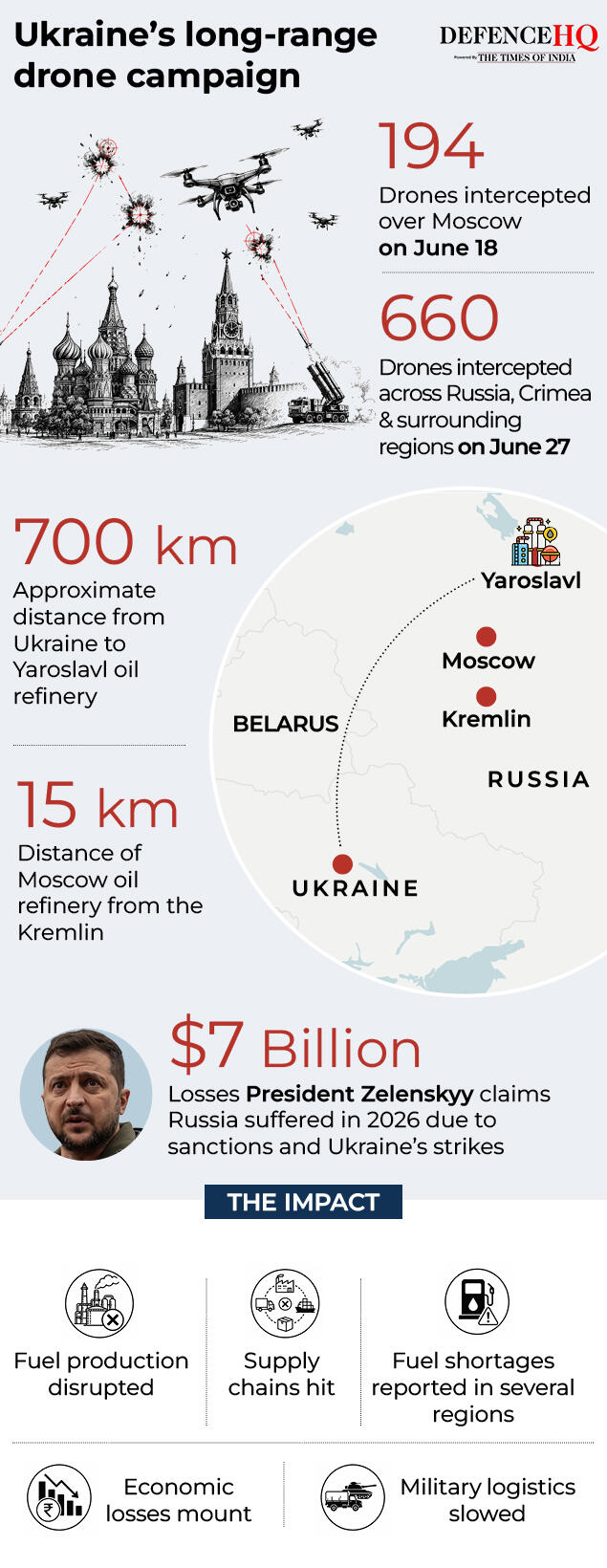
On June 18, Ukraine launched what CNN described as the largest drone offensive against Moscow since the beginning of Russia’s full-scale invasion.Russian authorities said air defences intercepted at least 194 drones heading towards the capital overnight, while the Russian Defence Ministry said almost 1,000 drones had been launched across multiple regions.Among the main targets was the Moscow Oil Refinery in Kapotnya, about 15 kilometres southeast of the Kremlin.CNN reported that geolocated videos showed explosions inside the refinery complex after drones penetrated Russian air defences. Large fuel tanks caught fire, thick black smoke rose over southeastern Moscow and flights at the capital’s airports were temporarily suspended, Reuters reported, citing Russia’s aviation authority.Residents described hearing repeated explosions throughout the night.“The smell is terrible. We closed the windows, but it’s still hard to breathe inside the apartment,” 25-year-old Natalya Klimova told CNN.“It is honestly very frightening.”Industry sources quoted by Reuters later said refinery operations were suspended after the attack, underlining the growing vulnerability of one of Russia’s most strategically important energy facilities.
Why oil refineries have become Ukraine’s preferred target
The strike on the Moscow Oil Refinery was not an isolated operation. It reflected a broader strategy that Ukraine has steadily expanded over the past year by targeting the economic foundations of Russia’s war effort rather than concentrating solely on the battlefield.Unlike military headquarters or heavily protected command centres, oil refineries present an attractive target for several reasons. Russia’s federal budget remains heavily dependent on energy exports, with oil and gas revenues contributing a substantial share of government income. Refined petroleum products also fuel military vehicles, aircraft, naval vessels and the logistics network that transports troops and equipment to the front.Another factor is that refinery damage often takes weeks or months to repair. Critical processing units require specialised equipment, much of which has become harder to obtain because of Western sanctions. As a result, even relatively small drone strikes can disrupt production for extended periods.According to Reuters, Ukraine has steadily expanded attacks on Russia’s energy infrastructure throughout 2026, targeting major refineries, oil terminals, ports and fuel storage facilities. The operations have become increasingly sophisticated, involving coordinated drone swarms striking multiple strategic targets across different regions at the same time.Kyiv has made little effort to conceal the objective behind the campaign.Earlier this year, Zelenskyy argued that attacks on Russia’s energy sector, combined with Western sanctions, were steadily increasing the economic cost of the war for Moscow.“Based on the results from April, our long-range sanctions have reached a new level across three components: reducing Russia’s oil revenues, as well as the range and intensity of sanctions,” he wrote on X on May 1.He added: “According to the most conservative estimates, since the beginning of the year, the aggressor state has lost at least $7 billion solely as a direct result of our precise sanctions against Russia’s oil industry and refining sector – due to direct hits, downtime, and delays in shipments.”The Ukrainian president also announced plans to further expand the country’s long-range strike capabilities, saying additional decisions were being prepared to increase both production and operational reach.Those statements have since been followed by one of Ukraine’s most sustained campaigns against Russian fuel infrastructure.
Ukraine widens the battlefield
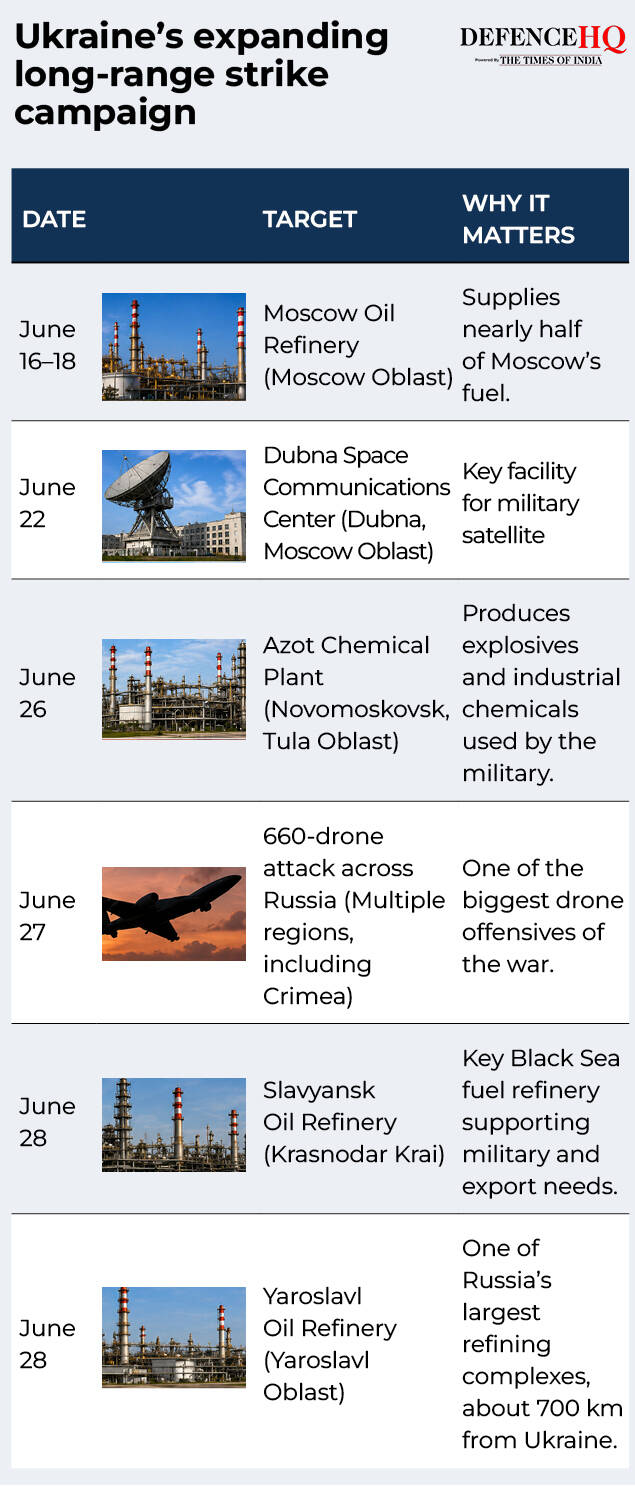
Following the attacks near Moscow, Ukraine expanded its operations well beyond the Russian capital.According to Reuters, Ukrainian drones have repeatedly struck refineries, oil storage depots, military factories, ports, railway infrastructure and satellite communications centres across western, southern and central Russia. Many of the targets are located hundreds of kilometres from the Ukrainian border, demonstrating Kyiv’s growing ability to conduct precision strikes deep inside Russian territory.Among the reported targets during the second half of June were the Dubna Space Communications Center in Moscow Oblast, the Azot Chemical Plant involved in explosives production, the Poltavskaya oil depot, bridges linking occupied Crimea with southern Ukraine, military production facilities in Voronezh and electronic warfare sites designed to jam satellite communications.Military analysts say the pattern suggests Ukraine is no longer carrying out isolated symbolic attacks. Instead, it is attempting coordinated operations that simultaneously target multiple sectors supporting Russia’s military campaign.
Russia’s biggest refineries under pressure
The campaign has increasingly focused on some of Russia’s largest refining complexes. Reuters reported that the NORSI refinery owned by Lukoil, Russia’s fourth-largest refinery, suspended operations after a Ukrainian drone attack on June 25.The Moscow Oil Refinery halted operations after strikes on June 16 and suffered additional damage during another attack on June 18.Tatneft’s technologically advanced TANECO refinery also suspended operations after being struck on June 12, while Rosneft’s Kuibyshev refinery halted processing after a drone attack on June 10.Ukraine has also claimed responsibility for attacks on the Syzran refinery, Tuapse refinery, Yaroslavl refinery, the Orenburg gas processing plant and several fuel storage facilities supporting Russian military logistics.The campaign has not been confined to refineries alone.Fuel terminals at Novorossiysk, Temryuk and Primorsk on the Black Sea have also come under attack, disrupting exports and fuel supplies linked to Russia’s military operations.
Weekend attacks deepen pressure
The offensive intensified again over the weekend of June 28.Zelenskyy announced that Ukrainian long-range drones had struck both the Slavyansk refinery in Russia’s Krasnodar region and the Yaroslavl refinery, located around 700 kilometres from Ukraine.“We continue our operations that weaken Russia’s ability to wage this war,” Zelenskyy wrote on X.He added that every successful strike “means fewer resources serving Russia’s war machine.”Russian officials confirmed attacks in both regions.Krasnodar Governor Veniamin Kondratyev said a fire broke out at the Slavyansk refinery and reported that one person was killed. In Yaroslavl, Governor Mikhail Yevrayev confirmed Ukrainian drones targeted the region, prompting temporary road closures.According to Reuters, the Yaroslavl refinery is among Russia’s largest processing facilities with an annual capacity of about 15 million tonnes of crude oil, while the Slavyansk refinery is another strategically important petroleum facility near the Black Sea.The attacks came only days after Ukrainian drones reportedly struck the Moscow refinery for a second time.
Fuel shortages begin spreading across Russia
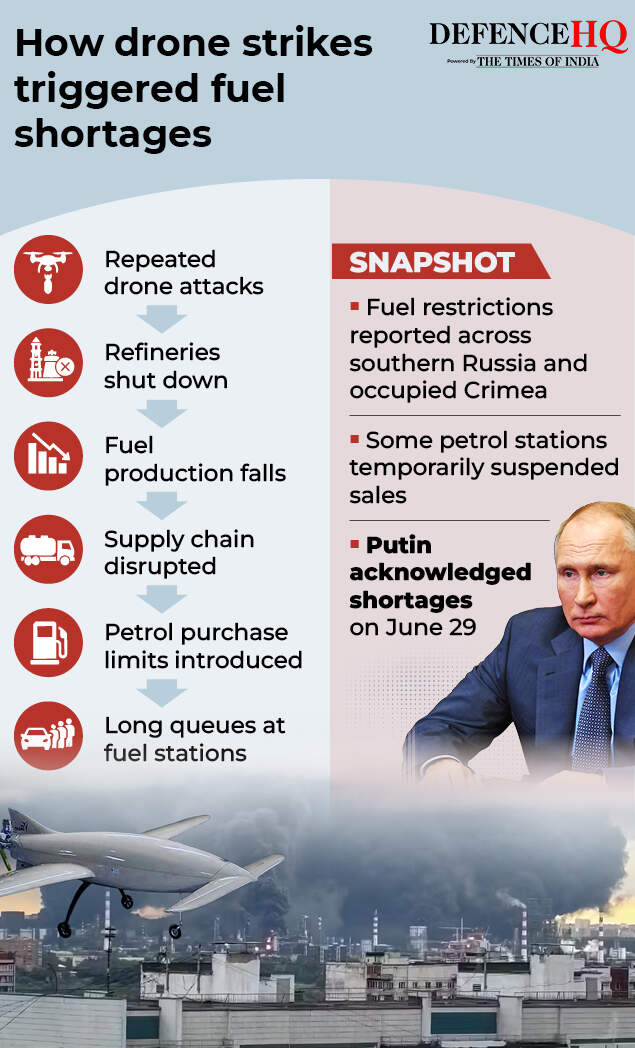
Perhaps the clearest indication that Ukraine’s strategy is beginning to have an impact has come from inside Russia itself.According to Reuters, fuel shortages have spread beyond occupied Crimea into southern Russia and parts of Moscow after repeated attacks disrupted refining capacity.Motorists across several regions have encountered restrictions on fuel purchases, while queues outside petrol stations have become increasingly common.Authorities have reportedly imposed purchase limits in parts of southern Russia, occupied Ukrainian territories and Siberia. Although Moscow has largely avoided formal restrictions, several filling stations in the capital temporarily shut down while others experienced long waiting lines.In Crimea, where Ukrainian strikes have repeatedly disrupted supply routes, authorities suspended fuel sales to private motorists, reduced operating hours for public transport and shortened business hours for restaurants and cafes.When limited fuel sales resumed in Sevastopol, Reuters reported that motorists queued for petrol priced at nearly three times its normal rate.The shortages later spread into Russia’s Rostov region, where photographs showed petrol pumps displaying notices reading “no fuel.”One resident described how the shortages had directly affected his livelihood.“I worked as a courier. I stopped working. Thanks, everybody!”Although major state-owned petrol stations in Moscow kept prices relatively stable, Reuters reported that several privately owned outlets increased prices by more than 10 percent.The shortages have become increasingly significant because fuel is essential not only for civilian transport but also for sustaining military logistics across Russia and occupied territories.Military analysts say even limited disruptions can complicate troop movements, reduce operational flexibility and place additional strain on supply networks supporting Russia’s forces in Ukraine.
Putin acknowledges growing impact of Ukrainian strikes
For months, the Kremlin sought to downplay the effect of Ukrainian attacks on Russia’s energy infrastructure, portraying them as isolated incidents that caused only temporary disruptions.That narrative shifted on June 29 when President Vladimir Putin publicly acknowledged that repeated Ukrainian drone strikes had disrupted fuel supplies in several parts of the country.Speaking during a meeting with senior officials, Putin admitted the attacks had created shortages but insisted the government was managing the situation and that Russia remained committed to achieving its military objectives.According to Reuters, Putin described the shortages as temporary and maintained that Russia remained capable of sustaining its military campaign despite the repeated attacks on refineries and fuel storage facilities.The remarks marked one of the clearest acknowledgements by the Russian leadership that Ukraine’s long-range drone campaign was creating economic disruption inside Russia.Military analysts say the significance extends beyond civilian inconvenience. Russia’s armed forces depend on a vast network of refineries, fuel depots, railway lines and road transport to keep troops supplied across the front. Even modest interruptions can slow logistics, complicate military planning and force the diversion of additional resources to protect critical infrastructure.
Ukraine expands attacks beyond the energy sector
Although oil infrastructure has become Kyiv’s preferred target, Ukraine’s campaign has steadily expanded to include assets directly supporting Russian military operations.According to Reuters and AP, Ukrainian drones have increasingly struck railway hubs transporting ammunition, bridges linking occupied Crimea with mainland Ukraine, military communications centres, ammunition depots and electronic warfare facilities.One of the most important recent targets was the Chonhar road crossing, a key logistical route connecting occupied Crimea with southern Ukraine.Ukraine also struck the Novoazovsk bridge while Russian military vehicles were reportedly crossing, disrupting another important supply route supporting operations in occupied Donetsk.Elsewhere, Ukrainian forces reportedly destroyed a Southern Starlink jamming facility, part of Russia’s electronic warfare network designed to interfere with satellite communications.Earlier in June, drones targeted the Dubna Space Communications Center in Moscow Oblast, a major satellite communications facility supporting Russian military networks.Taken together, the attacks point to a broader strategy that seeks to weaken Russia’s ability to coordinate and sustain military operations rather than focusing solely on destroying individual targets.
One of the largest drone offensives of the war
The scale of Ukraine’s long-range operations has also continued to grow.On June 27, Russia’s defence ministry said it had intercepted 660 Ukrainian drones across 12 Russian regions, occupied Crimea, the Black Sea and the Sea of Azov.According to the Associated Press, it appeared to be one of the largest drone attacks launched against Russian territory since the full-scale invasion began in February 2022.Regional officials acknowledged damage to industrial facilities, power infrastructure and residential buildings, although the Russian Defence Ministry released few details about the intended targets.Moscow mayor Sergei Sobyanin said dozens of drones heading towards the capital had been intercepted.Independent Russian outlet Astra reported that a chemical plant and a hydroelectric facility in Novomoskovsk caught fire during the attacks, although the reports could not be independently verified.The operation came shortly after Zelenskyy announced what he described as “a 40-day influence operation,” a phrase many military observers interpreted as an intensified campaign of deep strikes intended to increase pressure on Russia following the G7 summit.
Why Kyiv believes deep strikes matter
According to defence experts, Ukraine’s long-range drone programme has become one of the country’s most effective tools for offsetting Russia’s numerical advantages on the battlefield.Rather than attempting expensive and often costly frontal assaults, Kyiv is trying to force Moscow into defending thousands of kilometres of critical infrastructure spread across the world’s largest country.Every refinery, fuel depot, military factory, communications centre or logistics hub that requires protection compels Russia to disperse air defence systems and manpower that might otherwise be deployed closer to the battlefield.Dr. Rajan believes the strategy is intended to reshape Russia’s calculations rather than produce immediate battlefield gains.“Ukraine knows it cannot defeat Russia conventionally. What it can do is steadily increase the economic and military cost of continuing the war until Moscow is forced to reassess its position.”He said the campaign is also designed to influence any future negotiations.“These attacks are meant to strengthen Ukraine’s bargaining position. The message is that if Russia continues the war, the costs inside Russia itself will keep increasing.”At the same time, analysts caution that deep strikes alone are unlikely to change the course of the conflict in the near term.Russia retains overwhelming advantages in manpower, industrial production and missile capabilities, while Ukraine continues to depend heavily on Western military assistance for air defence, intelligence and financial support.For Russia, the challenge is no longer confined to defending troops in occupied Ukraine. It must also protect refineries, ports, factories, communications centres and transport networks spread across vast distances.That has forced Moscow to strengthen air defences around strategic facilities while investing additional resources in electronic warfare and counter-drone measures.Whether the strategy succeeds will depend on several factors, including Ukraine’s ability to sustain long-range drone production, continued Western military support and Russia’s capacity to repair damaged infrastructure and adapt its defences.What is increasingly clear, however, is that Kyiv is seeking to make the war more costly for Moscow far beyond the battlefield.The timing of the latest offensive suggests the G7 summit provided Ukraine with renewed political confidence and assurances of continued Western backing. Armed with fresh commitments on air defence, defence production and economic support, Kyiv appears to have intensified a strategy aimed at eroding Russia’s war economy while signalling that the conflict will carry growing costs inside Russian territory itself.As diplomatic efforts remain stalled and neither side shows any sign of abandoning its core objectives, Ukraine’s long-range strikes are likely to remain a central feature of the war, turning Russia’s energy infrastructure, logistics network and defence industry into an increasingly important front in one of the most closely watched conflicts in the world.
