



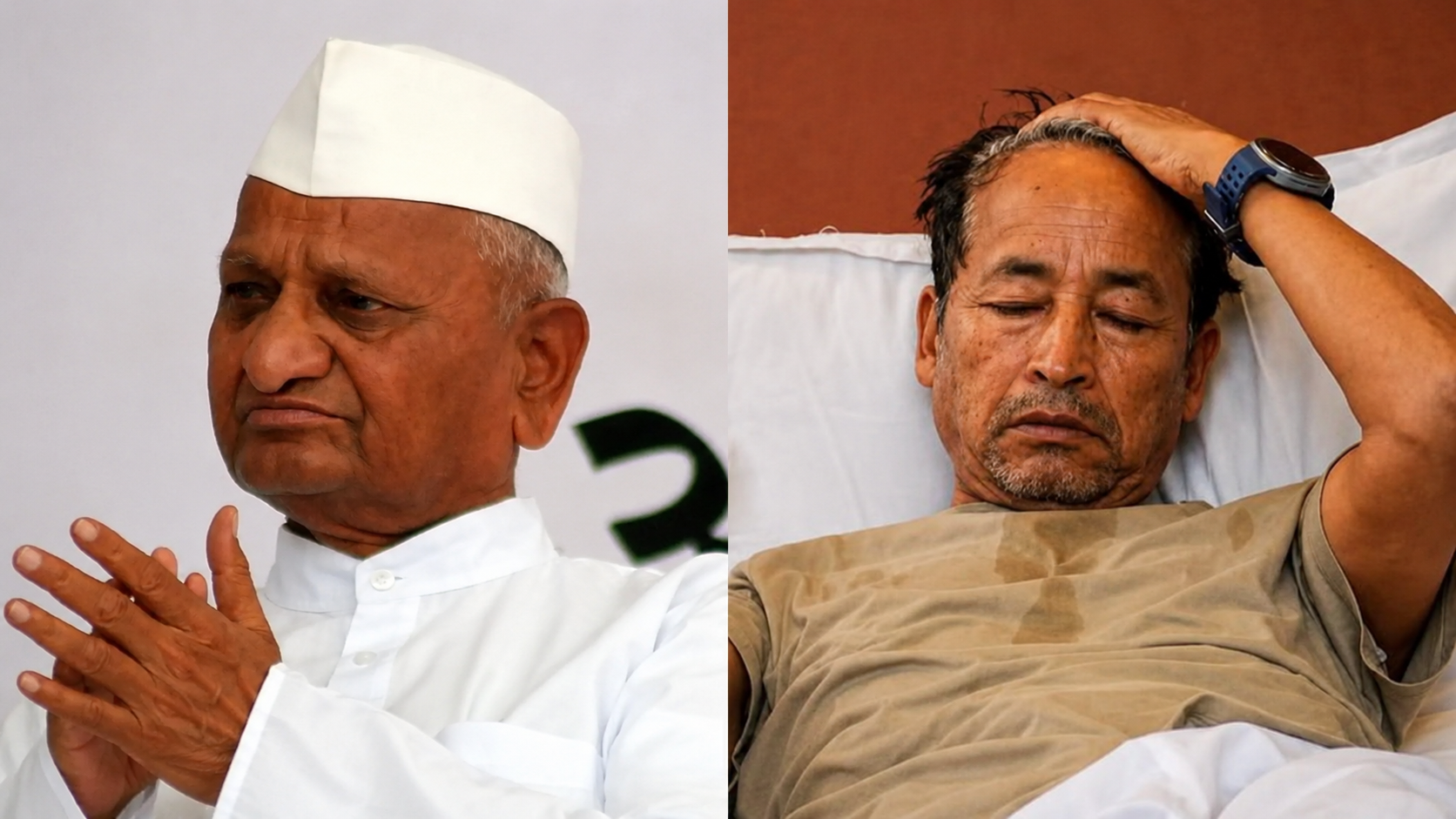
This is the tale of two people who stood up to their governments by going on hunger strikes, all within about 15 years. It is rather interesting to see how their stories differ, which really shows how India, its political scene and the people who thought they could keep society in order by their moral authority — seen as conscious guardians — have changed over time.
First, we have Anna Hazare. A serial agitator since the ’90s in Maharashtra, Hazare caught everyone’s attention when he started a hunger strike on April 5, 2011, in Delhi. It ended in just 96 hours on April 9, when the government agreed to form a joint committee to draft the Jan Lokpal Bill. His second, longer hunger strike began on August 16 at the famous Ramlila Maidan. It ended on August 28, 12 days later, after Parliament passed a resolution in favour of his core demands.

He had a relatively harmless demand: To get strong anti-corruption measures in place by creating an independent ombudsman, a Lokpal. In India, corruption is something that many people think everyone else is doing. Because so many people believe this, anti-corruption campaigns often succeed, even though they do not always completely solve the problem. And with the Manmohan Singh government besieged with a series of scams, or rather allegations of scams, Anna’s agitation struck the right chord. The impact of Anna’s fast was significantly amplified when television channels began broadcasting demonstrations live and self-righteous figures such as former police official Kiran Bedi and yoga guru Baba Ramdev joined the movement. Everybody wanted to showcase their anti-corruption credentials.
Interestingly, the real power behind the Anna movement stayed out of the spotlight. The RSS, apparently with its hidden workers and well-organised network, was believed to be gathering support for the Anna movement. Some socialists and those on the left, like Medha Patkar, Yogendra Yadav and Prashant Bhushan, also gave their full support to Anna. However, the biggest winner of the Anna movement was the BJP. The 2014 elections showed that.
The Manmohan Singh government also played a role, as it didn’t quite grasp the intricacies of the Anna movement initially. Once they did, they enlisted the help of two important individuals, along with Pranab Mukherjee and AK Antony, to “negotiate” the end of Anna Hazare’s fast. These two, Vilasrao Deshmukh, a former Maharashtra chief minister, and Umeshchandra Sarangi, a former NABARD chief and IAS official from the state, were better equipped to handle Anna than Mukherjee and Antony. Deshmukh and Sarangi were able to achieve their goal. But by then, it was too late — the genie was already out of the bottle.
Sonam Wangchuk’s ongoing fast differs distinctly from Anna’s agitation on two counts. One, Wangchuk’s demand is grounded in a more concrete reality. While what Anna wanted was theoretical and abstract, Wangchuk seeks the removal of Dharmendra Pradhan, a key lieutenant of the Narendra Modi government and the Union Education Minister. The contrast between their demands highlights the stark difference in political acumen between the two. Compared to the easily pliable, politically well-connected Anna, the incumbent agitator is much more headstrong and is a man of conviction. Fulfilling Anna’s harmless — and eventually useless — demand was much easier than what Wangchuk is seeking.
Secondly, Wangchuk has a complete lack of support from the Opposition. During Anna Hazare’s movement, the then key Opposition, the BJP, saw an opportunity to expose the chaotic Manmohan Singh government. In contrast, the current Opposition appears to be showing signs of inertia. One reason could be that the opposition is currently divided and lacks a cohesive strategy to challenge the Narendra Modi government. In Wangchuk’s success, no party sees any incentive. In contrast, Anna’s victory had a direct beneficiary: The BJP. In fact, Anna was the puppet in the hands of the BJP, while Wangchuk is a lone wolf playing his cards on his own. The BJP was then better placed to capitalise on anti-government sentiments ignited by Anna since it was the sole occupant of the Opposition’s space and thus the only challenger to the Congress-led coalition ruling at the centre.
This dark political reality brings up a really important question: What is society thinking as a whole? Have we become a bunch of people who only judge success and failure based on elections? Are we individuals who choose which morals to follow? During Anna Hazare’s movement, the whole country seemed to be united in supporting certain issues. Even small and big heroes and heroines from the entertainment industry could stand up and say they disagreed with the government. Where are those voices now?
Also, we don’t see the same level of media attention that was so loud during the Anna movement. Some good samaritans from business and industry were quick to support Anna’s movement. But it seems like India Inc, under the current government, is more interested in Vipassana right now. It’s quite striking how, in just about 15 years, our lively, boisterous and vibrant democracy has become so quiet.
We must consider whether we are prepared to challenge this silence. The outcome of Sonam Wangchuk’s hunger strike could determine whether our democracy reclaims its voice or we remain trapped in deafening silence. It is imperative to address these questions sooner rather than later, as the current silence may echo the silence of the lambs.
The writer is editor, Loksatta
