



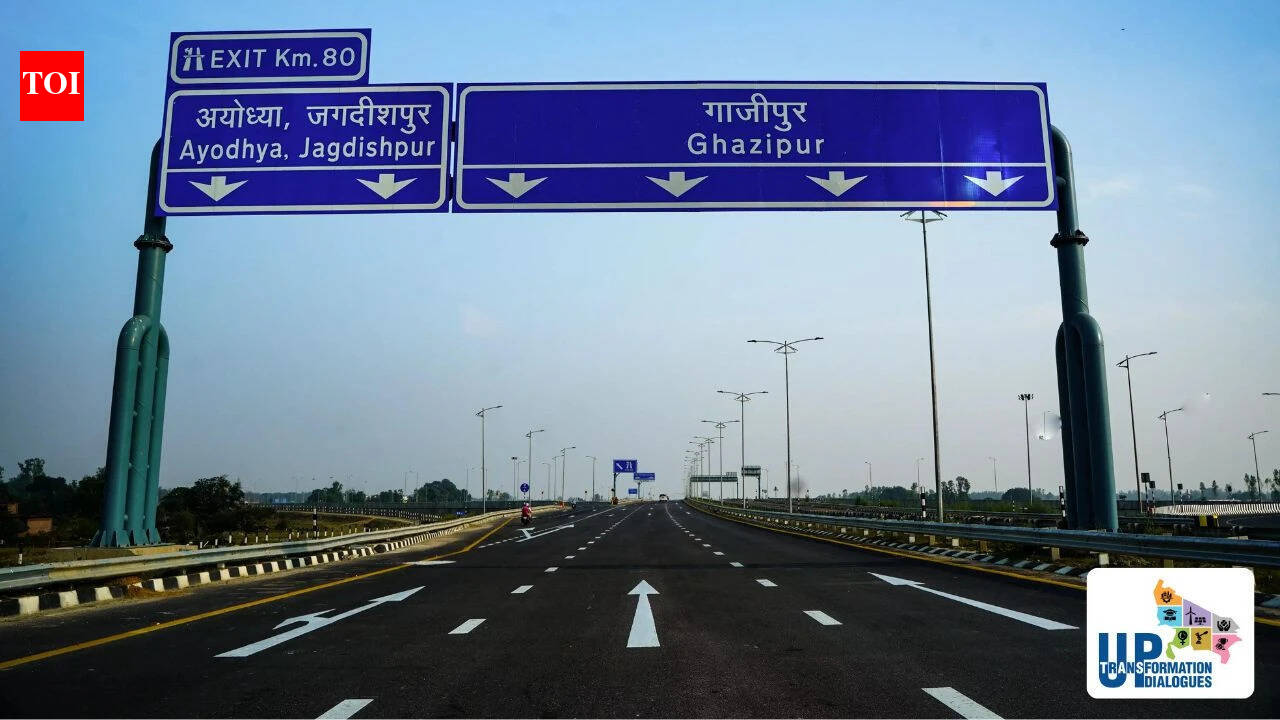
Infrastructure has emerged as the defining pillar of Uttar Pradesh’s development journey over the last nine years. Since 2017, the state has adopted an infrastructure-led growth strategy that has fundamentally transformed connectivity, industrial development, logistics, urban mobility and rural accessibility.Under the leadership of chief minister Yogi Adityanath, Uttar Pradesh has moved beyond incremental improvements to undertake one of the most ambitious infrastructure expansion programmes in independent India. Massive investments in expressways, airports, industrial corridors, rail connectivity, metro systems, waterways, power infrastructure and digital networks have collectively laid the foundation for making Uttar Pradesh a one-trillion-dollar economy.Recognising that infrastructure is the backbone of economic prosperity, the state government has consistently prioritised capital expenditure. Capital spending has increased from approximately Rs 69,789 crore in 2016-17 to nearly Rs 1.47 lakh crore by 2024-25. This unprecedented investment has not only improved physical connectivity but has also attracted industries, generated employment, strengthened supply chains and significantly enhanced the state’s investment climate.The most visible symbol of this transformation is Uttar Pradesh’s emergence as India’s ‘Expressway Capital.’ Until 2017, only three expressways were operational in the state. Today, Uttar Pradesh possesses the country’s largest expressway ecosystem, with around 22 expressway projects that are operational, under construction or planned. Nearly 55 percent of India’s access-controlled expressway network now lies in Uttar Pradesh. The expressway network, which was approximately 450 kilometres in length before 2017, is expected to exceed 3,000 kilometres once all ongoing projects are completed.The Yamuna Expressway and Agra-Lucknow Expressway provided the initial momentum by demonstrating the economic benefits of high-speed road connectivity. However, the real expansion began after 2017 with the construction of new corridors designed not merely to reduce travel time but also to stimulate regional economic development.The 341-kilometre Purvanchal Expressway has transformed eastern Uttar Pradesh by connecting Lucknow with Ghazipur. Districts that once suffered from inadequate industrial investment now enjoy faster access to markets, encouraging the establishment of food processing units, warehousing facilities, logistics parks and manufacturing enterprises. The expressway has also enhanced connectivity with neighbouring Bihar and eastern India, thereby strengthening interstate trade.Equally transformative has been the 296-kilometre Bundelkhand Expressway, which has unlocked the development potential of one of Uttar Pradesh’s historically backward regions. Stretching from Chitrakoot to Etawah, the expressway provides direct connectivity to the Uttar Pradesh Defence Industrial Corridor. Defence manufacturing nodes in Jhansi, Chitrakoot, Kanpur, Aligarh, Agra and Lucknow are expected to benefit immensely from improved logistics, making Bundelkhand an emerging hub for aerospace and defence production.The flagship Ganga Expressway represents the state’s most ambitious infrastructure project. With an estimated investment exceeding Rs 36,000 crore, the 594-kilometre expressway has connected Meerut in western Uttar Pradesh with Prayagraj in the east. Passing through twelve districts and hundreds of villages, it is one of India’s longest state expressways. More importantly, it will integrate agricultural belts, industrial clusters, religious centres and urban markets into one seamless economic corridor, reducing travel time while lowering logistics costs for businesses.Several additional projects—including the Gorakhpur Link Expressway, Lucknow-Kanpur Expressway, Vindhya Expressway and Chitrakoot Link Expressway—are ensuring that every region of Uttar Pradesh becomes part of a comprehensive high-speed transportation network. Recognising that roads alone cannot drive economic growth, the government has simultaneously identified thousands of hectares of land along these expressways for industrial parks, logistics hubs and manufacturing clusters, thereby converting transport infrastructure into engines of industrial development.The aviation sector has witnessed an equally remarkable transformation. A decade ago, Uttar Pradesh had limited air connectivity concentrated mainly in Lucknow and Varanasi. Today, the state has emerged as India’s leader in airport development with sixteen operational airports and several more under development.Uttar Pradesh is now the only state in India with five international airports. Chaudhary Charan Singh International Airport in Lucknow continues to expand its passenger handling capacity through modern terminals and upgraded facilities. Lal Bahadur Shastri International Airport at Varanasi has become a major gateway for domestic and international tourists visiting Kashi. Kushinagar International Airport has strengthened India’s Buddhist tourism circuit by providing direct international access to pilgrims from countries such as Sri Lanka, Thailand, Japan and Myanmar.The Maharishi Valmiki International Airport at Ayodhya has emerged as a major catalyst for religious tourism following the construction of the Shri Ram Mandir. Built with architecture inspired by traditional temple design, the airport is expected to accommodate the rapidly increasing number of pilgrims visiting the holy city while stimulating hospitality, retail and local employment.Perhaps the most transformative aviation project is the Noida International Airport at Jewar. Developed as one of Asia’s largest greenfield airports, it represents far more than an aviation facility. The airport is expected to become an integrated logistics, cargo, manufacturing and commercial hub. Designed to handle millions of passengers annually in its first phase, the airport is expected to attract global investments across logistics, aviation services, warehousing and export-oriented industries. Around the airport, the state government is also developing an aviation hub, aerospace ecosystem and a world-class Maintenance, Repair and Overhaul (MRO) facility, reducing India’s dependence on overseas aircraft maintenance.Rail infrastructure has simultaneously undergone rapid modernisation. Uttar Pradesh possesses India’s largest railway network, spanning over 16,000 kilometres. Station redevelopment, electrification, doubling of railway lines and improved passenger amenities have enhanced the efficiency of rail transport across the state.Even more significant has been Uttar Pradesh’s strategic role in India’s Dedicated Freight Corridor programme. The intersection of the Eastern and Western Dedicated Freight Corridors at Dadri has transformed the state into the country’s logistics gateway. More than one thousand kilometres of the Eastern Dedicated Freight Corridor pass through Uttar Pradesh, enabling faster movement of goods between eastern India and western ports. This dedicated freight infrastructure has dramatically reduced transit time and logistics costs while improving the competitiveness of Uttar Pradesh’s manufacturing sector.Urban transportation has also received unprecedented attention. Metro rail services are now operational in Lucknow, Noida, Greater Noida, Ghaziabad, Kanpur and Agra, while the Delhi-Ghaziabad-Meerut Namo Bharat Regional Rapid Transit System has introduced a new era of high-speed regional commuting. The recently approved Lucknow Metro Phase 1B will further expand urban mass transit within the state capital. In addition, flyovers, ring roads, smart traffic management systems and city road widening projects have significantly eased congestion across major urban centres.One of the most innovative aspects of Uttar Pradesh’s infrastructure strategy has been the revival of inland waterways. Eleven of India’s National Waterways pass through the state, making Uttar Pradesh uniquely positioned for low-cost river-based freight transportation. National Waterway-1 along the Ganga has emerged as a major logistics corridor.The country’s first multimodal terminal at Varanasi now integrates road, rail and inland water transport, allowing cargo to move more efficiently to eastern ports. Supporting infrastructure, including freight villages and cargo terminals at Ramnagar, Mirzapur, Ghazipur and Chandauli, has strengthened multimodal logistics. The establishment of the Uttar Pradesh Inland Waterways Authority demonstrates the government’s long-term vision of integrating waterways into the state’s transport ecosystem.Industrial infrastructure in UP has expanded alongside transportation projects. The Bundelkhand Industrial Development Authority (BIDA) is developing a massive industrial city spread across more than 56,000 acres. This marks the creation of Uttar Pradesh’s first major planned industrial city in nearly five decades. Similarly, Integrated Manufacturing Clusters under the Amritsar-Kolkata Industrial Corridor are being developed to promote advanced manufacturing, exports and industrial investment.Digital infrastructure has also become a priority. Under the state’s Data Centre Policy, Uttar Pradesh aims to establish multiple data centre parks with a cumulative capacity of around 900 MW. Noida and Greater Noida are emerging as major digital infrastructure destinations, attracting investments from leading technology companies. These facilities will support cloud computing, artificial intelligence, fintech and digital governance while generating high-skilled employment.Energy infrastructure has expanded in parallel with industrial growth. Recognising the need for reliable and sustainable power, the government has promoted large-scale renewable energy projects. Major solar parks are being established in districts such as Jalaun and Jhansi, contributing hundreds of megawatts of clean electricity. These projects complement ongoing efforts to strengthen transmission infrastructure, improve electricity distribution and ensure reliable power supply for industries and households alike.While mega projects dominate headlines, rural infrastructure has remained equally important. Through schemes such as the Pradhan Mantri Gram Sadak Yojana and state-funded rural connectivity initiatives, thousands of kilometres of village roads have been constructed or upgraded. The rural road network has expanded from around 51,500 kilometres to more than 77,000 kilometres over the past decade. Improved connectivity has enabled farmers to transport produce quickly to markets, reduced transportation costs, enhanced access to healthcare and education, and integrated remote villages with the mainstream economy.The impact of this infrastructure revolution is increasingly reflected in Uttar Pradesh’s economic indicators. Improved connectivity has significantly reduced logistics costs, making the state more attractive for manufacturing and exports. Uttar Pradesh has emerged as the leading landlocked state in India’s Export Preparedness Index, while industrial investments secured through successive Global Investors Summits continue to translate into new projects on the ground. Better infrastructure has also boosted investor confidence, reflected in rising bank credit, increased private sector investment and rapid expansion of MSMEs.Tourism has also received a major boost. Improved road and air connectivity to destinations such as Ayodhya, Varanasi, Prayagraj, Mathura, Vrindavan, Kushinagar and Chitrakoot has facilitated religious tourism on an unprecedented scale. Simultaneously, improved connectivity has benefited agriculture, logistics, healthcare, education and the service sector, demonstrating how infrastructure creates multiplier effects across the economy.The state’s development strategy has been notable for integrating transport, industry and urban planning rather than treating them as isolated sectors. Expressways are being linked with industrial parks; airports with logistics hubs; freight corridors with manufacturing clusters; waterways with multimodal terminals; and digital infrastructure with technology parks. This integrated planning approach has helped maximise economic returns on public investment.As Uttar Pradesh advances towards its vision of becoming a one-trillion-dollar economy, infrastructure will continue to remain its strongest competitive advantage. Projects currently under implementation—including the Ganga Expressway, Noida International Airport, Defence Industrial Corridor, new metro corridors, industrial cities and renewable energy parks—are expected to further accelerate growth over the coming years.The story of Uttar Pradesh over the last nine years is therefore not merely one of constructing roads, airports or bridges. It is the story of creating an entirely new economic architecture designed to connect people with opportunities, industries with markets and investors with world-class infrastructure.By combining massive public investment with long-term strategic planning, Uttar Pradesh has positioned itself as one of India’s fastest-transforming states. Its infrastructure renaissance is laying the foundation for sustained economic growth, regional balance, enhanced competitiveness and improved quality of life, making the state an increasingly important driver of India’s development journey in the decades ahead.
