



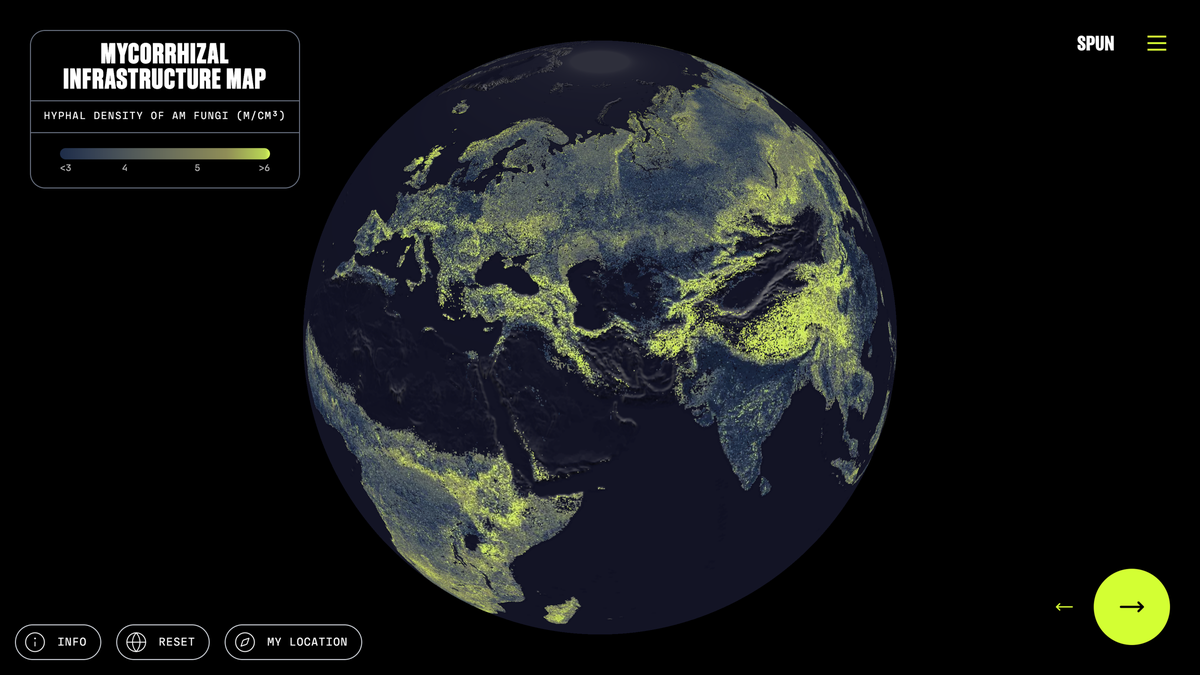

A global map of the density of AM fungi.
| Photo Credit: Truth & Beauty/Moritz Stefaner Justin Stewart, SPUN
A new study published in Science has reported the first global map of the earth’s vast underground network of arbuscular mycorrhizal (AM) fungi.
These fungi have sustained plant life for millions of years but their scale and distribution has been largely invisible until now.
Using machine learning and data from more than 16,000 soil cores, an international research team has revealed that topsoils around the world contain some 110 quadrillion km of fungal hyphae — a distance equal to nearly a billion trips from the earth to the sun.
The AM networks also weigh around 300 million tonnes of carbon, which is four- to six-times the weight of the entire human population.
By forming symbiotic relationships with 70% of plant species, trading nutrients for carbon, the AM networks sequester an estimated 4 billion tonnes of CO2-equivalent a year, or roughly 11% of all human-related carbon emissions.
The study also identified biodiversity hotspots and threats to them. Grassland ecosystems like those in South Sudan, the Tibetan plateau, and India’s Banni grasslands house 40% of the world’s AM fungal networks. However, the study warned that cropland typically has a 50% lower fungal density relative to wild ecosystems, and because grasslands are being converted to farms four-times faster than forests, these ecosystems are at extreme risk.
By quantifying the extent of this “living infrastructure”, as the Society for the Protection of Underground Networks put it, the work hopes to move fungi from the periphery of environmental policy to the centre of climate action.
Published – June 15, 2026 07:15 am IST

