



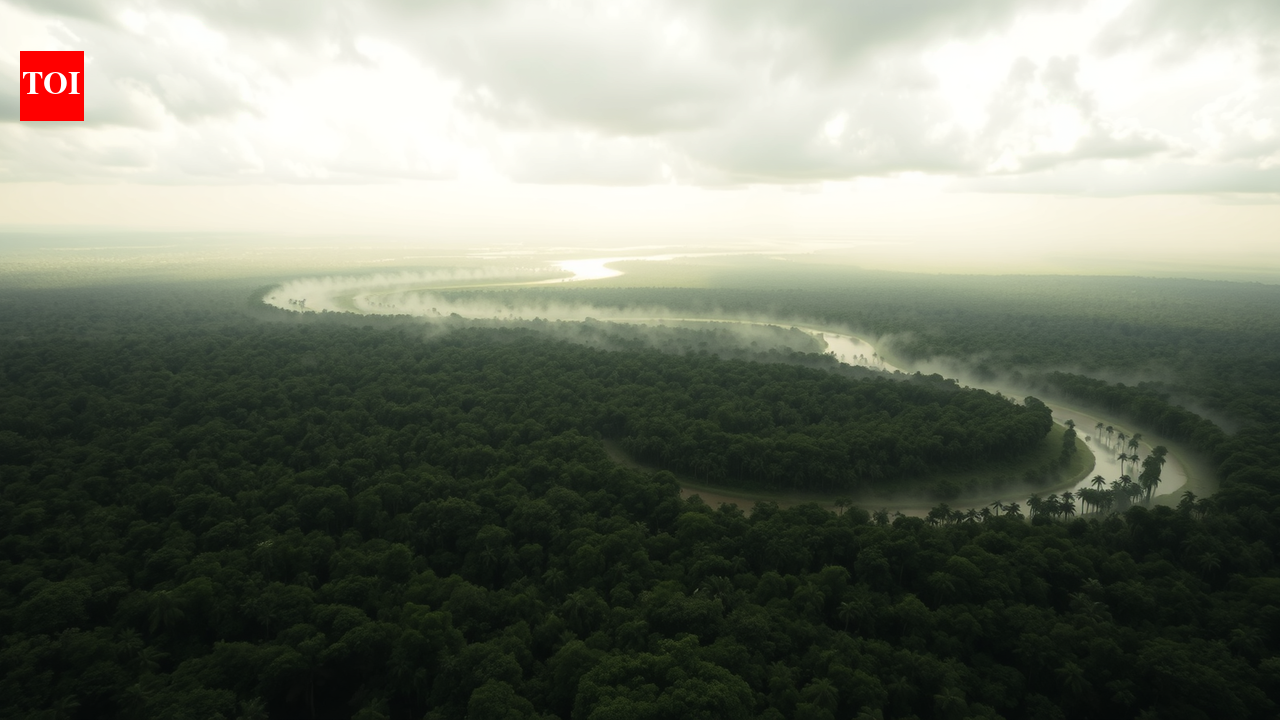
High above the Amazon rainforest, invisible currents of water vapour move through the sky in narrow, fast-flowing bands, carrying a volume of moisture that dwarfs even the largest rivers on the ground below. Scientists call this phenomenon an atmospheric river, sometimes nicknamed a flying river when it occurs above dense forest, and unlike a conventional river, it has no banks or channel, moving instead as a corridor of moist air pushed along by prevailing winds. These systems exist all over the planet, shaping rainfall patterns from California to Chile, but the version drifting above the Amazon carries particular significance, since researchers increasingly warn that deforestation and a warming climate could weaken or disrupt it, with consequences reaching far beyond the rainforest itself. Some climate models suggest that even partial disruption of the Amazon’s flying river could push parts of the rainforest closer to a tipping point, transforming sections of it into drier savanna-like ecosystems over time.
How much water an atmospheric river actually carries
Atmospheric rivers are not a rare or unusual phenomenon; they exist continuously around the globe and are responsible for most of the horizontal transport of water vapour outside the tropics. According to NOAA’s Physical Sciences Laboratory, atmospheric rivers are relatively narrow regions in the atmosphere, and the ones containing the largest amounts of water vapour and the strongest winds can create extreme rainfall and flooding if they stall over a vulnerable watershed, though most atmospheric rivers are considerably weaker and simply provide beneficial rain or snow that is genuinely crucial to regional water supply. According to the Scripps Institution of Oceanography, the vaporised water carried within these narrow bands is equivalent to the amount of liquid water carried by seven to fifteen Mississippi Rivers combined, and research focused specifically on the northeast Pacific Ocean has found that atmospheric rivers there transport, on average, roughly 27 times the volume of water flowing through the Mississippi River itself.
Why these rivers stayed hidden from science for so long
Despite moving enormous volumes of water across the planet continuously, atmospheric rivers were not formally recognised as a distinct meteorological phenomenon until relatively recently. According to Scripps, researchers at MIT first identified the pattern by analysing numerical weather models and noticing that water vapour around the world tended to move in consistent, narrow bands, and it was only around the same period that satellite microwave radar technology advanced enough to make these previously invisible currents suddenly visible in a clear, trackable way. Before that technological leap, atmospheric rivers had simply been too diffuse and too poorly resolved for earlier generations of satellite instruments to properly detect.
How the Amazon generates its own flying river
What makes the Amazon’s version of this phenomenon particularly distinctive is that the rainforest itself actively contributes to sustaining it. According to NASA’s Earth Observatory, atmospheric rivers stretch tens to hundreds of kilometres wide and can carry an amount of water vapour equivalent to between 7.5 and 15 times the flow measured at the mouth of the Mississippi River. Over the Amazon specifically, moist air moving westward produces rain showers across the rainforest below, and in turn, rainforest plants release enormous quantities of water vapour back into the atmosphere through evapotranspiration, effectively recycling and reinforcing the very moisture corridor passing overhead, a self-sustaining cycle that helps drive rainfall patterns across an enormous stretch of South America.
Why researchers are increasingly worried about disruption
This self-reinforcing cycle is precisely what makes deforestation such a serious threat to the system’s stability. Because the Amazon’s own trees are actively contributing moisture that helps sustain the flying river passing above them, cutting down large sections of forest risks weakening the very process that keeps the system functioning, creating a feedback loop where less forest leads to less atmospheric moisture, which in turn leads to reduced rainfall over remaining forest further downwind. Researchers monitoring the region have suggested that areas of Peru and Bolivia face particular risk, since these regions depend heavily on this specific atmospheric moisture pathway as their primary source of rainfall, meaning any disruption further upwind could translate into reduced water availability considerably further along the corridor’s path.
Why atmospheric rivers matter well beyond the Amazon
The broader importance of atmospheric rivers extends far beyond South America, since these systems supply a significant share of freshwater to numerous regions around the world. According to the International Atomic Energy Agency, atmospheric rivers account for roughly half of California’s annual rainfall, filling reservoirs and supporting agriculture across the American West, while similarly accounting for between 30 and 60 per cent of annual rainfall along the coasts of eastern China, the Korean peninsula and western Japan. The IAEA notes that as global temperatures rise, more moisture accumulates in the atmosphere, which is expected to make atmospheric rivers more intense, while the systems themselves are also gradually shifting away from the equator and toward the poles, a trend already reducing water supply in some subtropical regions even as it brings heavier rainfall and flooding risk to places like the Pacific Northwest, Europe and the Arctic.
What tracking these invisible rivers means for the future
Scientists studying atmospheric rivers increasingly rely on measurements like integrated water vapour and integrated water vapour transport, gathered through satellites, weather balloons and computer models, to track how these systems behave and shift over time. As Scripps researcher Julie Kalansky has noted, atmospheric rivers remain highly variable from year to year, making it genuinely difficult to predict how much rain any given region will receive in a particular season, an unpredictability that only adds to the challenge of managing water resources in places that depend heavily on these systems. Whether the specific flying river sustaining the Amazon continues functioning as it has for millennia, or gradually weakens under the combined pressure of deforestation and a changing climate, will likely shape rainfall patterns across a significant part of South America for generations to come, making a phenomenon most people have never seen or heard of one of the more consequential, if invisible, forces shaping the planet’s water cycle.
