



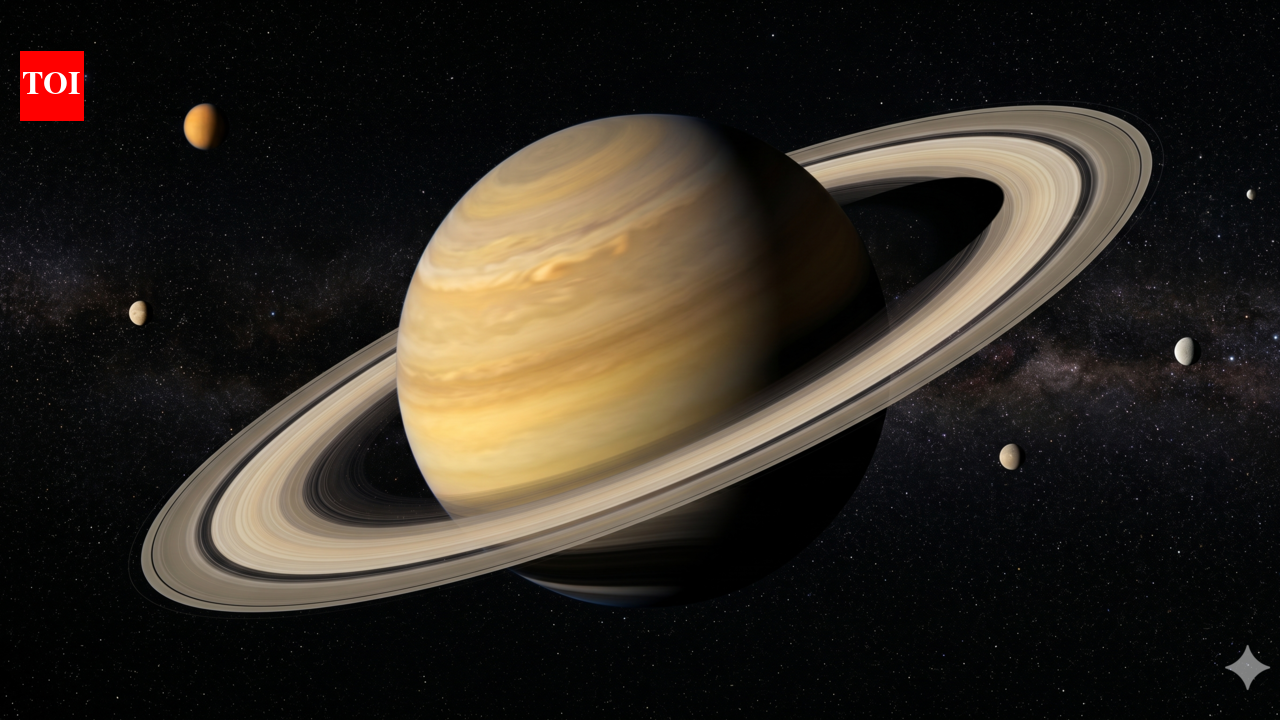
It is worth noting that for many years, the rotation speed of Saturn was seen as unusual by scientists, since it was changing from time to time. Days on the planet were not uniform, contradicting scientific laws and physical principles. Nevertheless, with the help of recent studies of NASA’s mission to Saturn and the James Webb telescope, the secrets of the gas giant’s rotation have been revealed. In reality, everything boiled down to a complex illusion created by natural phenomena on the planet.
Saturn’s changing rotation mystery explained
The mystery started back in 2004 when NASA’s Cassini satellite observed that Saturn appeared to rotate at varying speeds. This was very strange since a planet’s rotation cannot change. The experts referred to this problem as “something strange was going on with the rotation rate of Saturn.”Even more confusingly, the observations differed from each other, even showing that Saturn’s day could be longer or shorter by several minutes.The problem lies in the fact that Saturn is a gas giant, which means there is no solid ground for scientists to determine its actual rotation. They used indirect methods to find the rotation speed, which proved ineffective.
The role of winds, auroras, and magnetic fields
What recent studies have shown is that there was never any change in Saturn’s rotation. Rather, strong wind and auroral phenomena gave the impression of variability.Temperature differences in Saturn’s higher atmosphere led to strong winds, which impacted the auroras in its atmosphere. The interaction between auroras and Saturn’s magnetic field resulted in the variation of radio emissions, which were being used for calculating rotation.What they learned was that it was all due to winds; however, “it took our new observations from the Keck Observatory to finally provide direct evidence confirming the link,” they said.The problem was basically that the radio signals that were being recorded were not at all related to the rotation of Saturn’s core.
Why the discovery of varying Saturn spin matters
Besides being a groundbreaking scientific achievement, the findings have several practical applications for the study of planets. The knowledge gained about the real rotation of Saturn makes it easier to analyse its inner structure, magnetosphere, and atmospheric dynamics.In addition, the finding emphasises the difficulties involved in investigating gas giants due to their peculiar nature. For instance, in this particular situation, complex phenomena occurring on Saturn were the reason why it was so hard to understand what was really going on there with the help of the available equipment.Finally, it should be noted that the findings provide us with a great opportunity to improve the techniques used to investigate not only Saturn but also other faraway planets.

