



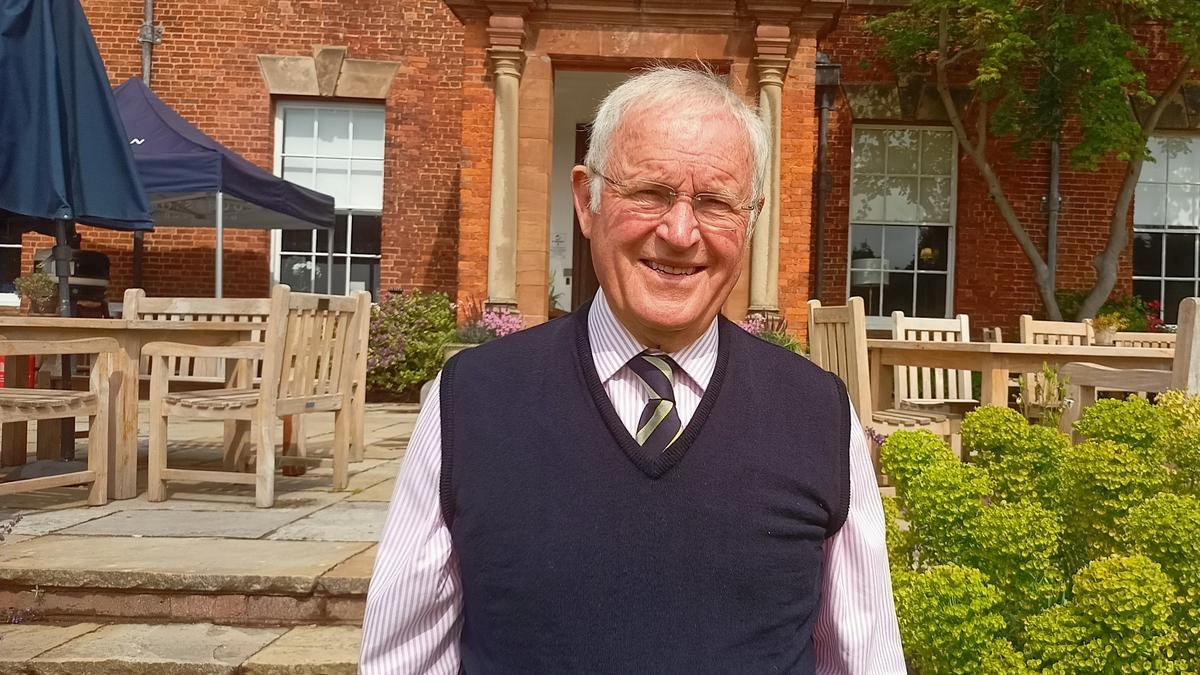
Dennis Amiss scored the first ODI hundred in history. He introduced the helmet to cricket. And he had a penchant for turning his hundreds into bigger hundreds (of his 11 Test centuries, eight went past 150). Excerpts from an exclusive interview Amiss gave The Hindu at the Edgbaston Golf Club in Birmingham:
 How did the idea of wearing a helmet while batting come up?

I first mentioned it to Tony Greig and said, ‘Look, you know, we are going to Australia, for Kerry Packer’s World Series Cricket. There are 16 bowlers who can all bowl at 90 miles an hour. Having been there with Lillee and Thomson, I think we need a bit of protection. I am at a helmet place at the moment. They might be able to provide us with helmets.’ I don’t remember how I came to be there. But I suddenly thought, my gosh, helmets for cricket!
Nobody had used helmets in cricket before that?
Well, Mike Brearley had his skullcap. But nobody wore a helmet.
So you were riding a bike when you saw this helmet shop?
So I took three helmets out, one of which I wore and Tony had the other one. And then David Hookes got his jaw broken trying to hook Andy Roberts at Sydney. There were so many fast bowlers. Michael Holding, Andy Roberts, Garth Le Roux… Holding was the fastest, when he got his rhythm right.
How did the rest of the cricketing world react to the helmet?
I never thought it would take off in this country, but suddenly it did. And I was just amazed. And then we brought the grill out. And so, yeah, it was something I started. It is just amazing how it has all taken off and especially in this country which is very traditional.

Ahead of the game: Amiss was ‘tooting around’ on his motorcycle when the idea of wearing a helmet occurred to him. He is ‘amazed’ the idea caught on.
| Photo Credit:
Getty Images
How do you look back at your two double hundreds against the West Indies? At Kingston in 1974, England had a deficit of more than 200 and you saved that Test.
Yes, we were facing defeat and we had lost the first Test in Trinidad. So, it was important, really important that we save that one and keep the series alive. We battled through and it was a really good wicket. And I suppose that Keith Boyce was slippery for the first few overs, as quick as anybody. So it was a matter of trying to see Boyce off and then they had Bernard Julien who was a good bowler, and of course Lance Gibbs and Garry Sobers.
The other double hundred came at the Oval in 1976…
I was coming back after being left out and hit on the head early in the series. There were no helmets then. So I ducked into one at Lord’s. But anyway, I changed my stance. I went and did a little bit back and across, which Kenny Barrington had done successfully all his career, and that helped me. We had beautiful sunshine and there were good wickets. My coach, Tiger Smith, always said to me, ‘Dennis, you will get noughts, lots of low scores, but when you get in, you get 100. Take your guard again and get 150. When you get 150, take your guard again and get 200. And when you get 200 and so on.’
Bishan Singh Bedi helped you play against spin. How did that happen?
Well, we were on the [1972-73] tour of India with Tony Lewis, and you had the four spinners — Bedi, B. Chandrasekhar, Erapalli Prasanna, Venkataraghavan. And the wickets turned, and we had not come across wickets like that against such great bowlers.
And, you know, it gets in your mind, how do you play them and that sort of thing. We were going to Pakistan afterwards, after the tour. And I was left out for the last Test. Bishan came to me and he said, ‘Why were you not batting well? At the beginning of the season, we thought you would be the main batter.’ And I said, ‘Well, you know, you bowl well at me and you have got me out. The only thing is I can’t practise because the nets are in the middle.’ He said, ‘I will tell you what to do. Leave it with me. And he came back later and said, ‘We have to get the net up after the match, tell the players to go home. You put your pads on. Pras, Venkat, and I will bowl at you, but not Chandrasekhar.’
And we played a match. ‘Okay, that’s two runs. Okay, that’s one run. Four. Really good shot. Four. You would have been out there. I think we would have got you out there. So, you are one wicket down. One for 20.’ That just gave me confidence. I went to Pakistan. It was very kind of Bish. And I think that he was chastised for that.
Was the decision to play the Packer series a tough one?
It was. It was a difficult time because the Warwickshire committee were entrenched in the England and Wales Cricket Board in London. They took a tough stand. It was only Packer saying that in the end, he would settle his disagreements with Australian cricket. Therefore, Test match cricket could resume, as long as all his players he had signed got a contract with their counties.
And of course, Warwickshire wouldn’t give me a contract. So Richie Benaud, who was his number one on cricket, was in touch with Jack Bannister, who was chairman of the Professional Cricket Association and a Warwickshire player. They said Dennis has got to have a contract. Otherwise, Kerry Packer doesn’t make the deal. So I was the last one to sign.

In full flow: Dennis Amiss in action against Australia in an ODI in 1977.
| Photo Credit:
Getty Images
How do you view the innovations in cricket, shots such as the ramp shot?
I think it is wonderful. I love short-form cricket. We played 40 overs.
The John Player Sunday League?
Yes. And we had players like Mushtaq and Hanif Mohammad playing the reverse sweep, before Mike Gatting. I am fine with all these innovative shots. What does concern me is the short boundaries. These days, with the bats, the new bats, the ball springs off. Ian Bell and Jonathan Trott lent me their bats, just to have a little knock in the nets. And I said, my gosh, I would like to make a comeback.

