



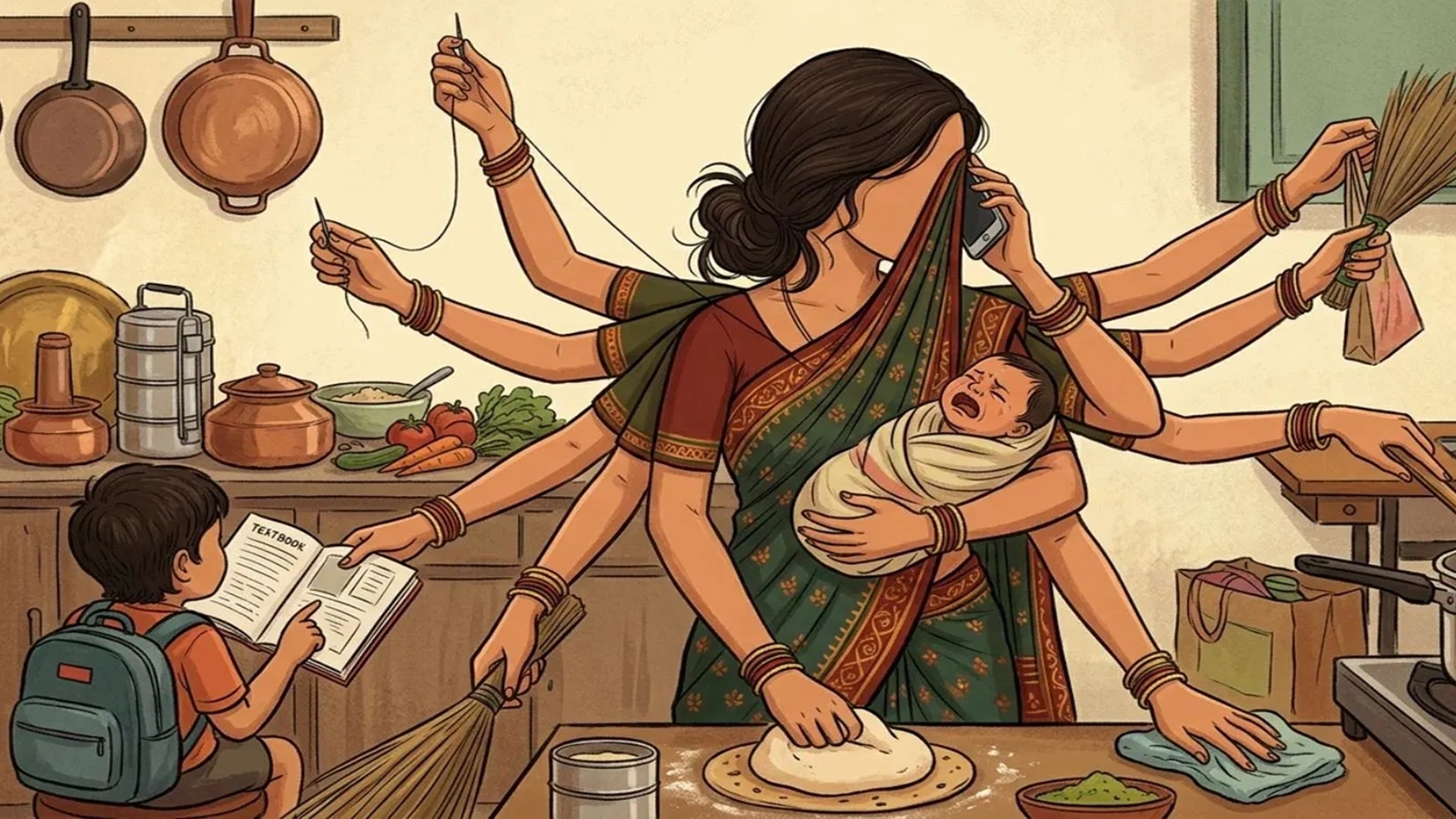
They say it is love. We say it is unwaged work.” Thus begins Silvia Federici’s foundational 1975 essay, “Wages Against Housework”. Federici’s Marxist-feminist argument was made in the context of Western industrial capitalism. Half a century later, and half a world away, the demand has shifted from wages to worth, from recognition to right.
The move from housewife (interchangeable for large periods of the 20th century, in thought if not in words, with house help/house elf) to homemaker has had a long, arduous journey. The marginal elevation has not altered much for the woman at the centre, still counted as the primary caregiver, still responsible, notionally at least, for the task of “housekeeping”, still with very little to show for herself in terms of actual economic heft.

Last week, while hearing the case of a woman killed in a road accident in 2001, the Supreme Court took a decisive step towards addressing this anomaly. It held that the loss of domestic care provided by a homemaker constitutes a distinct category of compensation in motor-accident claims. The Court also arrived at a minimum figure of Rs 30,000 per month, a floor to be revised upward by 10 per cent every three years. The bench observed that care-giving work — mostly by women — is estimated to contribute about 15 to 17 per cent of the country’s GDP, that in nurturing homes, values, and generations, homemakers perform the enduring work of nation-building. It is a landmark ruling that deserves to be celebrated. It also demands introspection.
For the purpose of the latter, let us turn to some basic accounting: Tally your monthly expenses for a cook, a part-time cleaner, a care provider for the elderly, and if you have young children, a nanny — more or less all the things a homemaker is, all at once, all day, every day. The figure, at least in Delhi, is likely to far exceed Rs 30,000. Now consider what the Court did not address, given that it falls outside the remit of the case. A woman who spends her lifetime managing a household, raising children, and enabling her spouse’s career is worth Rs 30,000 a month only after she has been killed by a negligent driver. In her lifetime, she is worth nothing in terms of asset entitlement or wealth accumulation, at least not in any enforceable, quantifiable way.
This is an injustice with compounding consequences. When a woman steps out of the workforce — to follow a spouse to a new city, to raise children, to care for ageing parents — she exits a system that measures contribution in salaries and provident-fund deposits. Every year outside the formal economy widens the gap and reduces them to what economist Devaki Jain called “virtual non-entities in economic transactions”. The apex court’s ruling compensates for the absence of a homemaker’s labour after death. It does nothing for the woman who is still alive, still holding up the home, still accruing none of the financial security that formal employment provides.
None of this is to suggest that the home be recast as a workplace or the spouse as a quasi-employer. It is an argument for rights and recognition, of the kind the Court itself offered: “It is ironic to describe a homemaker as dependent on earning members, when, in reality the household’s functioning depends substantially on the homemaker.” The homemaker, in other words, is the co-author of everything the household builds and everything it becomes.
To be fair, the judiciary has been pulling in the right direction. In February, the Delhi High Court observed that a wife’s non-employment cannot be equated with indolence or deliberate dependence, that the assumption reflects a fundamental misunderstanding of marriage as a partnership: “Where one spouse earns income in the marketplace, and the other sustains the domestic sphere, the economic stability of the household is the result of combined, though differently manifested, contributions.” In September 2025, a Delhi woman approached the High Court seeking a 50 per cent share in the matrimonial flat that her care had sustained for years. The division bench was candid about the bind it found itself in: It acknowledged that a homemaker’s contributions “remain hidden and downplayed”, called on the legislature to act, and then — because existing maintenance provisions lack the reach to cover asset-sharing — ruled against her.
Homemakers need more than a better payout at the Motor Accident Claims Tribunal that they themselves cannot enjoy. They need social infrastructure that eases the burden of care work, shares it more equitably, and values it more fully. They need community property laws that give them a share in liquid or income-generating marital assets; maintenance laws with teeth. And they need all of these in their lifetime.
The writer is senior associate editor, The Indian Express. paromita.chakrabarti@expressindia.com

