



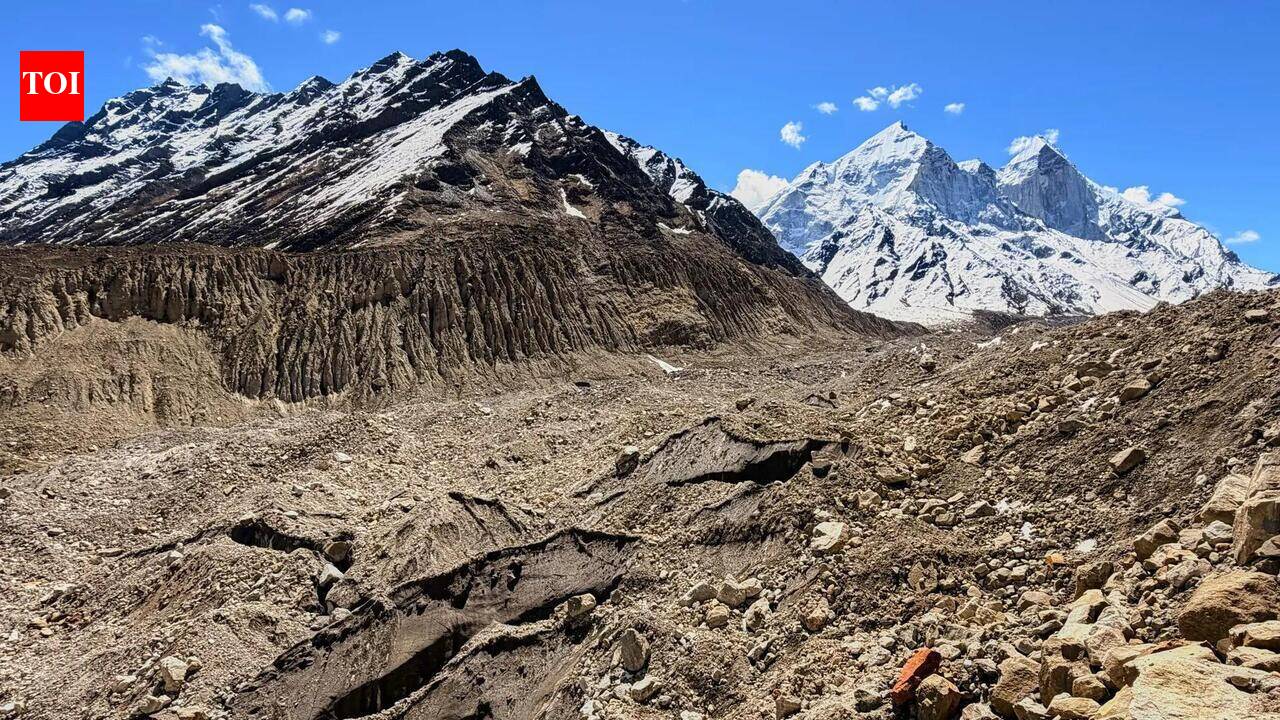
NEW DELHI: The Centre on Thursday said it is monitoring 2,485 glacial lakes spread across the Himalayan river basins using remote sensing techniques. It also informed Parliament that 56 glacial lakes have been classified as ‘very high risk’ following a scientific assessment conducted in 2025 due to their potential to trigger Glacial Lake Outburst Floods (GLOFs).In a written reply in the Lok Sabha, jal shakti state minister Raj Bhushan Choudhary said the Central Water Commission (CWC) monitors glacial lakes larger than 10 hectares across four states and two Union Territories from June to October every year using remote sensing.The minister said the National Disaster Management Authority (NDMA), in collaboration with national scientific agencies, carried out a scientific assessment of 189 high-risk glacial lakes across the Indian Himalayan Region in 2025.“Based on the assessment, 56 glacial lakes were classified as very high risk considering their potential to trigger Glacial Lake Outburst Floods (GLOFs) and the exposure of downstream habitations and infrastructure,” Choudhary said.He said the government has started establishing Glacial Lake Outburst Flood (GLOF) Early Warning Systems (EWS) at selected high-risk glacial lakes based on hazard assessments and continuous monitoring.However, the minister clarified that no end-to-end GLOF Early Warning System has been commissioned so far under the National GLOF Risk Mitigation Programme (NGRMP).Choudhary said the NDMA is implementing the NGRMP, which was approved in 2024 for Himachal Pradesh, Uttarakhand, Sikkim and Arunachal Pradesh at a cost of Rs 150 crore.“The programme envisages Hazard and Risk Assessment, Monitoring and Early Warning Systems, site-specific structural and non-structural mitigation of measures, and community awareness and capacity building,” he said.The minister added that Rs 52.50 crore has been allocated under the Monitoring and Early Warning System component of the programme.He also said the NDMA, along with the Swiss Agency for Development and Cooperation (SDC) and the Sikkim State Disaster Management Authority (SSDMA), carried out multi-agency expeditions to the high-risk South Lhonak and Shako Cho glacial lakes in Sikkim during 2023 and 2024. The expeditions were aimed at supporting scientific studies and developing monitoring systems, early warning mechanisms and mitigation measures.(with inputs from PTI)
