



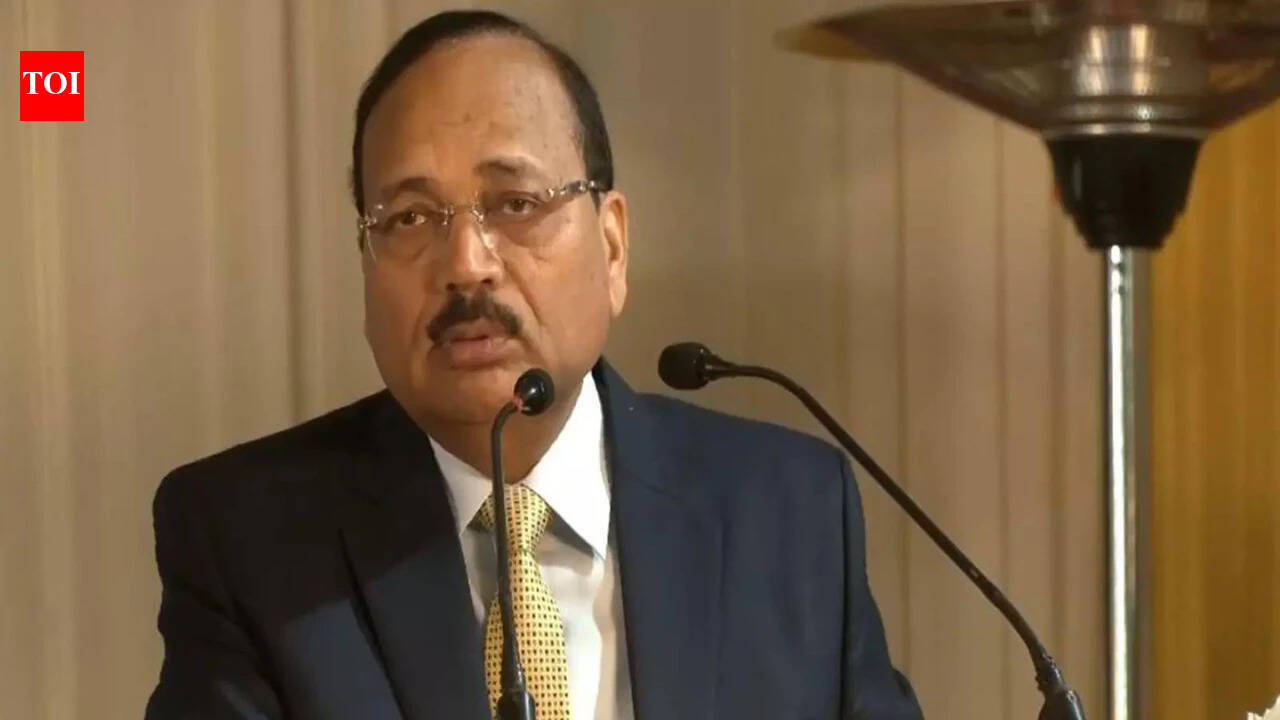
NEW DELHI: CJI Surya Kant on Friday recused from hearing a bunch of PILs challenging a 2023 law that altered the Supreme Court-framed composition of the panel for selection of chief election commissioner (CEC) and ECs by excluding the CJI from it.CJI Kant cited “conflict of interest” to recuse from hearing the petitions which challenge the validity of the CEC and Other ECs (Appointment, Conditions of Service and Term of Office) Act, 2023. He said he would post the petitions before a bench that does not include any future CJIs. The bench led by CJI Kant had Justices Joymalya Bagchi and Vipul M Pancholi, both of whom will go on to become CJIs in future. The CJI’s stand that no future CJI would be part of the bench to hear the petitions would mean exclusion of the following judges – Justices Vikram Nath, B V Nagarathna, P S Narasimha, J B Pardiwala and K V Vishwanathan.On Feb 3 last year, the Supreme Court had rejected pleas for stay on the selection of CEC Rajiv Kumar, who was succeeded by Gyanesh Kumar on Feb 19, 2025.A five-judge SC bench on March 2, 2023, in the Anoop Baranwal case, had noticed a “legislative vacuum” on the process for selection of CEC and ECs, and directed that a panel comprising PM, leader the opposition and CJI would advise the President on appointments to the EC until Parliament enacted a law for the purpose. The law, which came into force from Dec 29, 2023, replaced the CJI with a Union cabinet minister chosen by the PM.Till enactment of the 2023 law and through the decades since 1950 when the EC was estbalished, appointment of CEC and ECs in the commission – as per Article 324(2) of the Constitution – had remained the sole prerogative of the executive. As per the Constitution, the process of appointment of CEC and ECs was to be subject to “provisions of any law made in that behalf by Parliament”.From 1950 till 2023, no law was enacted for the appointment of CEC and ECs, and the resultant “vacuum” led SC to rule that the appointments were made by a panel comprising PM, LoP and CJI until the enactment of a law.Petitioners have argued that the executive has a firm grip over the entire selection process which creates doubt in the people’s mind about the fairness of the EC, which in turn puts a question mark on the fairness of elections.KVK Sundaram remains the longest-serving CEC, (Dec 20, 1958 till Sept 30, 1967), followed by first CEC Sukumar Sen (March 21, 1950 till Dec 19, 1958). From 1950 to 2004, in a span of 54 years, there were 12 CECs, but in next 22 years, there have been 13 CECs. The EC was a single-member body comprising the CEC till Oct 1989. Since then it has become a three-member body.
