



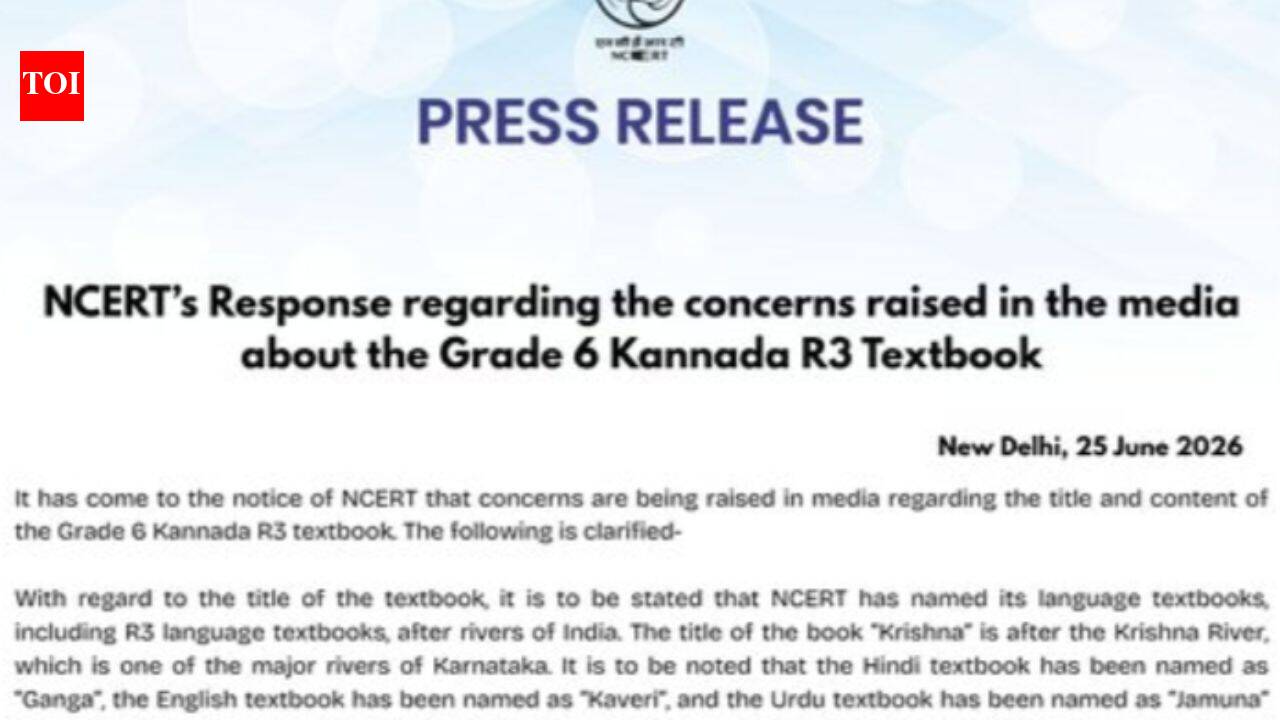
National Council of Educational Research and Training (NCERT) has responded to concerns raised over its newly introduced Class 6 Kannada textbook, Krishna, after a Karnataka-based education rights group accused it of promoting religious themes and sidelining the state’s cultural identity.In a statement, NCERT said all its language textbooks are named after rivers of India. It clarified that the Kannada textbook was named Krishna after the Krishna River, one of the major rivers flowing through Karnataka.The council pointed out that its Hindi textbook is called Ganga, the English textbook is named Kaveri, and the Urdu textbook is called Jamuna (Yamuna). “Similarly, the Kannada textbook has been named as ‘Krishna’ as it is one of the major rivers flowing in Karnataka,” NCERT said.The clarification came after the People’s Alliance for Fundamental Rights to Education (PAFRE) alleged that the name reflected an attempt to introduce religious themes into school education and demanded that the textbook be withdrawn from the current academic year’s syllabus.NCERT also addressed criticism related to a lesson on nutrition. The group had claimed that the chapter presented only vegetarian food as part of a balanced diet and excluded foods such as fish, eggs and meat, which are widely consumed across Karnataka.Rejecting the allegation, NCERT said the concept of a balanced diet is covered in Chapter 6 of the textbook and is discussed separately under the heading “Balanced Diet” on page 63. It added that the illustration on that page includes both vegetarian and non-vegetarian food items.“Nowhere in the textbook is vegetarianism explained or justified, nor is non-vegetarian food opposed,” the council said.PAFRE had earlier argued that the textbook ignored Karnataka’s diverse food culture and cultural traditions. The organisation also questioned why the book was named Krishna instead of being linked to noted Kannada literary and social reform figures. It has asked for the textbook to be withdrawn, renamed and revised.Recently, the iconic “Dancing Girl” of Mohenjo-daro, one of the most celebrated artefacts of the Indus Valley Civilisation, appeared in an altered form in the NCERT’s new Class 9 arts textbook, with its traditionally bare torso visually covered, sparking debate over the representation.

