



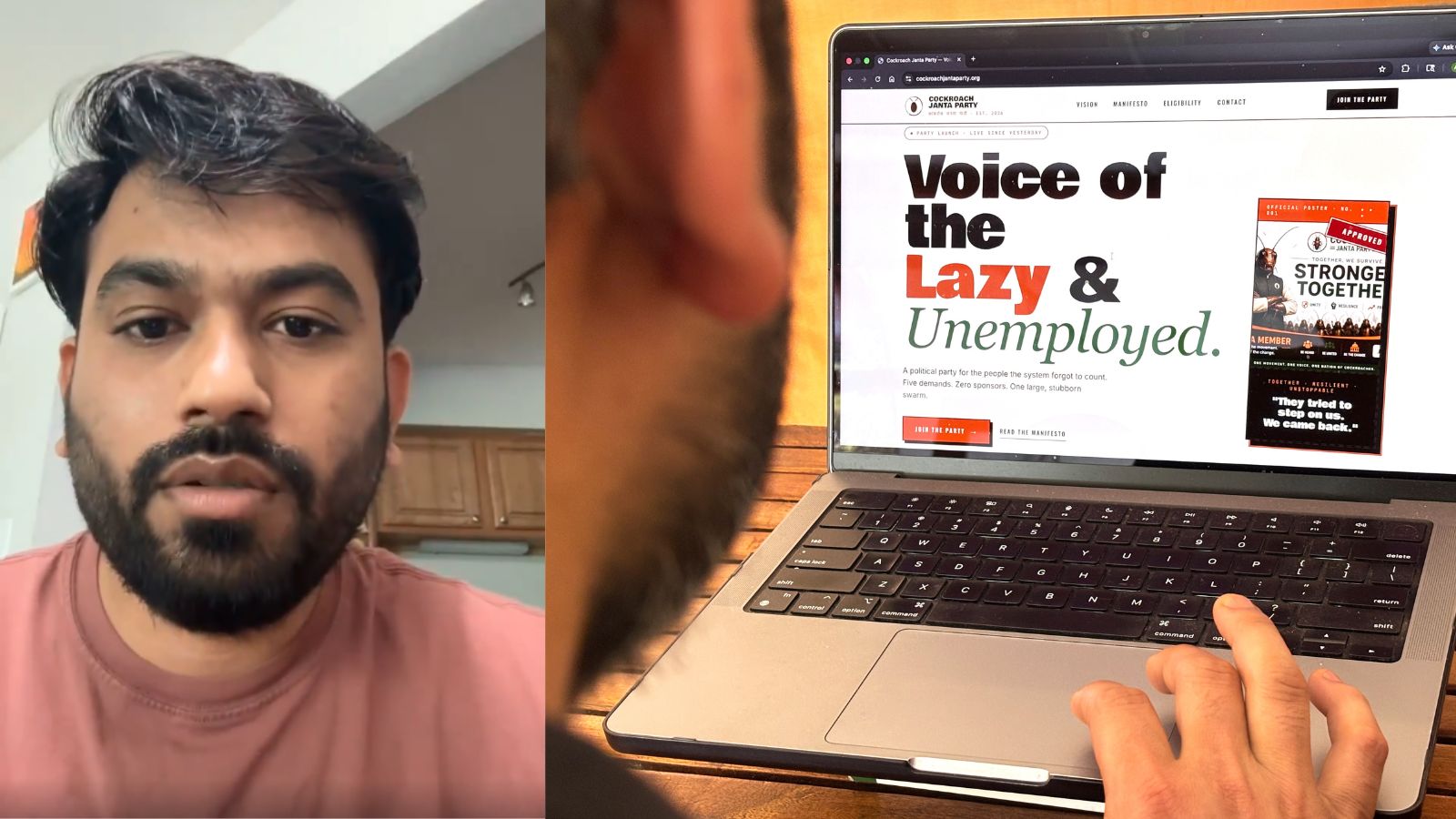
The recent emergence of the so-called “Cockroach Janta Party” on Indian social media is more than internet humour or satire. It reveals a deeper crisis within urban Gen Z politics — a generation increasingly fluent in the aesthetics of rebellion, yet increasingly disconnected from the social realities of resistance itself.

The campaign emerged after controversial remarks attributed to Chief Justice of India Surya Kant, where sections of online users interpreted his comments as comparing critics and sections of the youth to “cockroaches.” Whether misquoted or later contextualised, the damage was already done. Meme pages, influencers, and politically expressive youth reclaimed the insult, transforming the “cockroach” into a symbol of alienation and anti-establishment identity.
Suddenly, rebellion became fashionable.
But the phenomenon deserves scrutiny not because it is political, but because it reveals how politics itself is increasingly becoming a performance staged by the urban middle class.
Who’s the core of the Gen Z resistance?
The central contradiction of the “Cockroach Janta Party” lies in its class position.
For years, workers, farmers, Dalits, Adivasis, minorities, and informal labourers faced structural violence with little sustained emotional investment from the metropolitan digital class. Construction workers died building urban skylines while cities celebrated “development.” Farmers protesting on highways were treated as inconvenience. Labour unions were mocked as outdated. Political prisoners disappeared into jails without becoming Instagram conversations.
But the moment censorship touched creators, algorithms reduced visibility, and unemployment entered urban middle-class homes, the language of revolution suddenly exploded online.
Urban Gen Z politics today is shaped largely by a class that once believed itself insulated from precarity. English-speaking, digitally connected youth consumed injustice from a distance for years. Economic instability and police repression belonged to activists, workers, or distant rural populations.
Now the promise made to the middle class is collapsing. Degrees no longer guarantee jobs. Gig economies offer instability instead of mobility. Social media visibility itself has become economic survival. Urban youth are encountering insecurity for the first time and mistaking this personal anxiety for universal political consciousness.
Resistance discovered only after privilege became fragile
The campaign repeatedly asks: Where were people when workers were beaten, journalists jailed, students assaulted, and Adivasis displaced?
But the question rebounds onto the campaign itself.
Where was this same urban outrage then?
The uncomfortable truth is that much of Gen Z’s political awakening emerged not from solidarity with the oppressed, but from fear that privilege itself is becoming unstable. Repression became emotionally real only when it entered urban digital life. Censorship mattered when Instagram pages disappeared. Economic injustice mattered when educated urban youth became unemployed.
This is not class solidarity. It is class panic.
The “Cockroach Janta Party” attempts to speak for the marginalised while fundamentally emerging from middle-class insecurity. Workers and farmers become symbolic references within an urban narrative still centred on elite discomfort.
The Instagramisation of politics
The deeper crisis is cultural.
Politics for many urban young people is no longer organisational; it is performative. Resistance is increasingly consumed visually rather than practiced collectively. Viral slides replace grassroots work. Cynicism substitutes political education. Revolution becomes an online identity.
The “Cockroach Janta Party” perfectly captures this transformation. Its creators understand internet psychology brilliantly. Their rebellion is stylish, ironic, and emotionally intelligent. But it remains trapped within the same algorithmic economy it claims to resist.
Social media rewards outrage without responsibility. Algorithms reward emotional intensity rather than ideological clarity. The result is a generation that often confuses expression with action. Posting becomes activism. Visibility becomes participation. Anger becomes branding.
The rebel today is not necessarily organising workers, joining unions, or building student movements. More often, the rebel is curating an identity.
Beyond performative resistance
India does not suffer from a shortage of rebellious aesthetics. It suffers from a shortage of democratic organisation rooted in solidarity beyond urban comfort.
The danger is not that Gen Z has become political. It is that politics itself is increasingly becoming a cultural performance — rapidly consumed, aesthetically amplified, and abandoned once the trend changes.
Yet the uncertainty driving this digital rebellion is real. Beneath the irony and memes lies fear about unemployment, rising living costs, shrinking freedoms, and collapsing institutional trust. The contradiction, however, is striking: many among this same demographic have also supported or normalised the very political-economic order that produced these anxieties, including continued electoral support for the Bharatiya Janata Party and its neoliberal-nationalist framework.
This reflects not ideological clarity, but political confusion — a generation angry at precarity yet unable to locate its structural roots. That is precisely why opposition parties, student organisations, trade unions, and democratic movements must seriously study this emerging frustration instead of dismissing it as performative urban rebellion. The challenge is to transform scattered digital alienation into political consciousness rooted in labour rights, public education, social justice, and democratic accountability.
Otherwise, this anger risks remaining trapped within the algorithm — visible everywhere, but transformative nowhere.
Khan is a researcher in urban planning focusing on labour, housing, and the political economy of contemporary Indian cities
