



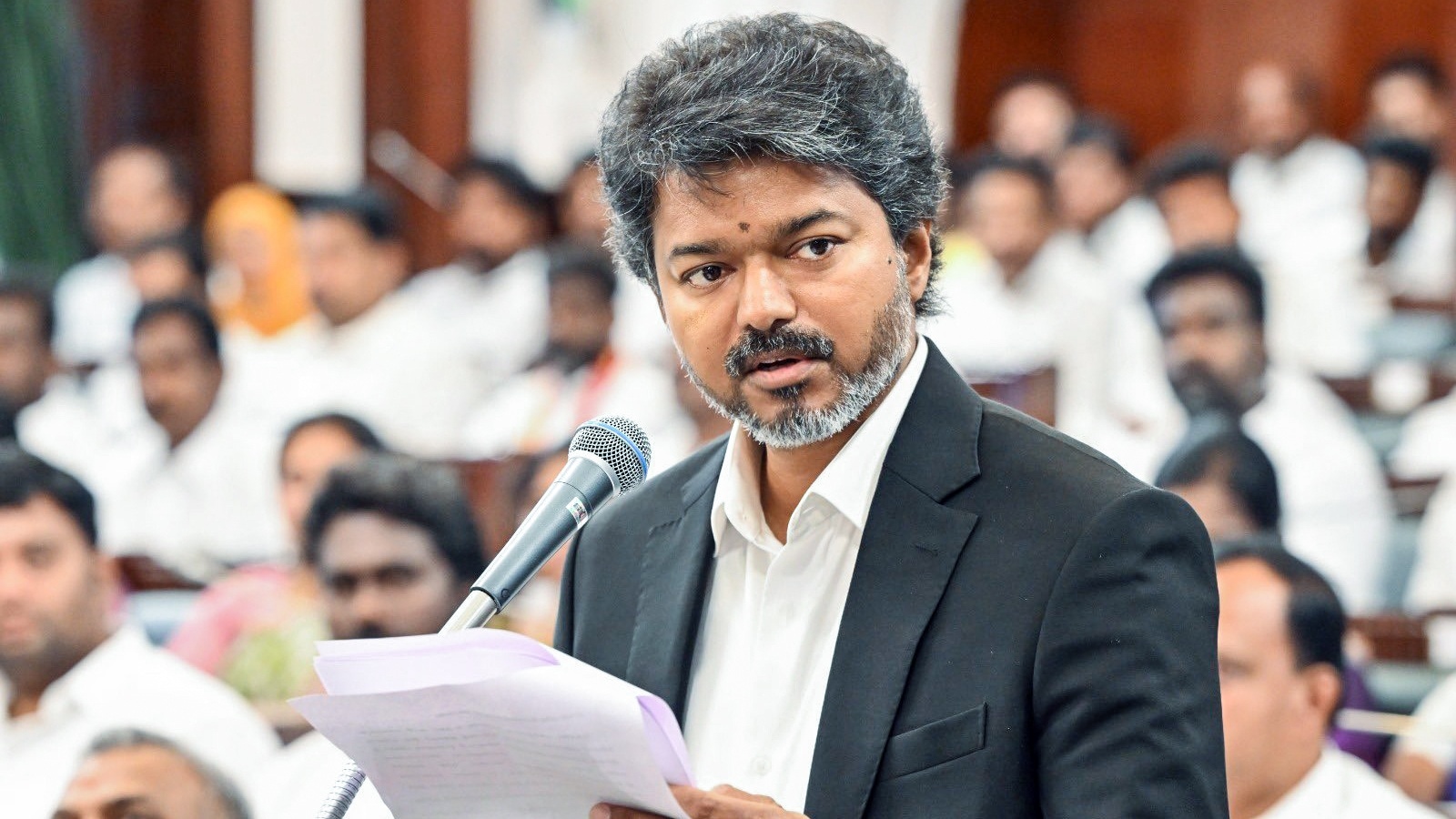
Thanks to the Tamil Nadu assembly election results, we now have a 100-plus opinion pieces explaining why Vijay’s Tamilaga Vettri Kazhagam (TVK) emerged as the single largest party. What makes these pieces interesting is that none of these political commentators saw it coming. They are now performing post-mortem analyses to make sense of what happened. This piece may not be very different. It too is an attempt to understand what catapulted Vijay to success.
The first obvious reason for Vijay’s ascension to the CM’s desk lies in how Tamil Nadu continues to sustain a deep connection between cinema and politics. The communities, cartels, groups, and families that produce cinema also have a strong stake in the state’s political functioning. The success and future of both cinema and politics are often determined by the same working-class groups. This overlap, both in production structures and consumption patterns, allows cinema and politics to remain deeply intertwined.

This is very different from Bollywood and the politics of the Hindi belt, where neither production nor consumption overlaps meaningfully. Hindi cinema may be controlled from Mumbai, but politics is largely controlled in UP or Bihar. There is no real convergence between film production, political intervention, or their respective consumers and voters. In Tamil Nadu, however, the filmgoing fan is also the active voter who determines the state’s politics. The same masses who turn a star into a box office phenomenon can also turn him into a political force.
Actor Vijay’s unique posturing
Vijay has managed to pull off something very similar to what M G Ramachandran once did in cinema. The other actors with political aspirations in recent times were Rajinikanth, Kamal Haasan, and Vijayakanth. Among them, Kamal Haasan cultivated the image of a versatile artist and intellectual through his films, which also distanced him from large sections of the working-class population. Rajinikanth and Vijayakanth, meanwhile, built strikingly similar screen images. They were usually the angry Bahujan young men speaking against power and injustice, while occasionally also playing noble feudal lords. These roles brought them closer to OBC and Dalit audiences, especially younger men. Vijayakanth managed to convert some of that image-building into political relevance, while Rajinikanth spent decades flirting with politics without ever fully committing to it.
Vijay, however, positioned himself differently. He played the working-class hero, too, but he was not always consumed by rage. Instead, he crafted the image of an affable working-class hero. That affability, more than anger, earned him extraordinary acceptance among women and younger audiences. So it is hardly surprising that the youth responded enthusiastically to Vijay during his political canvassing before the elections. The election results themselves suggest that women and younger voters sided heavily with TVK.
Changing careers at the peak
Possibly the single most important strategic move Vijay pulled off was gambling on a career shift from cinema to politics while he was still at the absolute peak of his stardom. This is something no other major Tamil actor truly attempted.
Rajinikanth reached the peak of his career with Baashha (1995), but took another 25 years to seriously consider politics, only to retreat at the final moment. Vijayakanth entered politics when his film career had already begun declining. So did Kamal Haasan.
Vijay, in contrast, made the leap when his films were drawing some of the biggest crowds Tamil cinema had seen in years. By doing this, he captured his fans’ imagination at its most frenzied point. The collective emotional energy of his fan base was at its peak when he entered politics. Had he made this move five years earlier or five years later, the effect may not have been the same.
Lack of larger-than-life political leaders
Like in their cinema, Tamil people also prefer their political leaders to feel larger than life. After the demise of Kalaignar M Karunanidhi and J Jayalalithaa, Tamil Nadu’s political space experienced a vacuum of charisma.
Stalin positioned himself as a capable administrator, while Edappadi Palaniswamy spent most of his political energy consolidating control over AIADMK. Whatever their administrative or organisational strengths may be, neither possesses the larger-than-life aura that Tamil political culture has historically celebrated.
Vijay’s arrival changes that equation. He offers the Tamil electorate exactly what it has long been emotionally conditioned to embrace: Someone who feels both accessible and mythic at the same time. A next-door boy who is also larger than life.
The slow death of AIADMK
After J Jayalalithaa’s death, AIADMK has steadily fragmented into multiple factions. While Edappadi Palaniswamy has tried to hold together whatever remains of the party, the organisation continues to splinter even now. At the same time, it has become common political perception that the BJP has acquired considerable influence within AIADMK and has been slowly cannibalising the party from within.
This has created a psychological and political vacuum among Tamil voters. There is now a growing sense that Tamil Nadu needs an alternative to AIADMK that can effectively oppose the DMK and preserve the state’s long-standing political balance.
For decades, Tamil voters have preferred oscillating between two dominant Dravidian parties. They now seem to be searching for another strong regional force capable of taking turns with the DMK in power. Since AIADMK no longer appears capable of performing that role with stability or confidence, many voters seem willing, at least for now, to entrust Vijay’s TVK with that responsibility.
The writer is a Chennai-based filmmaker
