



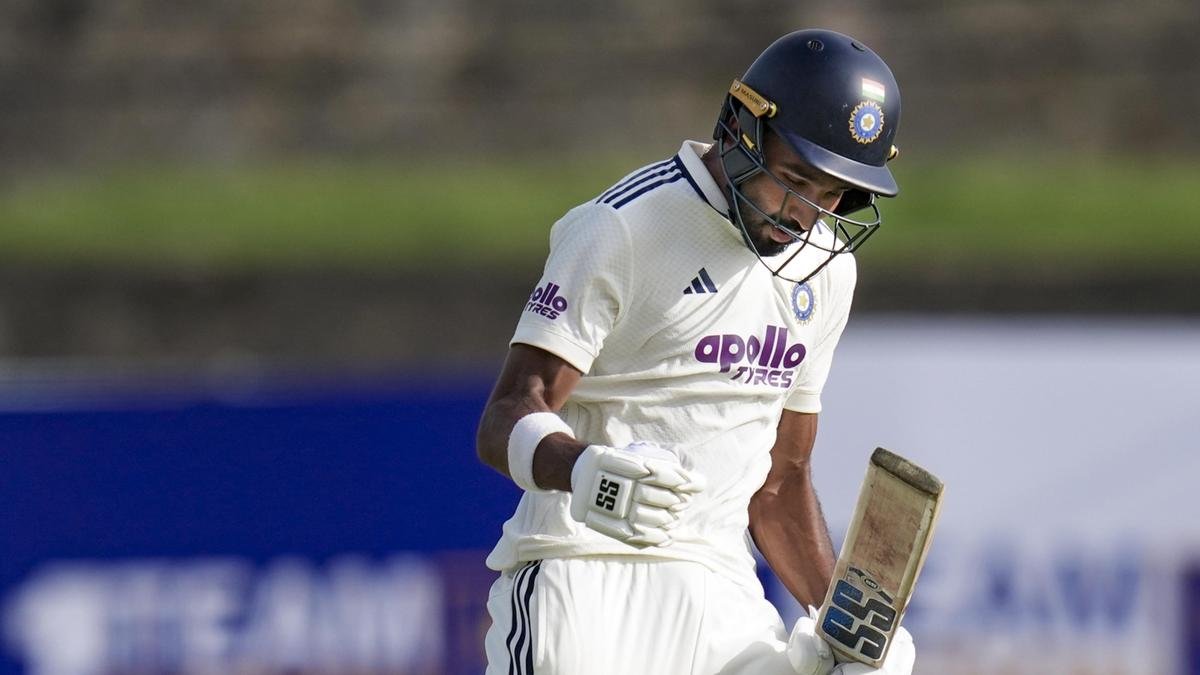
A scrambled single to mid-off, a little leap in the air. The helmet whipped off, arms held half-aloft, his face bathed in a million-dollar smile. And just like that, Devdutt Padikkal became the 84th player to conjure a Test century for India.
And it wasn’t just any hundred. It was Padikkal’s maiden three-figure knock in the five-day game, in only his third Test appearance. These three appearances have come over a period of 29 months, which isn’t a reflection on the left-hander’s abilities but more a pointer to the logjam for places in the Indian batting which, despite its recent spin-infested afflictions at home, is still a formidable force.
Each of the 26-year-old’s caps has come because someone else has been unavailable. His debut, against England in March 2024, was a proverbial last-minute development, after Rajat Patidar was ruled out with an injury to his left ankle on the morning of the match. Summoned at little notice, Padikkal hardly looked out of place at No. 4, stroking his way to a majestic 65 marked by handsome strokes through the off-side off the back foot on a surface that encouraged that style of play.
Eight and a half months later, as India lined up for the first of five Tests against Australia at the sprawling Optus Stadium in Perth, out went the SOS to the Karnataka batter, this time because Shubman Gill was unavailable after fracturing his left thumb while fielding in the slips in an intra-squad simulation match. Despite having had greater time to come to terms with his overseas debut, Padikkal found little joy in the Western Australia capital in the first innings, nicked off by Josh Hazlewood for a 23-ball duck. He batted with a little more composure in the second innings as he came in on the back of a 201-run opening stand between Yashasvi Jaiswal and K.L. Rahul, but couldn’t progress beyond 25 as he was dismissed for the second time in the Test by Hazlewood.
Since then, it has been a whirlwind ride for the rangy left-hander, majestic and authoritative with an all-round game that he has used as an ally in domestic and franchise cricket. He had a fantastic time of it in IPL 2026 for defending champions Royal Challengers Bengaluru, fusing aggression with consistency in making 464 runs at a wonderful strike-rate of 168.72. Only Virat Kohli (675) and skipper Patidar (501) made more runs for the holders, and of those who made at least 250 runs, only Patidar (192.69) and Tim David (188.27) boasted a better rate of scoring. To say that Padikkal was one of the engine rooms as the Bengaluru franchise emulated Chennai Super Kings and Mumbai Indians by becoming only the third franchise to retain the IPL crown will be a gross understatement.
Leader of sorts
Within the RCB setup, Padikkal had grown into a leader of sorts. New skipper Patidar was clearly in charge, but Padikkal was no longer one of the happy-go-lucky boys. Given a high-profile role at No. 3 to take on the bowling from the get-go, Padikkal had grown into that responsibility; the fear of being dismissed was replaced by a quiet confidence in his assiduous preparation, and it was hardly a surprise to see him repeatedly deposit his first ball out of the park, with correctness and elegance and no more than a semblance of power.
That he was growing in stature had earlier been evidenced by Amit Verma’s selection panel bestowing on him the captaincy of the Karnataka Ranji Trophy side midway through a stop-start campaign that was seemingly taking them nowhere. As they relieved Mayank Agarwal of the leadership role, the hat sat snugly on Padikkal’s head; justifying the show of faith, the new captain reeled off several impactful knocks as he hauled his team to the title round, where the hosts came up short against an inspired Jammu & Kashmir in the final in Hubbali.
His exploits caught the eye of Gautam Gambhir, the Indian head coach, and chief selector Ajit Agarkar. India had rewarded Karun Nair’s stellar domestic run by recalling him to the Test set-up after a long gap on the tour of England last summer, but Karun didn’t exactly cash in, making just a solitary half-century in the final Test at the Oval to play himself out of contention. A disastrous set of matches against South Africa at home in November last meant India had to revisit their options going forward as their World Test Championship aspirations hung by a slender thread.
Padikkal was earmarked as a sure-shot Test option, though no one was quite sure when his turn would come. There was a slant towards Dhruv Jurel to occupy a middle-order position, so if Padikkal had to be accommodated, it would have to be in the top three. But the decision-makers had thrown their weight behind the performing opening duo of Rahul and Jaiswal and the perceived promise at No. 3 of Sai Sudharsan, so it seemed as if Padikkal’s time wasn’t nigh yet.
But as is often the case, one man’s misfortune is another’s opportunity. Sudharsan, not exactly translating backing and potential into consistent performances, seemed to have nailed down the No. 3 berth after making centuries for India ‘A’ in consecutive unofficial ‘Tests’ in Sri Lanka in June and July, until a stress reaction in his big toe led to him being ruled out of the ongoing Test series. Arrive Padikkal, stage left. This time, as he took a bow after a virtuoso performance, there was a strong, lingering feeling that he wouldn’t have to wait another 21 months for his next Test appearance.
Pivotal position
The No. 3 position is a massively responsible, pivotal one in Test cricket. India have been blessed with exceptional personnel who manned that spot for long periods; since the turn of the millennium, the two men who made No. 3 their very own were Rahul Dravid, Padikkal’s Statemate and the former National captain, and Cheteshwar Pujara.
From the middle of 2023 until last summer, when he was named Rohit Sharma’s successor as the Test captain, Gill was a prolific scorer after stepping into Pujara’s shoes in the Caribbean. But once Gill dropped down to No. 4 — the spot opened up after Kohli’s Test retirement — the quest for the No. 3 began afresh.
In the last few years, India have tried out numerous options in a desperate bid to unearth a dependable hand that can steer the ship through choppy waters. That quest has taken them through a fair few names — Sudharsan, the aforementioned Karun, Rahul himself and Washington Sundar — but the fact that no one had scored a Test century from No. 3 since Gill in September 2024 against Bangladesh in Chennai reiterated that they had yet to button down a one-for-the-future choice. Sudharsan emerged as the one that enjoyed the backing of the coach and the captain, but now, Padikkal has stolen a march and has the chance to build on the gains of the Galle Test next week in the Sri Lankan capital.
Padikkal’s first of what is certain to be several Test tons was a win for planning and preparation. Between the ‘A’ tour in which he scored 12, 67 and 94 and embarking for Sri Lanka again, Padikkal trained hard at the Karnataka Institute of Cricket with personal coach Naseeruddin Mohammed. It wasn’t just mindless, ‘let’s get through the grind’ training; a lot of thought had gone into what were the areas that needed to be addressed. Among them was getting a feel of playing consistently against the red Kookaburra ball, and getting used to different types of spinners — variety- and height-wise — on pitches offering varying degrees of turn in a concerted bid to replicate what was expected to be on offer during the Tests in Sri Lanka.
Batters often make minute, conditions-based technical adjustments that are so subtle that they often go unnoticed. In the IPL, for instance, Padikkal relied heavily on an upright stance. At KIOC, he worked hard to stay low so that he could get to the pitch of the ball to smother turn. Hard hands are a must in T20 cricket but an absolute no-no on turning tracks, so Padikkal embarked on another exciting journey to consciously keep the hands softer, to drop his wrists, so that he didn’t put the close-in cordon in business.
Staking a claim
All this, even when he wasn’t sure that he’d get a look-in. Ten days back in Colombo, with Sudharsan’s tour banging in the balance, Padikkal staked his claim all over again with an unbeaten 142 against an SLC XI, and once the Tamil Nadu left-hander was officially ruled out, it was obvious that Padikkal’s time to rise and shine was imminent.

The southpaw is eyeing bigger things.
| Photo Credit:
PTI
What stood out when he took guard at the Galle International Stadium on Saturday, day one of the first Test, was his self-belief. It must have helped that he walked out to join his senior Karnataka colleague, because Rahul and he share a terrific relationship with the older man taking his state captain under his wing, so to say. Padikkal started like he often did in the IPL, with a pulled four (off debutant off-spinner Keshara Nuwantha) off the first ball he faced. A couple of deliveries later, he put on his dancing shoes to shimmy down the track and deposit experienced left-arm spinner Prabath Jayasuriya over the long-on fence. Padikkal had bared his hand, but Sri Lanka had nothing to counter him with.
The day-one surface had plenty for the spinners, but Padikkal was unstoppable. Without hitting a stroke in anger, he moved through the gears effortlessly, overshadowing Rahul’s calm, unflustered presence with a glittering array of delectable strokes. The decisiveness in foot movement was the most standout feature as he ended a 35-innings wait for an Indian No. 3 to keep his tryst with three-figures in Test cricket.
By the time he was finally dismissed after five and a half hours of the most compelling presence in the middle, Padikkal had eased — there really is no more appropriate word — to 167. In all the years that India have travelled to Sri Lanka, only Sachin Tendulkar (203), Virender Sehwag (201) and Shikhar Dhawan (190) have registered a numerically more substantial individual score. That Padikkal wasn’t satisfied with just a tryst with three-figures but aimed bigger and higher must delight Gill and Gambhir no end.
Having fired the first salvo, it’s entirely up to Padikkal to make himself undroppable. And thereby to make sure that he doesn’t keep having to look over his shoulder.
