



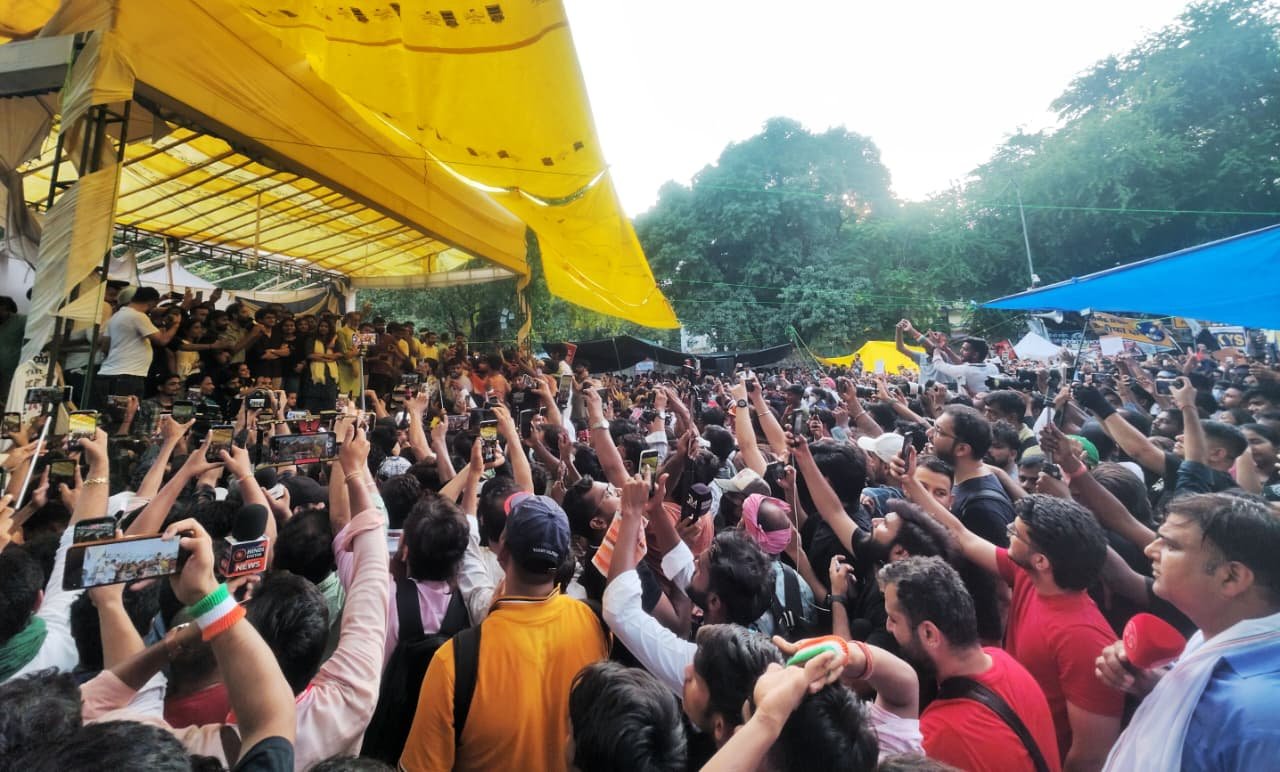
What will history remember from the recent scenes at Jantar Mantar? The demand for examination reforms? The allegations of police excesses? The debate over accountability? Perhaps.
Many, however, may remember something else entirely: Young women shouting out misogynistic abuse, as though vulgarity itself had become a badge of courage. That surprised me. After all, this is the Instagram generation, one that has reinvented communication. It creates memes that puncture powerful narratives in minutes. It speaks through satire and humour with a creativity previous generations could scarcely imagine. It has built an entirely new language of expression. Which is what makes its dependence on abusive language, rooted in centuries-old patriarchal formulations, all the more disappointing.

Surely a generation capable of inventing a new vocabulary of memes can invent a new vocabulary of anger? Surely it can express dissent with greater wit, intelligence and originality, instead of simply recycling the oldest slurs from the patriarchal playbook? That isn’t cool; it is intellectually lazy.
There are those who have defended the language. Why should only men have the freedom to swear, they ask. Others have dismissed criticism as moral policing. Anger, they argue, has its own language.
These are fair points, but they miss a more fundamental one: Why are young women proudly using the language that patriarchy invented to humiliate women?
Having been a part of both the Anna Hazare movement and the Nirbhaya protests, I witnessed public anger at its most visceral. The streets overflowed with emotion. We marched, shouted slogans, confronted those in power, and demanded accountability. We were lathi-charged, and FIRs were booked against us. We even had to deal with vindictive actions like electricity connections being cut. Yet, through all that rage and all that suffering, I do not recall women resorting to profanity to make themselves heard.
Our anger was fierce, but it was never crude. We communicated with passion, conviction and moral force — not by borrowing the language of misogyny. We believed our arguments were strong enough to carry our outrage. We never felt the need to sound like the crudest voices in the crowd.
Every society uses profanity. The English language has its own deeply misogynistic insults. But many Indian gaalis carry a particular cultural imprint. They derive their power from the old patriarchal belief that a man’s honour resides in the women of his family. The abuse is directed at him, but the humiliation is imagined through his mother, sister or daughter.
That is the anatomy of a gaali.
These are not merely vulgar words. They encode an entire social order. They reduce women to repositories of male honour, turning them into territory through which men assert dominance over one another. Even when exchanged between men, women remain the battlefield.
Language is never just language. It carries history, preserves hierarchies and quietly transmits prejudice across generations. Every casual repetition normalises the idea that a woman’s body is a legitimate site for humiliation.
Which is why hearing young women use these abuses as though they represent empowerment is so deeply ironic. There is nothing cool about recycling the oldest expressions of misogyny in our language.
Patriarchy wins twice, first when it invents these filthy abuses, and again when women mistake repeating them for rebellion and liberation.
Women did not struggle for generations merely to inherit the worst instincts of men. They fought to redefine what courage, dignity and strength look like — and what they sound like. The opposite of patriarchy is not women behaving like the worst men. Aping masculine aggression is not empowerment.
We rightly speak about toxic masculinity. But toxic patriarchy cannot be replaced by toxic feminism. Liberation does not lie in imitating the language of those who diminished women for centuries. It lies in rejecting that language altogether and creating a vocabulary worthy of equality.
The protests at Jantar Mantar raised important questions about examination reforms and allegations of excessive force. None of that, however, explains why misogynistic abuse should become the soundtrack of a movement.
Can claims about dismantling patriarchy be made while speaking its oldest vocabulary? Can women truly call it liberation when they voluntarily reduce themselves and other women to property or repositories of honour?
Women deserve freedom not only from discriminatory laws, but also from the invisible prison of a vocabulary that has, for centuries, reduced them to somebody’s honour, somebody’s property and somebody else’s shame. Freedom begins when women stop mistaking the vocabulary of patriarchy for the language of liberation.
The first battle for women’s freedom was fought in our laws and institutions. The next must be fought in our language.
For as long as women speak words that derive their power from humiliating mothers and sisters, patriarchy will continue to echo through voices that believe they are free.
That is not liberation. That is patriarchy, speaking through a different voice.
The writer is national spokesperson of the BJP
