



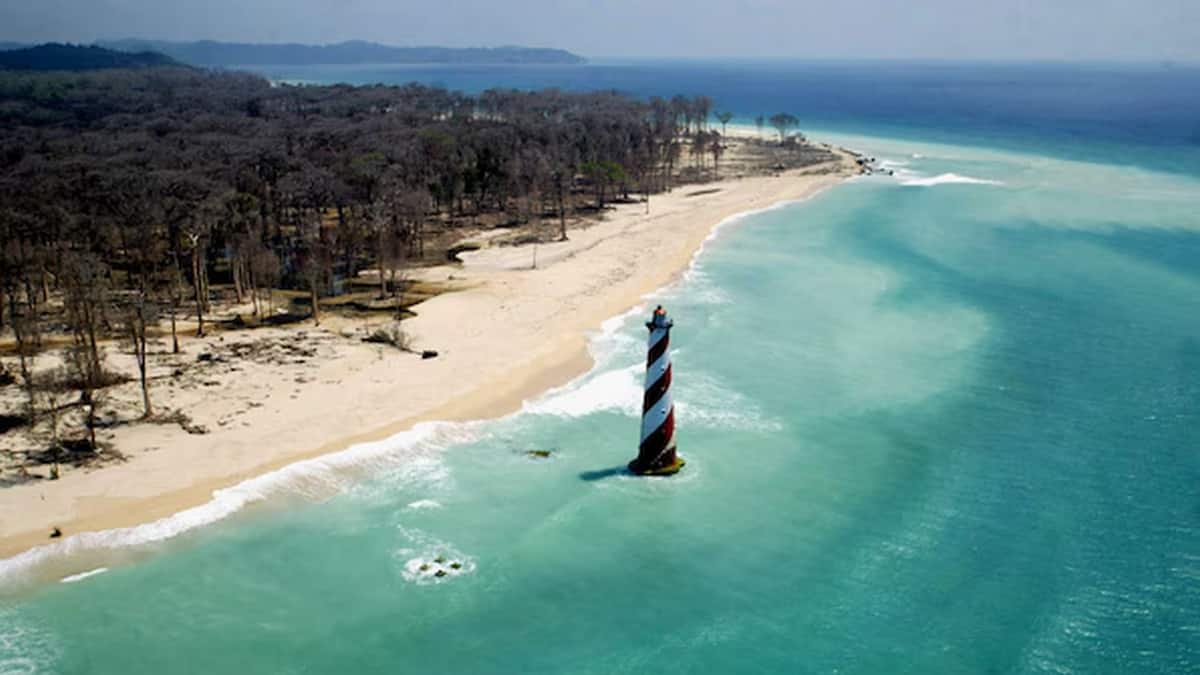
With environmental clearance, India’s strategic Great Nicobar project in the Bay of Bengal, with a firm eye on China, is ready to begin
A key hurdle to the Great Nicobar project has been cleared, setting the stage for a forward Indian presence at the mouth of the Malacca Strait, making it central to New Delhi’s long‑term contest with China in the Bay of Bengal (BoB) and, to a degree, aligning with growing American interest.
The Great Nicobar development plan is an $11 billion project centred on an International Container Trans-shipment Terminal (ICTT) at Galathea Bay, an international airport, power plants and a new township on about 166 sq km of land, of which roughly 130 sq km is forest and 84 sq km is notified tribal land. The environment clearance (2022) was challenged, but the National Green Tribunal in February 2026 explicitly declined to interfere, emphasising that “considering the strategic importance of the project” there was “no good ground” to halt it, thus removing the main legal obstacle and signalling that the judiciary accepts strategic arguments as overriding in this geography. In effect, the court has enabled the state to convert Great Nicobar from a sparsely developed island into a large dual‑use complex, whose port is to be under naval control and whose airport is planned as a civilian‑military facility.
This legal closure matters because it stabilises timelines and investor confidence: policy papers indicate Phase I of the ICTT is targeted around 2028, after which India can begin diverting trans‑shipment traffic away from foreign hubs. Environmental and tribal‑rights disputes will likely persist, but the core principle that the island’s development is a ‘project of strategic importance’ has now been judicially affirmed, limiting the scope of future injunctions.
From Vulnerability to Leverage
Geographically, Great Nicobar sits at India’s extreme maritime frontier: it is roughly 40 nautical miles from the western approaches to the Malacca Strait, through which a large share of global container traffic and a significant proportion of China’s energy imports and seaborne trade pass. China’s long‑discussed ‘Malacca dilemma’, the fear that adversaries could choke this narrow corridor, has driven its push for bases and port access agreements from Myanmar and Bangladesh to Gwadar and for overland pipelines through Myanmar and Pakistan. Without a strong presence in the Andaman and Nicobar chain, India has had geography but not fully developed capability; Great Nicobar’s port and airfield give it a sustainable, scalable foothold right on China’s critical sea lane.
The Bay of Bengal already sees intense Chinese naval activity, including submarine forays and research vessels whose paths bring them close to the Indian EEZ and undersea cable routes. As India’s own RBI has pointed out in a 2022 report, India’s poor shipping connectivity and dependence on foreign trans‑shipment hubs have been structural weaknesses limiting its participation in global value chains. By building a deep‑draft ICTT that can directly handle large mainline container vessels, India reduces both economic and strategic vulnerability: ships no longer need to congregate at hubs like Colombo or Singapore, where India has limited leverage, before feeding traffic to the Indian coast.
The development of advanced radar and signals intelligence (SIGINT) facilities on Great Nicobar directly counters China’s suspected intelligence presence on Myanmar’s Coco Islands, located just 55 km north of India’s Andaman chain. GNI allows India to maintain a persistent eye on the 10-degree and 6-degree channels, through which Chinese submarines must surface to navigate safely.
Currently, nearly 75 per cent of India’s transshipped cargo is handled at foreign ports like Colombo and Singapore. By building a transshipment hub with a natural depth of over 20 metres, India claws back economic agency. This reduces reliance on ports where China has significant equity (like Colombo) and integrates India more deeply into the East-West shipping corridor.
Chinese Checkers
The Great Nicobar ICTT is designed to be a ‘transshipment hub of the East’, specifically to capture cargo that currently moves via foreign ports along the Malacca route. When Indian containers are trans‑shipped abroad, port charges and value‑added services accrue to other economies. Great Nicobar, together with Vizhinjam on the Arabian Sea side, is part of a two‑pronged strategy to repatriate this revenue and shorten sailing distances and times for Indian trade. For some routes, direct calls to Great Nicobar are projected to halve sailing distance and time compared with current patterns, reducing logistics costs and reinforcing India’s position as a manufacturing and export hub competing with China.
Strategically, the port’s planned naval control and the dual‑use airport transform Great Nicobar into a forward operating base for sustained naval and air presence in the eastern Indian Ocean. This allows India to monitor Chinese naval movements close to a vital chokepoint, complicate PLAN (Chinese Navy) operations into the Bay, and, in extremis, hold out a credible capability to monitor or threaten shipping lanes that China regards as vital for its energy security. Commentaries on the project explicitly link it to countering Chinese presence in the Bay of Bengal and Indo‑Pacific and to addressing China’s Maritime Silk Road push.
The island’s development also supports a layered basing architecture: Andaman and Nicobar Command at Port Blair already provides a joint‑services outpost, but Great Nicobar’s location further south, closer to Malacca, gives India more flexible options for forward deployment of surface assets, submarines, maritime patrol aircraft and drones. Once the port and airport are operational, India will be better positioned to host multinational exercises in the Bay, bolster anti‑submarine warfare (ASW) networks and integrate its maritime domain awareness (MDA) with partner navies.
Rising US Interest in the BoB
Parallel to India’s moves, American overt and covert interest in the eastern Indian Ocean has grown markedly as Washington seeks to balance China’s expanding naval presence. The long‑standing US base at Diego Garcia already anchors US power projection in the central Indian Ocean to balance China. New Delhi, once wary of US basing, is now widely seen as quietly relieved that the Diego Garcia arrangement will continue even as the UK moves to settle sovereignty over the Chagos Archipelago with Mauritius, because it helps maintain the preferred balance of power.
But the fight for the Bay is only just beginning.
(Hindol Sengupta is a professor of international relations and director of the India Institute at the OP Jindal Global University. Views expressed are personal and solely those of the author. They do not necessarily reflect Firstpost’s views.)
End of Article

