



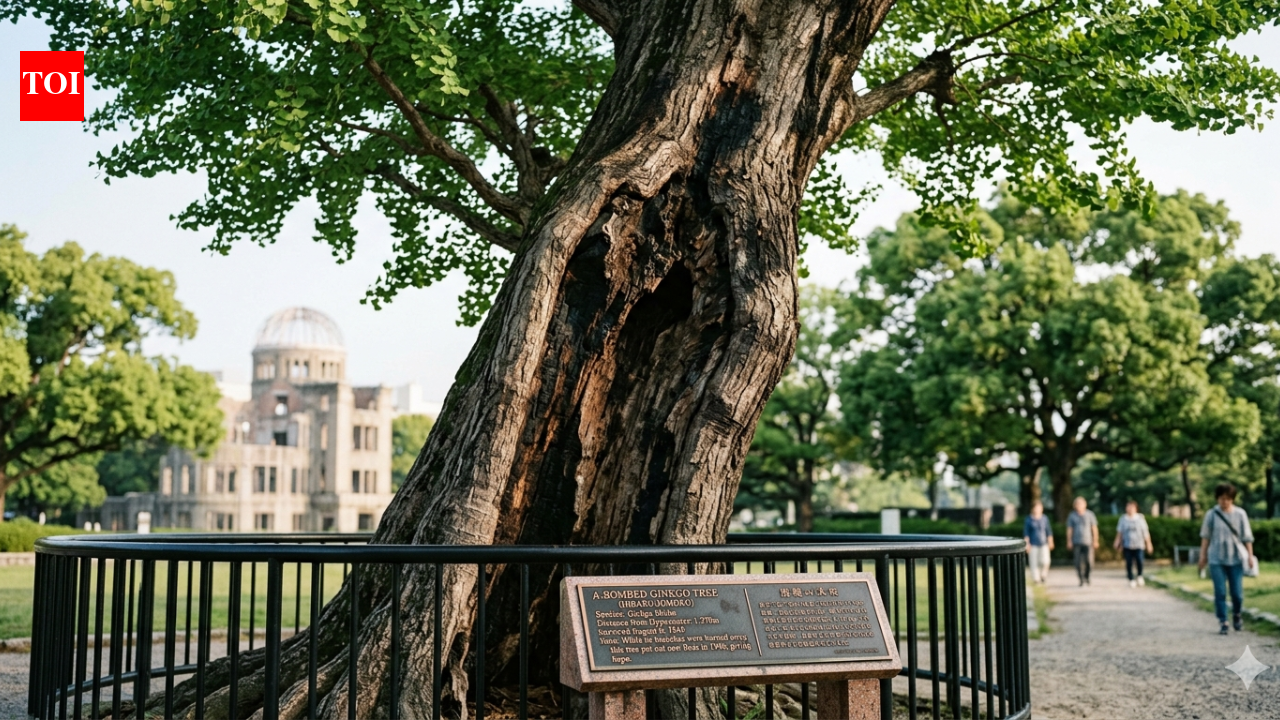
As the effects of the atomic bomb on Hiroshima in August of 1945 proved to be devastating enough to convince scientists that nothing would grow in this place for decades, with the temperature around the explosion site being excessively high and the level of radiation dangerously increased, along with practically all forms of life in this area dying, life started growing back much earlier than expected. In just several months after the explosion occurred, trees that had burned down started growing again. Now, many years later, these astonishingly surviving trees are still alive and thriving as hibakujumoku.
Hiroshima survivor trees and the nuclear bomb impact
Early scientific hypotheses indicated that it could take years for vegetation to grow back in the region after the incident. Nevertheless, by the spring of 1946, vegetation had already begun to grow back. Examples include the Ginkgo biloba, or Ginkgo tree, which is sometimes referred to as a “living fossil,” owing to its prehistoric origin. The trees were located within two kilometres of the hypocentre, and they were able to regenerate themselves, despite being severely damaged.It is recorded in the United Nations, an international organisation, that they are regarded worldwide as a symbol of resilience. The organisation states that they stand for “hope for a peaceful future.”
Why these trees survived radiation exposure
Much attention has been devoted to figuring out why the trees could withstand such high levels of radiation and heat. According to a recent study at Stanford University, it is all due to characteristics inherent in the tree itself. In science terms, this is known as “constitutive resilience” or stress resistance.The atomic bombing of Hiroshima created “a unique environment of acute, high-dose ionising radiation,” and some plants were able to survive this because of their innate defence mechanisms. This is largely due to high efficiency in DNA recovery and high levels of antioxidants that help mitigate the negative effects of the irradiation on the molecules.Another factor is structural biology. Unlike animals, trees do not depend on any crucial organ. They can lose a large part of their biomass and continue to live. Moreover, their roots, which are located deep in the ground, might have survived the irradiation. It is from this point that new growth will start. This type of growth could emerge even after the visible parts of the tree were destroyed.
Scientific research into radiation-resistant plants
The fact of the survival of trees in Hiroshima provides possibilities for further scientific research. The difference from the gradual adaptation in cases like Chornobyl is in the fact that in Hiroshima, no evolutionary process took place; it was the immediate survival of trees, which prompted researchers to study their genome, trying to determine the causes of such strong adaptation.According to experts, the discoveries of such studies can help mankind develop more effectively in many aspects of life. The insights gained from studying the trees’ genes may be used in growing crops resistant to severe conditions and degraded soil. Moreover, space travel may become another area to which this research can provide benefits, growing plants in the environment with a high level of radiation.There are programs that are designed to preserve the legacy of the survivor trees of Hiroshima. Thus, the program called Green Legacy Hiroshima aims at collecting seeds from the trees in order to propagate them worldwide.In conclusion, the example of the survivor trees demonstrates that mankind should reconsider some of its assumptions. It turns out that the vegetation can grow again even after an absolutely devastating effect of a nuclear bomb. Not only did these trees endure, but they proved to be more biologically resilient than previously thought possible. The study of these organisms is likely to lead to discoveries that will allow scientists to understand how to sustain life in conditions we have never even considered before.

