



My 8-year-old thinks I have no chill. Her friends go to South Korea and come back with those plastic anime toys. They go to Paris and eat croissants at a café that is famous on Instagram. They go to a Scandinavian country for a white Christmas. And here I am, telling her that our next vacation is a trip to Hazaribagh in Jharkhand to visit artisans who paint cave painting-inspired murals on the walls of their homes during the harvest season. No wonder she believes I am the root of all her woes!
But I have always travelled differently.

In 2008, I was still in my corporate job. At a party, I met a friend’s friend. A week later, she asked if I would be interested in a monsoon trip to Goa, inspired by British travel writer Alexander Frater’s book Chasing the Monsoon: A Modern Pilgrimage Through India (2011, Picador). We would take a train from Mumbai, meet her other friends, and drive down the coast chasing the rain. I said yes to a trip with strangers built around a book about weather.
It has been by far the best trip of my life. We were drenched throughout. I drank a full bottle of toddy because I didn’t know what so much of the innocently sweet-tasting thing would do and I laughed for three hours straight. We trekked up Yana caves in Gokarna, Karnataka, pulled our car out of muck, slept in dorms. Those people are my family now. If not for them, there would be no CraftCanvas, my design studio that works with over 30 craft traditions across India and brings artisanal work into contemporary spaces. They were the first ones to pull out their cheque-books to say, ‘Go live your dream. We’ve got your back.’

A monsoon trip to south Goa, north Karnataka and parts of Udupi, in 2008.
| Photo Credit:
Courtesy Nisha Vikram
A few years later in Istanbul, Turkey, my husband and I took the bus till the last stop and stumbled upon a row of pastel-hued homes, ate local bakery bread, and spent our days like locals, somehow imagining we lived there. A lesson I have carried back with me to my trips within India.

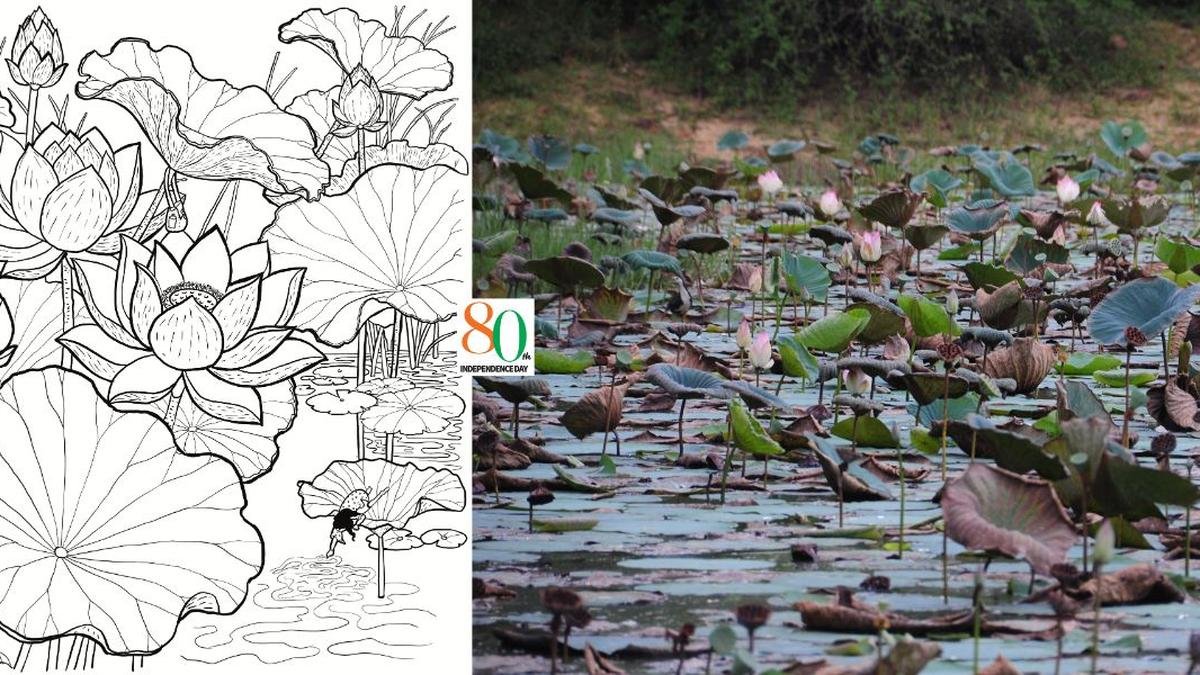
A sketch of the lotus pond by Nisha Vikram.

A hidden lotus pond somewhere between Tamil Nadu’s Kumbakonam and Thanjavur in 2014.
| Photo Credit:
Nisha Vikram
Chance encounters, to me, are what distinguishes travel from tourism. Travel evokes a particular line from singer Lucky Ali’s popular song ‘Dekha Hai Aise Bhi’: “Nazare bhi humse mile.” The sights will come to meet you. It is my life anthem, to not chase the experience but allow it to find you. And be slow, unscheduled, and present enough for this to work. Be willing to stop the auto to answer nature’s call, and discover a hidden lake full of giant lotuses on the other side of a raised mound. That lake in Tamil Nadu, between Kumbakonam and Thanjavur, was not in any guidebook. There was no location pin. We found it because we were not trying to find anything.
Looking for craft villages
I have been travelling to craft locations across India since 2009, before Instagram existed, before Google Maps covered the roads I was taking. The methodology has been simple. I look up the village in the Handmade in India, by textile designer and design thinker Aditi and M.P. Ranjan (2007), and head there. Someone in the village would know the artisan. Everything would come together from that point.

Stone carvers in Shivarapatna, Kolar District, Karnataka, in 2011.
| Photo Credit:
Nisha Vikram

A craftsman in Shivarapatna, Kolar District, Karnataka, in 2011.
| Photo Credit:
Nisha Vikram

Stone-carved idols in Shivarapatna, Kolar District, Karnataka, in 2011.
| Photo Credit:
Nisha Vikram
In 2011, a friend and I drove towards Shivarapatna in Karnataka to find stone carvers with nothing but a printed page from the book and a Nokia GPS that gave up past Kolar. A tea-shop owner sent a local boy with us the rest of the way. In 2017, I travelled to Chamba in Himachal Pradesh in my third trimester, threw up along the way, conducted a meeting supine on embroidery artist Padma Shri Lalita Vakil’s couch, and pushed furniture against my hotel door. All because my photographer friend went for picturesque over practical and had booked us into a shady, remote hotel, reached only on foot. When morning came, there was a magnificent river in front of us, with giant flowers and butterflies everywhere.

Meeting Chamba Rumal artisan Padma Shri Lalita Vakil in Chamba District, Himachal Pradesh, in 2017.
| Photo Credit:
Nisha Vikram
On a craft-scouting trip to Upper Kinnaur in Himachal in 2015, our group arrived late and ended up at the temple on the night of the annual festival. Arrack was passed as an offering to the goddess. The village head had to intervene after several rounds. Every married lady that night wore her bridal dress and jewellery, all hand-woven and crafted over months. For my line of work, this was treasure. I had stumbled into something I had no way of knowing was happening.

A village temple festival in Upper Kinnaur in 2015.
| Photo Credit:
Nisha Vikram
Today, these villages will likely have location pins and reels about them. That tea stall probably has a Zomato rating. Artisans have Instagram pages, WhatsApp numbers and order catalogues, and it is wonderful. Less information asymmetry means an artisan does not have to wait for someone like me to show up for an order. There is no denying that those days were often harder, for the artisan more than for me.
As most things in life, however, two things can be true at once. Somebody’s pin might be the reason an artisan’s daughter can afford college this year. And I long for the sort of adventure that is getting harder to seek out.
Chance encounters
But the romantic that I am, I still stick to my methodology. The willingness to arrive without a fixed expectation of the outcome, and to be genuinely curious about what I encounter.
With this mindset, the artisan may sit with you for hours sharing stories that no influencer was privy to. And if you are lucky, even feed you rice, aloo posto and his share of the fish. True story, mind you.

On the road to Chamba District, Himachal Pradesh in 2017.
| Photo Credit:
Courtesy Nisha Vikram
The monuments of Rajasthan are incredible and you can stand in front of them and feel something stir inside you. But to me, the answers lie in the tea stall, in a temple on a festival night, in a hidden lake that only belongs to you.
My daughter will find this for herself, in her own time. For me, the most alive I have ever felt in a place was when I let the unpredictable remind me that I am part of something larger than myself.
The Bengaluru-based writer is the founder of CraftCanvas, a design studio in Bengaluru and Ahmedabad.
Published – August 14, 2026 01:43 pm IST
