



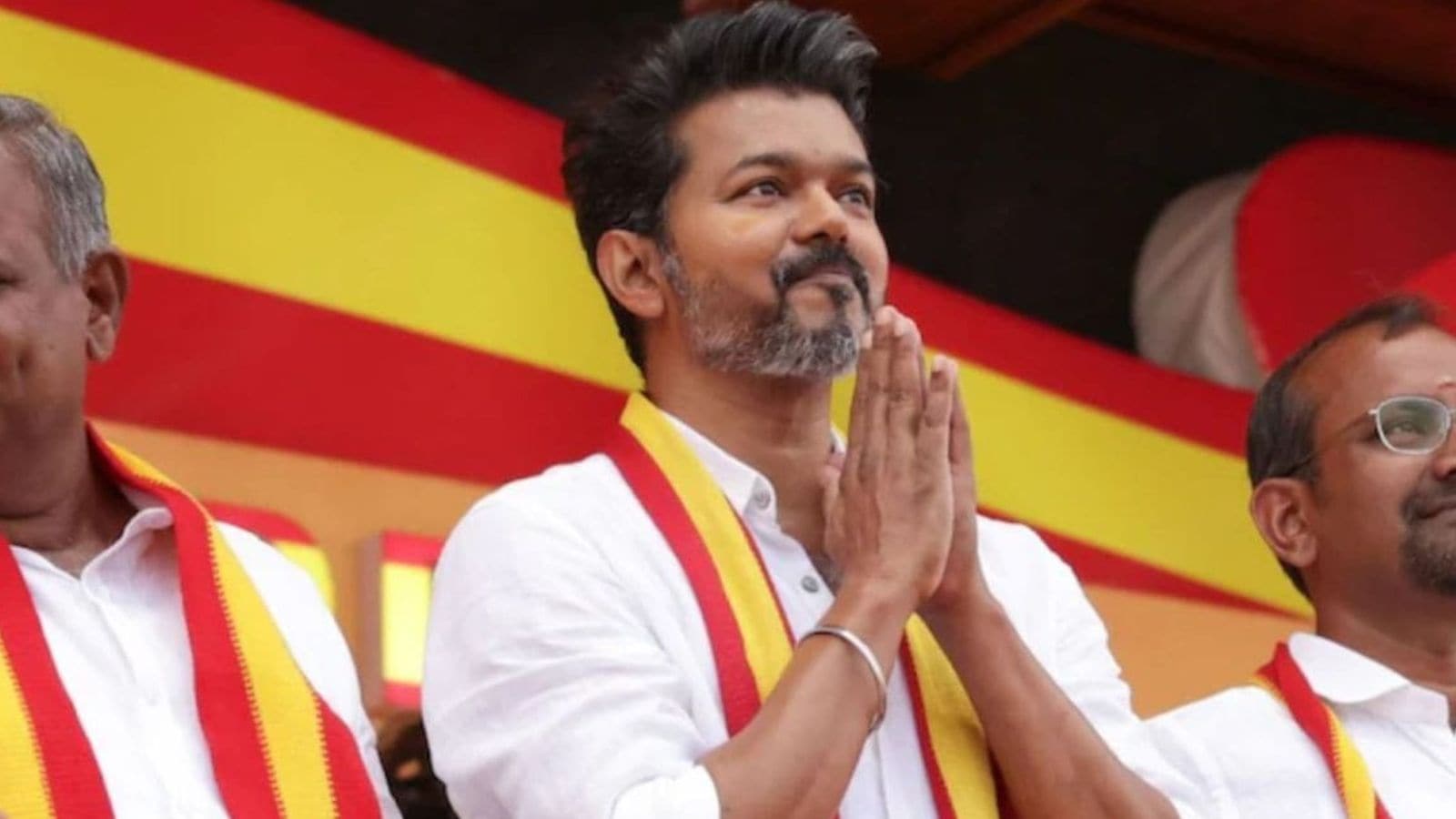
A governor cannot create a legislative majority in his office. In a parliamentary democracy, the real test of power does not take place through private assurances, letters, or political calculations placed before the governor. It takes place on the assembly floor, where elected representatives must publicly state whom they support. That is the basic grammar of the Westminster system India adopted: the governor invites, the assembly decides.
Tamil Nadu’s hung verdict has now put this principle under stress. Joseph Vijay Chandrasekhar’s Tamilaga Vettri Kazhagam has emerged as the single-largest party with 108 seats in a 234-member Assembly, where the majority mark is 118. Congress, with 5 seats, has declared support, taking Vijay’s claim to 113. This does not mean he has already proved a majority, but it does mean his claim is serious enough to be tested in the House.

The governor’s reported insistence that Vijay must first establish the required majority before being invited reverses the parliamentary sequence. A claimant to government is not expected to win a private trial of strength before the governor. The governor may examine who has the most credible claim, but he cannot become the final judge of legislative support. If there is doubt, the answer is not to delay. The answer is to convene the House and let Tamil Nadu’s elected representatives decide.
Discretion is real, but not sovereign.
The governor does have discretion in choosing whom to invite when no party commands a majority, but that discretion exists only to set the parliamentary process in motion and not to decide who enjoys a majority. This distinction is central to responsible government. The Council of Ministers is collectively responsible to the legislative assembly and not to the governor. Therefore, the governor’s satisfaction cannot replace the assembly’s confidence, and his doubt cannot prevent the assembly from expressing itself. Once Vijay has offered to face a floor test, the burden shifts from Lok Bhavan’s subjective assessment to the assembly’s objective vote.
Prescriptions from Commissions
This is precisely where the Sarkaria Commission and the Punchhi Commission become indispensable. Both studied the recurring problem of hung assemblies and laid down a clear order of priority that governors must follow when deciding whom to call first to form government.
The Sarkaria Commission recommended a sequenced approach. The first preference must go to a pre-poll alliance or coalition that together commands a majority. If such an alliance exists and has a single agreed-upon leader, the governor should call that leader without hesitation. The second preference is the single largest party in the Assembly, provided it has the support of other parties or independents sufficient to demonstrate a credible claim to a majority. The third preference covers a post-poll coalition of parties that decide to govern together after the election results, provided they enter government with a common programme and a united leadership. The fourth and final preference is for a post-poll alliance in which one party is supported from outside by others, without those parties formally joining the government.
The Punchhi Commission broadly affirmed this hierarchy while adding important nuance. It stated that the governor’s role in appointing a chief minister in a hung assembly must follow what it called “clear guidelines to be followed as Constitutional conventions.” Critically, the Commission warned against governors inventing their own criteria or applying personal political judgment in place of these settled conventions. Both Commissions were unanimous that these categories exist to guide the governor’s initial choice of whom to invite, not to authorise him to sit in private judgment over whether that claimant will ultimately succeed.
Applied to Tamil Nadu, this framework strengthens Vijay’s constitutional position considerably. TVK is the single-largest party. Congress has declared outside support. No pre-poll alliance has come forward with a competing majority claim. Under the Sarkaria and Punchhi frameworks, the governor’s obligation is to call upon Vijay as the leader meeting the second preference category, invite him to form a government, and direct an early floor test. The commissions did not imagine the governor as someone who must be personally convinced before issuing an invitation. They imagined him as a constitutional facilitator working through an ordered process.
Bommai, Bihar, and the Floor Test
The Supreme Court’s nine-judge Constitution Bench judgment in S R Bommai v Union of India (1994) settled the matter in terms that have not been improved upon since. The Court held that wherever doubt arises about confidence, “the only way of testing it is on the floor of the House.” More sharply, Para 391 of that judgment declared that determining the majority “is not a matter within his subjective satisfaction. It is an objective fact capable of being established on the floor of the House.” The governor’s personal assessment cannot substitute for a legislative vote.
The Supreme Court’s 2006 judgment in Rameshwar Prasad v Union of India reinforces this. Governor Buta Singh had recommended dissolution of the Bihar Assembly in May 2005 before it had ever met, citing fears of horse-trading. The Court held the dissolution unconstitutional and found that the governor’s conduct amounted to something “wholly illegal and irregular”, driven by the motive of preventing a particular party from staking its claim. Democratic legitimacy cannot be protected by bypassing the democratic forum itself.
Tamil Nadu presents a version of the same structural risk. Vijay is being asked to prove a majority before being allowed to take his claim to the House. The elected forum is postponed while unelected discretion expands.
Delay manufactures the very instability it claims to prevent
In a hung assembly, every day of delay shifts incentives and creates space for inducements and tactical realignments. Karnataka demonstrated this with precision in 2018. Governor Vajubhai Vala gave B S Yediyurappa 15 days to prove majority after being sworn in. Congress and JD(S) moved the Supreme Court, which compressed that 15-day window to a single day, ordering a floor test for the following Saturday. The Court understood that a prolonged gap between oath and floor test does not protect democracy; it distorts it.
The Goa precedent is equally instructive. When the BJP was invited to form a government despite not being the largest party, the Supreme Court ordered an immediate floor test, holding that such a vote would “remove all possible ambiguities, and would result in giving the democratic process the required credibility.”
Tamil Nadu does not need constitutional innovation. It needs constitutional memory. The governor must follow the Sarkaria-Punchhi order of priority, invite Joseph Vijay as the leader of the single largest party with declared outside support, convene the House, and step aside. The floor of the House is not a stage that follows the governor’s verdict. It is the only stage on which the verdict can legitimately be delivered.
The writer is a lawyer and a postgraduate from NALSAR University of Law with a specialisation in public law
