




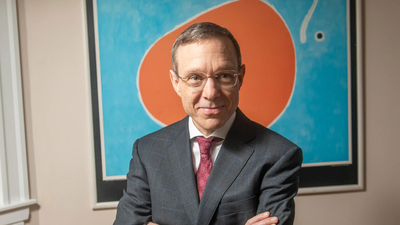
The question of whether humanity is alone in the universe has fascinated scientists for generations, but few have pursued an answer as publicly or as controversially as Harvard astrophysicist Avi Loeb. While most researchers argue that extraordinary claims require extraordinary evidence, Loeb believes advanced alien civilisations may already have left technological traces in our cosmic neighbourhood and that scientists should investigate those possibilities with an open mind rather than dismiss them outright. His theories about mysterious interstellar objects such as ʻOumuamua and, more recently, 3I/ATLAS have sparked heated debates within the scientific community and captured global attention. Now, the astronomer known for challenging conventional thinking has been chosen to lead the White House’s scientific advisory council on unidentified anomalous phenomena (UAP), placing him at the centre of America’s latest UFO investigations.
Avi Loeb’s journey from an Israeli village to Harvard University
Long before his name became synonymous with UFOs and alien technology, Avi Loeb was a curious child growing up in Beit Hanan, a small farming village in Israel. Rather than dreaming of becoming an astronomer, he was drawn to philosophy and the biggest questions imaginable: Why does the universe exist? Are humans alone? Could there be intelligent civilisations beyond Earth? Those childhood questions would eventually shape one of the most unconventional scientific careers of the modern era.Loeb’s academic path began with Israel’s elite Talpiot programme, which recruits exceptional young scientists for advanced military research. He later earned a PhD in plasma physics from the Hebrew University of Jerusalem in 1986 before moving to Harvard University, where he established himself as one of the world’s leading cosmologists. Over the next three decades, he published hundreds of scientific papers on black holes, galaxy formation and the early universe, eventually serving as chair of Harvard’s Department of Astronomy from 2011 to 2020.
The mysterious visitor that changed his career forever
Despite an already distinguished career, it was a mysterious object from deep space that transformed Loeb into one of the world’s most talked-about scientists.In October 2017, astronomers detected ʻOumuamua, the first confirmed interstellar object ever observed passing through the Solar System. The object displayed several unusual characteristics. It accelerated as it moved away from the Sun, appeared unusually elongated and showed no obvious signs of the gas or dust typically released by comets.While many scientists searched for natural explanations, Loeb proposed something far more extraordinary. He suggested ʻOumuamua could be a giant “light sail”, a thin artificial structure built by an advanced extraterrestrial civilisation and propelled through space by radiation from stars.The idea immediately divided the scientific community, but it also made Loeb a household name. He later expanded the theory in his bestselling book Extraterrestrial: The First Sign of Intelligent Life Beyond Earth, arguing that science should investigate even the most unexpected possibilities rather than dismiss them outright.
The scientist who refuses to rule out alien technology
Unlike many people associated with UFO discussions, Loeb insists he is not driven by belief but by curiosity and evidence. Throughout interviews and public lectures, he has repeatedly argued that scientists should not reject extraordinary ideas simply because they challenge conventional thinking.“We should put all possibilities on the table until the evidence tells us otherwise,” he has often said.To Loeb, the greatest scientific mistake would be assuming humanity already knows all the answers. He believes the universe is simply too vast to dismiss the possibility that advanced civilisations may exist elsewhere.Another of his most widely quoted remarks reflects his approach to science.“Science is not about us lecturing the public what’s right and wrong. It’s about the process by which we all learn together.”Even criticism has done little to change his outlook.“I don’t really care what people think,” he once said when asked about fellow scientists who questioned his theories.
Building the Galileo Project to search for extraterrestrial evidence
Rather than limiting his ideas to books and interviews, Loeb decided to search for evidence himself.In 2021, he launched the Galileo Project, an ambitious scientific initiative dedicated to finding evidence of extraterrestrial technological objects. Named after the famous astronomer Galileo Galilei, the project aims to use modern telescopes, infrared cameras, artificial intelligence and advanced sensors to search the skies for unexplained aerial phenomena.Loeb believes decades of debate over UFOs have suffered from one major problem: a lack of reliable scientific data. Instead of relying on blurry photographs or eyewitness testimony, the Galileo Project focuses on collecting measurable evidence that can either confirm or reject extraordinary claims.For Loeb, the answer lies not in speculation but in better observations.
Searching the Pacific Ocean for pieces of another world
Loeb’s determination to find evidence took him from observatories to the middle of the Pacific Ocean.In 2023, he led an expedition to recover fragments from a meteor known as IM1, which exploded over Earth in 2014. US government data suggested the meteor had travelled unusually fast, raising the possibility that it originated from outside the Solar System.Using specially designed magnetic sleds dragged across the seabed, his team recovered hundreds of tiny metallic spheres known as spherules.After analysing the material, Loeb suggested some of the spheres possessed unusual chemical compositions that could point to an interstellar origin or even represent fragments of extraterrestrial technology.The expedition drew worldwide attention and reinforced his reputation as one of the few mainstream scientists willing to actively search for physical evidence of alien technology rather than simply discuss the possibility.
3I/ATLAS put him back in the headlines
When the newly discovered interstellar object 3I/ATLAS entered the Solar System, Loeb once again found himself at the centre of global attention.While many astronomers quickly identified it as a natural comet, Loeb argued that scientists should not rush to conclusions before gathering sufficient observations. According to him, every explanation deserved consideration, including the possibility that the object might have an artificial origin.His comments quickly reignited worldwide debate and turned 3I/ATLAS into one of the most discussed astronomical discoveries of the year.For Loeb, the principle remained unchanged.“If we ignore possibilities because they sound extraordinary,” he has argued on multiple occasions, “we may overlook the biggest discovery in human history.”Loeb’s appointment to lead the White House’s scientific advisory council on UAP marks the most significant recognition yet of his influence in one of science’s most debated fields.Created under President Donald Trump’s transparency initiative, the advisory council will support the government’s UAP Governance Board by reviewing military sightings, analysing sensor data, recommending better methods of collecting evidence and advising officials on whether unexplained aerial objects pose national security risks.Following its first meeting, the council reportedly requested more than 50 videos, photographs and official documents related to known UAP incidents from the Pentagon.Loeb has made it clear that he intends to approach the work scientifically. However, he also believes the government’s willingness to involve outside researchers shows that some questions remain unanswered.“If they were sure these objects are human-made, they would file these cases as classified reports within the Pentagon,” he recently said. “The fact that they open up to the scientific community implies that there is a chance that perhaps one or more of these objects might be not human-made, in which case it would be the biggest discovery ever made by humanity.”He has also rejected conspiracy theories about hidden alien spacecraft, saying he believes government agencies themselves are trying to understand phenomena they cannot yet fully explain.
The man who changed the conversation about alien life
Love his ideas or reject them, Avi Loeb has succeeded in doing something few scientists ever achieve: he has changed the way the public talks about extraterrestrial life. Instead of treating the subject as science fiction, he has pushed it into mainstream scientific discussion, arguing that curiosity should never be limited by convention or fear of criticism.His theories continue to divide opinion, but they have also inspired a new generation of researchers to ask difficult questions and gather better evidence. As he begins leading the White House’s scientific advisory council on UAP, Loeb enters a new chapter in a career built on challenging assumptions. Whether his search ultimately uncovers evidence of alien technology or simply advances humanity’s understanding of the universe, one thing is certain: the Harvard professor has ensured that the search for life beyond Earth is no longer confined to the fringes of science.
