



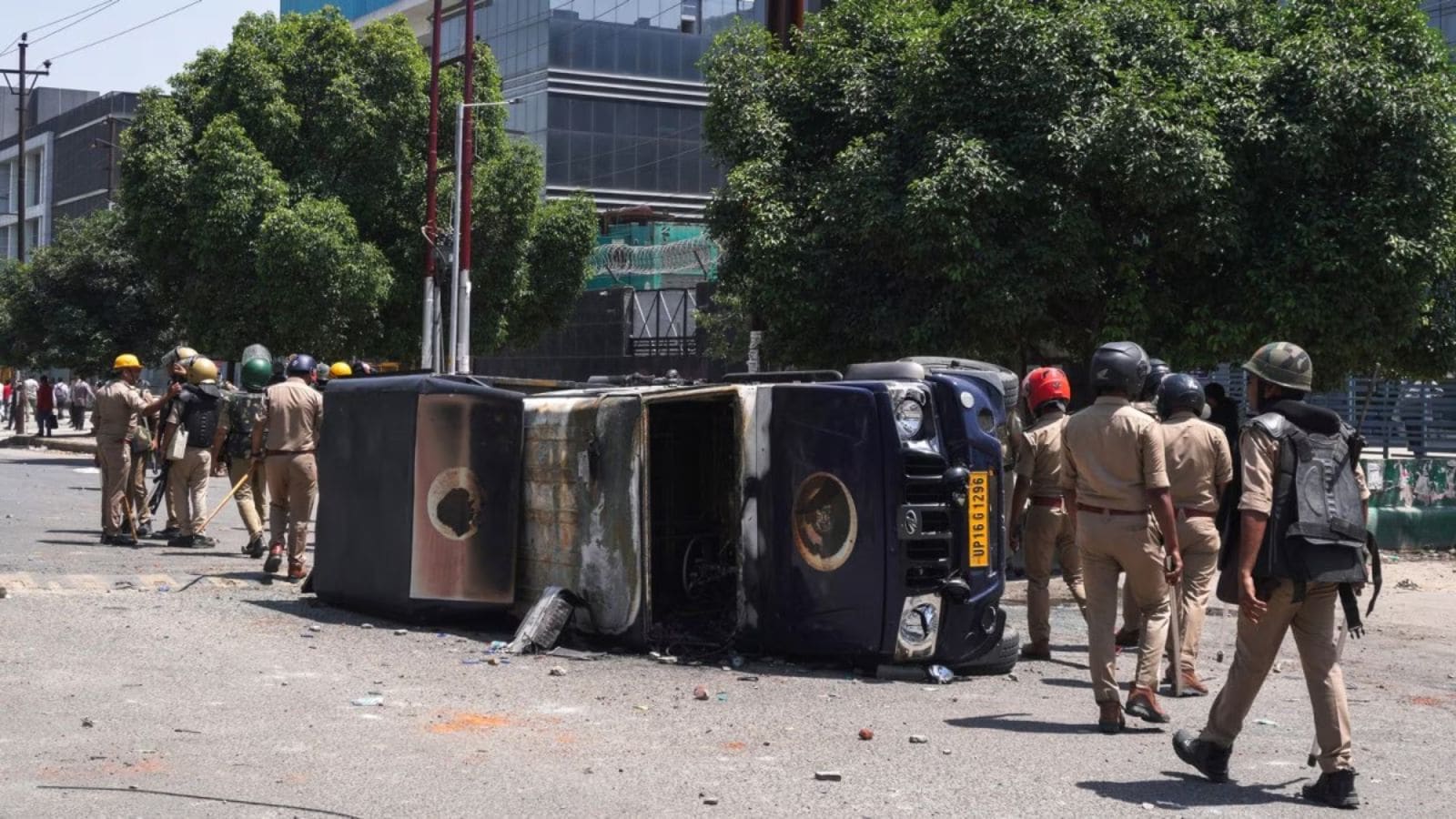
Thousands of workers took to the streets on April 13 at different places in Noida and continued with their protest the following day. This, unfortunately, descended into violence leading to multiple arrests at different sites. The immediate trigger appears to be the hike in minimum wages (MW) in Haryana on April 9, along with strong inflationary pressure due to the war in West Asia (particularly the sharp rise in LPG cylinder prices, an essential component of the subsistence basket, in the black market). Nonetheless, there may be structural reasons behind such unrest.

In this context, it is instructive to focus on the key demand of workers, namely, inadequacy in MW revision. Now, MW comprises two components: Basic pay and dearness allowance (normally revised twice a year based on CPI-IW to adjust for price rise). While inflation updates happened regularly before the current round of increase, the basic component was last revised in Haryana in 2015 and in 2014 in UP. Even though it is stipulated to raise the basic component every five years, this was not done. Thus, the present unrest can be understood as arising from the inability to share the gains in labour productivity — for over a decade — with workers. Additionally, CPI measuring average inflation often falls short of capturing price rise in certain essential segments like housing, healthcare and education. Indeed, calculations show falling real wages between 2021 and 2026, in Noida and Faridabad — the epicentres of protest.
The shortcomings in setting MW are evident from the accounts of various workers, many of whom complain about rent frequently consuming one-third to half of their monthly income. However, for MW calculation, the house rent component is arrived at by considering only 10 per cent of expenditure on food and clothing. Therefore, estimation of MW suffers from a fundamental lacuna — severely underestimating the cost of shelter, particularly in the vicinity of metro cities. It also shows the necessity of arriving at National Floor Wage (NFW) based on objective criteria — which is currently missing — since state governments are bound to set their MWs above NFW.
The above indicates that essentially it is the inability to meet subsistence needs — along with concerns over other work conditions — that is driving the protests. Close to 400 people have been arrested and, going by the Maruti Manesar plant incident, many may end up losing their jobs or even land up in jail. Only a threat to subsistence is likely to push workers towards such desperation.
Interestingly, state governments have implicitly accepted this fact and the wages of unskilled workers in Haryana were raised by 35 per cent, immediately after the protest, followed by a 21 per cent hike in UP. However, workers in Haryana are still protesting and labour unions demanded MW revision to be Rs 23,196. Similarly, workers in UP are not satisfied with their increase (21 per cent), for the large gap with their counterparts in Haryana (35 per cent hike) — possibly, on account of both areas being part of the NCR region and cost of living not being very different.
The question that arises is what steps are needed to avoid such incidents in future. First and foremost, the Noida protests should not be seen in isolation. Before Noida, there was labour unrest in Barauni (Bihar), Surat (Gujarat), and Manesar, Panipat (Haryana). In all these places, workers were demanding higher wages, improved overtime pay and better working conditions. In Noida, even before the protest of factory workers subsided, domestic workers were on the road demanding wage revision. In December 2025, gig workers went on strike for fair pay and the suspension of 10 minute delivery. These examples show that workers across the country and in widely different sectors are facing hardship and surviving at the threshold of subsistence; adequate steps should be taken to address their grievances in time.
Second, it is crucial to understand that there is no substitute to sustained tripartite dialogue between the government, employers and workers to maintain industrial peace. Otherwise, discontent is likely to spill over to the streets.
Finally, stable industrial relations are beneficial from the point of view of business as well, since industrial growth and investments flourish in such an environment rather than under industrial unrest. This should be the way forward, otherwise, the benefits of building an international airport in Noida could be considerably dampened with recurring industrial unrest.
The writer teaches at JNU, New Delhi

