



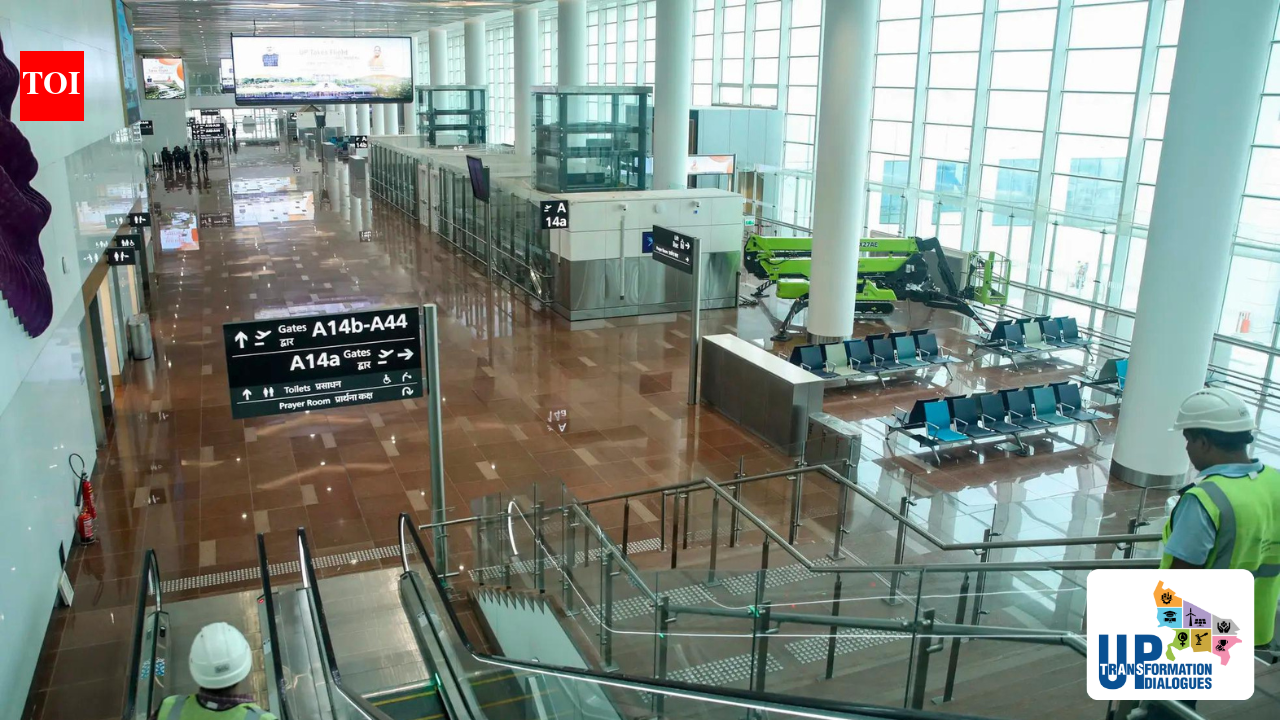
“From an IT and electronics hub to an integrated global business, manufacturing, logistics and aviation corridor, western Uttar Pradesh is scripting one of India’s most remarkable urban transformation stories.“Over the last nine years, few regions in India have witnessed a transformation as dramatic as the Noida–Greater Noida–Jewar region in Gautam Budh Nagar district. Once viewed primarily as a suburban extension of Delhi, the region has steadily evolved into one of the country’s fastest-growing economic ecosystems. Today it combines world-class infrastructure, industrial manufacturing, information technology, electronics production, logistics, higher education, urban development and international aviation into a single integrated growth corridor.This transformation has not occurred by chance. Since 2017, the Uttar Pradesh government has pursued a strategy of infrastructure-led development, industrial policy reforms, investment promotion and ease of doing business. The result is a region that increasingly serves not only Uttar Pradesh but the entire northern Indian economy.Stretching from Noida through Greater Noida to the Yamuna Expressway and Jewar, the corridor now represents the state’s most globally connected economic zone. With the operationalisation of the Noida International Airport at Jewar, the region is entering a new phase in which manufacturing, exports, logistics and high-value services are expected to expand even further. Analysts increasingly describe the Noida–Greater Noida–Jewar belt as one of India’s most significant airport-led economic corridors.
From satellite township to global investment destination
Noida was established in the 1970s as a planned industrial township. Greater Noida followed during the 1990s with wider roads, integrated industrial sectors and institutional areas. Yet for many years, development remained uneven. Infrastructure expanded, but large-scale industrial investment and international business growth were limited.The past nine years have significantly altered this trajectory. The government’s emphasis on industrialisation, investor-friendly policies, improved law and order, digital governance and infrastructure has substantially increased investor confidence. Large domestic corporations, multinational companies and global manufacturers have chosen Noida and Greater Noida as their preferred investment destination in North India.Today the region hosts thousands of manufacturing units producing electronics, mobile phones, electrical equipment, automotive components, medical devices, garments and engineering products.
India’s electronics manufacturing powerhouse
Perhaps the biggest success story of Noida and Greater Noida has been electronics manufacturing. Noida and Greater Noida have emerged as India’s leading hub for mobile phone production and electronics manufacturing. Major global manufacturers and their suppliers have established production facilities in the region, supported by the Central Government’s Production Linked Incentive (PLI) scheme and Uttar Pradesh’s industrial policies.The region today manufactures smartphones, televisions, consumer electronics, printed circuit boards and various electronic components for domestic consumption and exports. Industrial parks across Sector 63, Ecotech areas, Greater Noida and the Yamuna Expressway Industrial Development Authority (YEIDA) area have become centres of advanced manufacturing.This manufacturing ecosystem has generated thousands of direct jobs while creating opportunities for logistics companies, MSMEs, component suppliers and service industries.
A magnet for investment
One of the defining achievements of the past nine years has been the unprecedented inflow of investment. The Uttar Pradesh Global Investors Summit, industrial policies, digital approvals and the single-window clearance system have attracted proposals worth several lakh crore rupees across sectors.Within Uttar Pradesh, Gautam Buddh Nagar district has consistently emerged among the leading investment destinations. The availability of planned industrial land, reliable infrastructure, proximity to Delhi, expressway connectivity and investor-friendly governance have encouraged companies to establish manufacturing facilities, corporate offices and research centres.Recent studies also indicate that Noida and neighbouring Ghaziabad account for a dominant share of the state’s real estate investment, reflecting the corridor’s growing economic importance.
Infrastructure as the foundation of growth
Infrastructure development has been the backbone of the region’s transformation. The Noida-Greater Noida Expressway continues to serve as one of India’s finest urban expressways, connecting residential, commercial and institutional sectors.The Yamuna Expressway has dramatically improved connectivity between Delhi NCR and western Uttar Pradesh while opening vast areas for industrial development. Multiple expressways—including the Eastern Peripheral Expressway and Delhi-Mumbai Expressway linkages—have further strengthened regional connectivity. Metro rail expansion has connected Noida and Greater Noida more efficiently with Delhi NCR, reducing travel time and improving urban mobility.Road widening, grade separators, elevated corridors and intelligent traffic systems have enhanced urban transportation. Together, these projects have significantly reduced logistics costs and improved the region’s competitiveness.
Jewar: A new aviation hub
The biggest game changer has undoubtedly been the development of the Noida International Airport at Jewar.For decades, Delhi’s Indira Gandhi International Airport served as the only major aviation gateway for northern India. Rapid passenger growth and cargo demand highlighted the need for additional capacity. The decision to develop an international airport at Jewar fundamentally changed the development prospects of western Uttar Pradesh. The airport is envisioned as one of India’s largest aviation hubs with multiple runways planned in phases.Beyond passenger travel, the airport is expected to become a major cargo hub supporting exports of electronics, perishables, pharmaceuticals, engineering goods and high-value manufacturing. Its operationalisation marks the beginning of a new airport-led economic ecosystem extending across the Yamuna Expressway region.
Airport-led industrial development
Around the airport, the Yamuna Expressway Industrial Development Authority has planned integrated industrial sectors, logistics parks, warehousing zones, commercial districts and residential townships.This represents a shift from conventional urban development to airport-centric economic planning. Large land parcels along the Yamuna Expressway provide opportunities for industries that require modern logistics infrastructure.Manufacturing units can now access highways, dedicated freight infrastructure and international air cargo facilities within a single integrated corridor. This significantly improves export competitiveness.Industry experts believe the combination of mature commercial districts in Noida, industrial expansion in Greater Noida and airport-linked development around Jewar creates a unique investment proposition unmatched elsewhere in North India.
Logistics and warehousing revolution
One of the less visible but equally important transformations has been logistics. India’s rapidly expanding e-commerce sector requires efficient warehousing and distribution networks.Noida and Greater Noida have emerged as major logistics centres because of their location. Warehousing facilities now serve Delhi NCR, western Uttar Pradesh, Rajasthan, Haryana and parts of Uttarakhand.The Jewar airport is expected to accelerate this growth further through integrated air cargo services. Cold storage facilities, distribution centres, freight terminals and multimodal logistics parks are increasingly becoming part of the region’s industrial landscape.
IT and corporate services continue to expand
While manufacturing has grown rapidly, Noida continues to strengthen its position as one of India’s leading IT and business process outsourcing centres.Numerous multinational companies operate technology centres, software development facilities and global capability centres in Noida. Modern office parks along the Noida Expressway continue to attract IT companies, financial services firms and digital enterprises.This has diversified the regional economy, reducing dependence on any single sector.
Education supporting economic growth
Another strength of the corridor is its educational ecosystem. Greater Noida has become an important higher education destination, housing universities, engineering colleges, management institutes and medical institutions.Thousands of students from across India study here every year. This continuous supply of skilled human resources supports industries ranging from electronics manufacturing to software development. Industry-academia collaboration is gradually strengthening innovation and research capabilities.
Urban development and quality of life
The region’s planned urban development has also contributed to its attractiveness. Wide roads, organised sectors, green spaces, modern residential townships, hospitals, schools, shopping centres and recreational facilities have created a relatively high quality of urban life.Large integrated townships continue to emerge across Noida, Greater Noida West and the Yamuna Expressway. Real estate activity has accelerated significantly as improved infrastructure and the airport project boost demand from both end-users and investors. Reports note strong residential launches and growing confidence linked to the airport corridor.
Employment generation
The combined impact of industrialisation, construction, logistics, IT services, education and infrastructure projects has created extensive employment opportunities.Direct employment has expanded in manufacturing, aviation, warehousing, retail, hospitality and corporate services. Indirect employment has grown through transportation, maintenance, food services, security, construction and MSMEs.This employment generation attracts skilled workers from across Uttar Pradesh and neighbouring states.
Film city and creative industries
Another ambitious initiative is the proposed International Film City near Jewar. Envisioned as a world-class production ecosystem, the project aims to promote film production, animation, visual effects, gaming and digital entertainment industries.Its proximity to the airport is expected to enhance international accessibility and attract investment in creative sectors. The project reflects the government’s broader strategy of diversifying the regional economy beyond manufacturing.
Better regional connectivity
The Noida–Greater Noida–Jewar corridor is becoming increasingly integrated with the wider NCR. Proposals for new Regional Rapid Transit System (RRTS) corridors, including a connection to Noida International Airport, could further improve high-speed regional mobility if implemented.Together with expressways, metro networks and future rail connectivity, these projects will strengthen the region’s position as North India’s transport hub.
The road ahead
The coming decade could be even more transformative.As the airport expands through future phases, cargo operations increase and industrial sectors mature, the economic geography of North India is likely to shift further toward western Uttar Pradesh. Manufacturing, logistics, aviation, electronics, information technology, education and services will increasingly operate as interconnected sectors.The Noida–Greater Noida–Jewar corridor has the potential to become India’s equivalent of globally recognised airport-driven economic regions where infrastructure serves as the catalyst for sustained industrial growth.The story of Noida, Greater Noida and Jewar over the past nine years is not merely about urban expansion. It is about the creation of an integrated economic ecosystem built on connectivity, industrialisation and long-term planning.Noida has strengthened its position as an IT and electronics hub. Greater Noida has expanded as a centre for manufacturing, education and planned urban development. Jewar has emerged as the new aviation and logistics gateway that could redefine the economic future of western Uttar Pradesh.Together, these three centres now form one of India’s most dynamic growth corridors—a region where expressways meet airports, factories connect with global markets, universities supply skilled talent, and planned infrastructure creates opportunities for businesses and citizens alike.As Uttar Pradesh advances toward its ambition of becoming a trillion-dollar economy, the Noida–Greater Noida–Jewar corridor is poised to remain one of its most powerful engines of growth, reinforcing its role as the emerging economic gateway of North India.
