



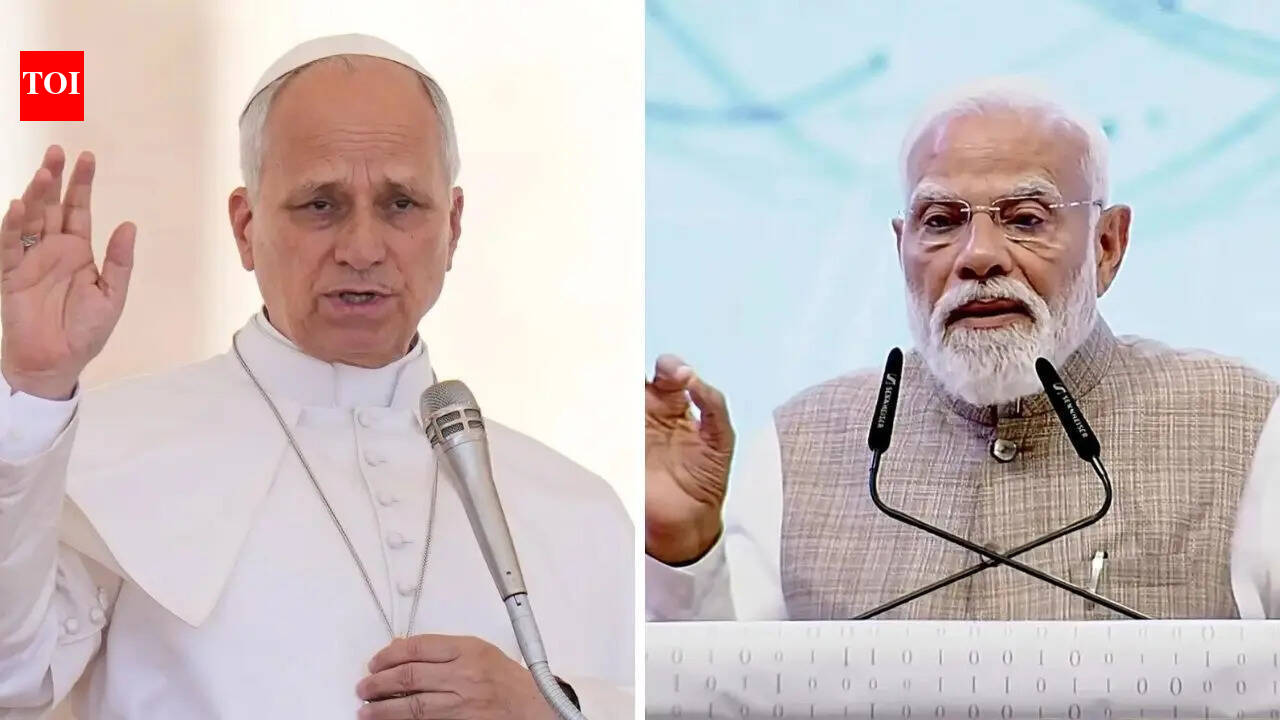
NEW DELHI: Pope Leo XIV’s first major moral reflection on artificial intelligence appears to closely echo Prime Minister Narendra Modi’s repeated calls for human-centric, ethical and inclusive AI governance, with both leaders warning that technology must serve people rather than reduce them to data, profit or power.In his encyclical Magnifica Humanitas: On Safeguarding the Human Person in the Time of Artificial Intelligence, Pope Leo XIV frames AI as one of the defining moral questions of the age. The document places human dignity, truth, justice, freedom, work and peace at the centre of the AI debate.PM Modi, in speeches at global forums including the GPAI Summit, the AI Action Summit in Paris and the India AI Impact Summit 2026, has advanced a strikingly similar argument: AI must remain trusted, safe, inclusive and directed towards public welfare rather than pure commercial or geopolitical competition.The strongest point of convergence is the idea that AI must remain centred on the human person rather than the machine.Pope Leo XIV writes, “In the era of artificial intelligence, when human dignity is threatened by new forms of dehumanization, ours is the pressing duty to remain profoundly human.”PM Modi has used almost identical framing in policy terms, saying, “Technology exists to serve humanity, not replace it.”At the India AI Impact Summit 2026, PM Modi described the central challenge as “how to make AI human-centric rather than machine-centric, sensitive and responsible rather than reckless.”The Pope’s warning that no machine can replace “the grandeur of humanity” closely mirrors PM Modi’s insistence that technology must enhance, and never override, human judgment and responsibility.The Vatican document repeatedly warns against a “culture of power” driving the AI race, particularly through concentration of data, compute and technological influence in the hands of a few corporations and states.Pope Leo XIV argues that “technology is never neutral” because it reflects the values and intentions of those who build, finance and regulate it. He also rejects the idea that ethics can remain a voluntary corporate principle without legal accountability.“It is not enough to invoke ethics in the abstract; robust legal frameworks, independent oversight, informed users and a political system that does not abdicate its responsibility are required,” the Pope writes, adding: “A more moral AI is not enough if that morality is determined by a few.”PM Modi has similarly argued that AI governance cannot be left solely to markets or technology companies.At the India AI Impact Summit 2026, he said: “Ethics in AI cannot be optional or limited. Profit must align with purpose.”The convergence is especially visible in how both leaders define the purpose of technology itself.Pope Leo XIV writes that technology can “heal, connect, educate and protect our common home,” but warns that it can also “divide, exclude and generate new forms of injustice.”PM Modi has repeatedly invoked the Indian civilisational phrase ‘Sarvajan Hitay, Sarvajan Sukhaye’, saying the end goal of technology should be “Welfare for All, Happiness of All.”For both, AI is not merely an efficiency tool or a race for technological supremacy. Its legitimacy depends on whether it improves health, education, agriculture, public services, climate action and last-mile welfare delivery.Equity and access form another major area of overlap.The Pope warns that when technological goods remain concentrated “in the hands of a few”, new imbalances are created, particularly for poorer societies and vulnerable populations.PM Modi has made a parallel argument from the perspective of the Global South. Speaking at the GPAI Summit in 2023, he warned that unequal access to technology had deepened inequalities in the previous century and said humanity must avoid repeating that mistake with AI.At the Paris AI Action Summit in 2025, PM Modi said, “Governance is also about ensuring access to all, especially in the Global South.”He also called for the Global Partnership on AI to become more inclusive of developing countries and their priorities.The two leaders are also aligned on the dangers of dehumanisation and the reduction of human beings into algorithmic categories.Pope Leo XIV cautions against “the pretense that a single language, even a digital one, can translate everything, including the mystery of the person, into data and performance.”PM Modi, in a strikingly similar formulation, warned that “AI must not reduce human beings to mere data points or raw material.”While the vocabularies differ — metaphysical on one side, developmental on the other — both reject the same reductionist logic: that human identity can be fully quantified, optimised or governed by machine systems.Both leaders also see risks in bias and exclusion embedded within AI systems that present themselves as objective.The Pope warns that AI can reinforce “the stereotypes or ideological bias of their designers and developers,” while hiding behind a “veneer of neutrality”.PM Modi has similarly argued for “quality data sets, free from biases”, warning that in a deeply diverse society like India, AI bias can emerge through language, culture, region, gender and socio-economic realities.At the Paris AI Action Summit, he used a simple example to illustrate the problem: if asked to generate an image of someone writing with their left hand, an AI system would most likely depict a right-handed person because that is what dominant training data reflects.The future of work is another point of overlap.The encyclical acknowledges widespread anxieties around automation, unemployment and de-skilling, warning that job loss is not merely an economic problem but one affecting dignity, families and the social fabric itself.Pope Leo XIV argues that every expansion of automation should be accompanied by protections for employment, retraining and worker participation.PM Modi has adopted a more transition-focused approach but arrives at a similar conclusion: “Loss of jobs is AI’s most feared disruption. But, history has shown that work does not disappear due to technology. Its nature changes and new types of jobs are created.”He has repeatedly argued that preparation, skilling and human-AI collaboration are the best safeguards against disruption.The convergence ultimately points to a broader global argument: AI governance cannot be left to a handful of companies or powerful states acting alone.Pope Leo XIV calls for “shared responsibility and courage” to ensure technology serves humanity rather than domination or exclusion.PM Modi has advocated a global compact on AI built around human oversight, safety-by-design, transparency and safeguards against deepfakes, terrorism and criminal misuse.His proposed MANAV framework — Moral and Ethical Systems, Accountable Governance, National Sovereignty, Accessible and Inclusive, and Valid and Legitimate AI — translates these principles into an Indian policy idiom.The Pope’s framework emerges from Catholic social teaching rooted in human dignity, solidarity, labour rights and the common good. PM Modi’s framework draws from democratic governance, developmental priorities and India’s civilisational ethos.Yet both interventions emerge from the same underlying anxiety: that artificial intelligence may outpace the moral and institutional frameworks needed to contain it.Together, the two visions suggest the emergence of a broader global consensus: AI must not become an instrument of domination, exclusion or dehumanisation. It must remain accountable to the human person.
