



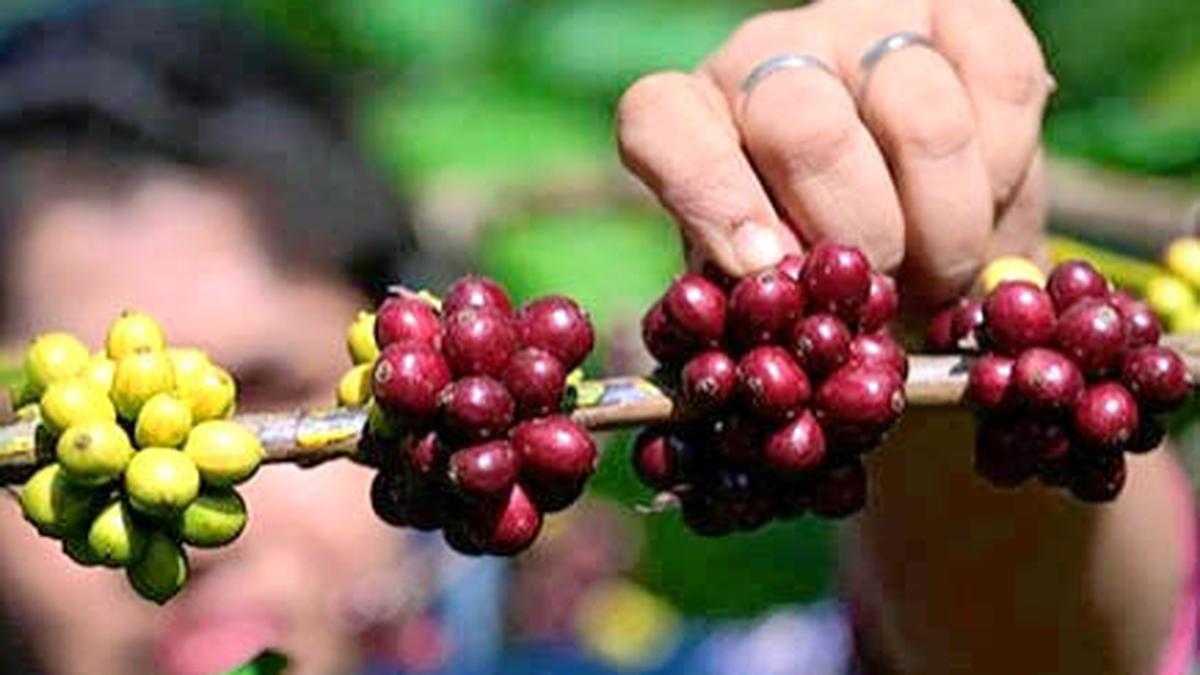
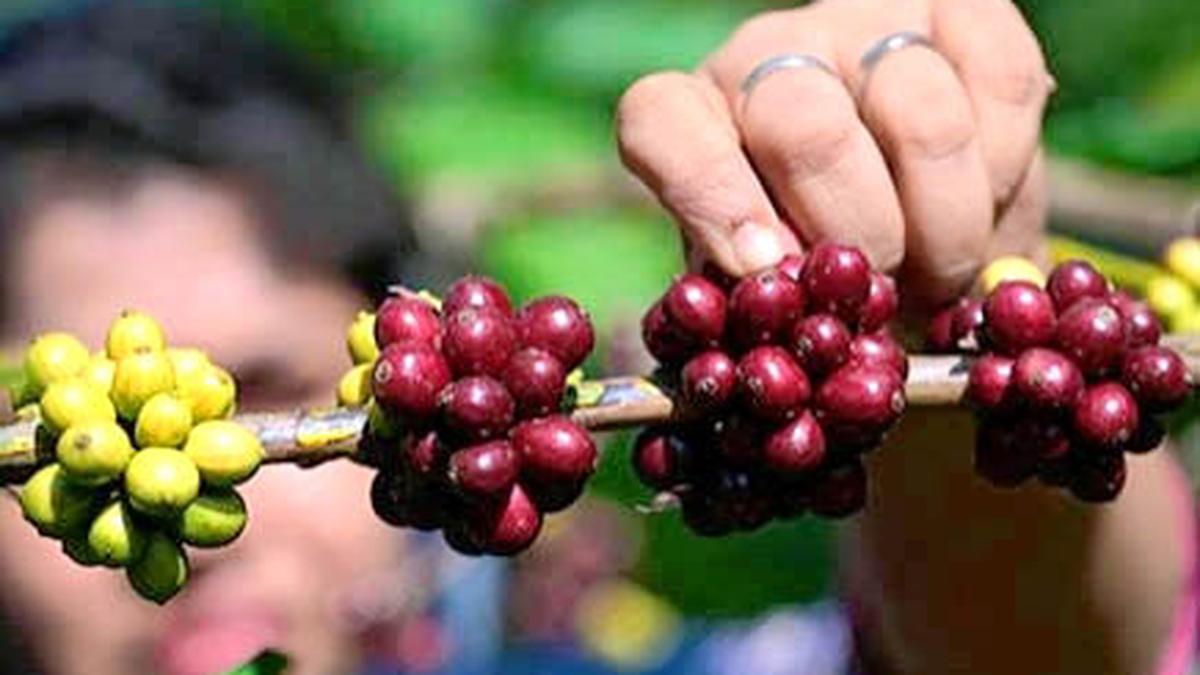
Harvest-ready coffee beans are seen at a plantation in Meppady, Wayanad, Kerala.
| Photo Credit: File photo
While the world’s coffee drinkers favour Arabica or Robusta, a newly identified hybrid called Coffea x libex (the X denotes its hybrid status) — or just Libex — could be their brew of choice in future.
The world drinks roughly 17,000 tonnes of Arabica and 10,000 tonnes of Robusta beans (pre-roasting) every day. Together, they account for more than 99.99% of global coffee production. However, they are susceptible to rising temperatures and erratic rainfall.
Libex on the other hand may be able to grow and crop in warmer temperatures and a wider range of rainfall patterns, according to new research by the Royal Botanic Gardens, Kew, in the U.K.
It was recently published in Scientific Reports.
This work builds on a 2025 study in Nature Plants that settled a longstanding botanical debate when it ‘proved’ that Liberica and Excelsa are distinct species rather than varieties of the same plant.

If Arabica harvesting is delayed, the cherries either over-ripen or dry and fall to the ground, where they get damaged and cannot be used.
| Photo Credit:
File photo
The research team investigated coffee samples from Central America, Africa, and Asia to quantify hybridisation between Liberica and Excelsa and to assess the hybrid’s potential to be cultivated in future.
While hybrids between these two species had long been inferred from their physical characteristics, their existence had not been confirmed using genomic evidence.
Better yield, outturn
The team analysed 113 individual plant samples and confirmed that Excelsa and Liberica had indeed been hybridised in cultivation. The team also reported that improved genotypes (sets of all genes) of these hybrids can be brought to production quickly using technologies like clonal propagation, micropropagation or by grafting to select rootstocks, such as those of Liberica or Excelsa.
The Indian version of Libex is a “delicious coffee,” Akshay Dashrath of the South India Coffee Company (SICC) and a study co-author, said. Material from the Malleshwara Estate near Ballupet in Hassan district, taken from trees planted between 1980 and 1982, was confirmed by Kew to be an Excelsa-Liberica hybrid.
SICC’s research division, called SICC Labs, contributed Indian samples and field expertise to the international study.
On the SICC site, Mr. Dashrath wrote that according to a leading coffee roaster in the U.K. with whom he works, “Early tastings of Libex reveal a balanced and approachable cup, blending tropical fruit notes from Liberica with chocolate and dried fruit depth from Excelsa.”
Traditionally, farmers grew Excelsa as a boundary marker in Indian coffee estates. This tree coffee can also be seen in some estates. Its value in the time of climate change is only just gaining ground.
Further, while Liberica is a low-yielding coffee, Mr. Dashrath said the Libex hybrid has better yield and outturn (the conversion ratio of fresh fruit to coffee beans), which is good news for farmers. Libex also has thinner pulp and parchment, which can make post-harvest processing more efficient and improve coffee quality relative to Liberica.
Finally, the study suggests Liberica can be farmed where Arabica and Robusta cannot.
Meena Menon is an independent journalist. She has a PhD from the University of Leeds.
Published – June 24, 2026 08:00 am IST

