



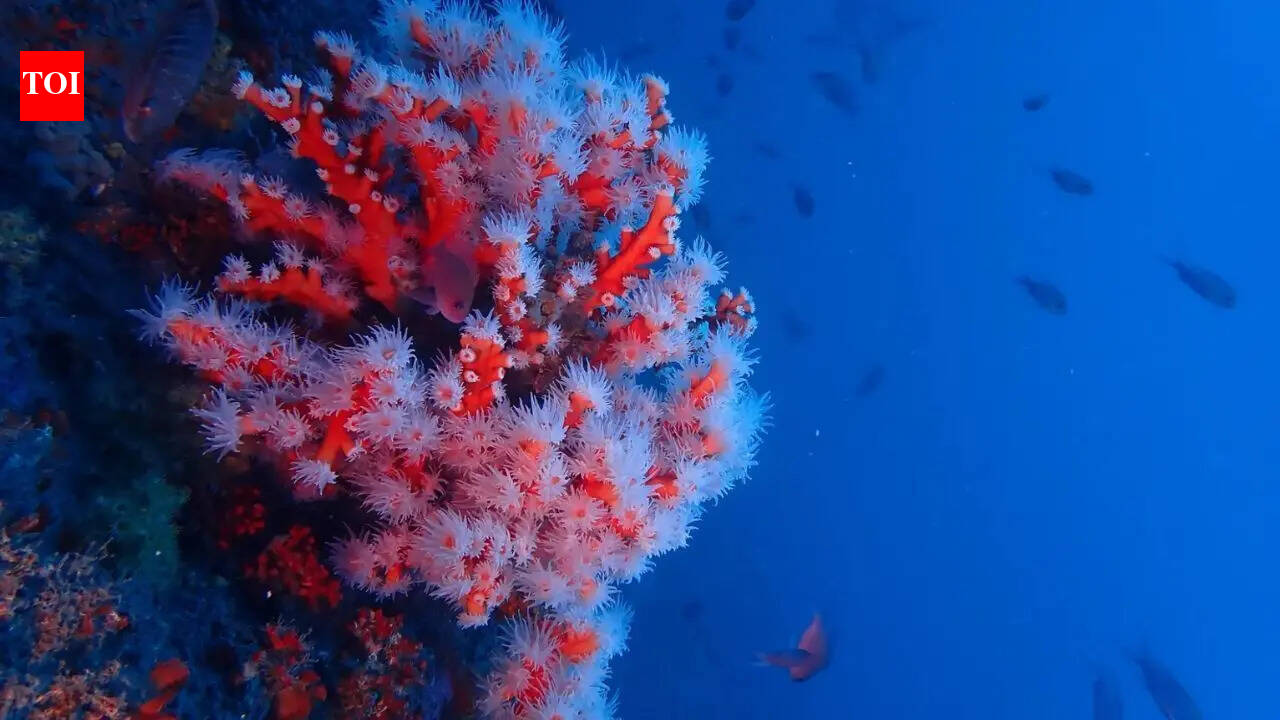
Deep-water expeditions in the Coral Sea continue to reveal how little of the ocean’s biodiversity has actually been documented. Areas that appear visually empty on sonar scans often contain dense biological communities once remotely operated vehicles descend to the seafloor. In several recent surveys, scientists working across reefs, seamounts and steep underwater slopes encountered species that had never been formally recorded before, including crustaceans, soft corals, molluscs and marine worms found at depths difficult to access through conventional diving.The researchers identified more than 1,121 potentially new marine species during expeditions in the Coral Sea and nearby Pacific waters. The findings emerged from collaborative work involving taxonomists, underwater imaging specialists and specimen collection teams operating from research vessels over multiple survey periods.
More than 1,100 Coral Sea species findings revealed unseen marine ecosystems
Much of the work focused on isolated underwater formations that receive little direct human attention despite supporting complex ecosystems. Seamounts in particular appear to function almost like biological islands. Their changing currents, temperature gradients and rocky surfaces create habitats where species can evolve separately over long periods.As per the Ocean Census report, scientists documented unfamiliar species of shrimp, sea spiders, bamboo corals and gastropods collected from depths ranging from a few hundred metres to several kilometres below sea level. Some organisms were identified immediately as unusual because of their body structure and colouration, while others required genetic examination after samples returned to laboratories.In deep-water environments, visual similarities can often be misleading. Marine animals that appear nearly identical externally sometimes turn out to belong to entirely different evolutionary branches once DNA sequencing is completed.
Scientists use DNA sequencing to identify new deep-sea coral species
Public announcements about “new species” usually arrive long before formal scientific naming is complete. Taxonomic verification remains slow because every specimen must be compared against historical records, museum collections and existing literature from different regions of the world.According to a study published in the Zoological Journal of the Linnean Society, titled “Single origin and convergent host use of hexactinellid sponge symbiosis in Hesionidae with descriptions of two new deep-sea species,” marine classification work increasingly combines physical examination with molecular analysis to distinguish closely related organisms. The paper describes how genetic sequencing has become important in separating species that traditional visual methods once grouped incorrectly.That process becomes more complicated in deep-ocean research because many species are fragile by the time they reach the surface. Some gelatinous organisms partially degrade during retrieval, leaving scientists dependent on video footage, tissue samples and microscopic structures for identification.
Coral Sea biodiversity research reveals vast, unexplored deep-sea ecosystems
The Coral Sea lies east of Australia and contains extensive reef systems, trenches and isolated submarine plateaus. Large sections remain poorly mapped biologically, even though the region has attracted scientific interest for decades. Ocean depth and difficult weather conditions have limited the number of detailed expeditions possible each year.Researchers involved in recent surveys have suggested that the region may contain far greater biodiversity than earlier estimates indicated. Certain species also appear highly localised, meaning they may exist only within restricted underwater zones shaped by temperature and current conditions.According to the Ocean Census report, some newly recorded organisms were discovered near environments already facing pressure from warming waters and changes in ocean chemistry. Scientists working on biodiversity cataloguing projects increasingly argue that species documentation has become urgent because ecological shifts may outpace formal classification work.
Scientists used robotic technology to study new marine species
Older deep-sea surveys depended heavily on dredging equipment that often damaged fragile marine life during collection. Current expeditions rely more frequently on remotely operated vehicles equipped with cameras, robotic arms and precision sampling tools that allow scientists to observe habitats before collecting specimens.Video imaging has also changed how marine ecosystems are studied. Behaviour, movement patterns and habitat interactions can now be recorded directly on the seafloor rather than inferred afterwards from damaged samples brought to the surface.As per the Zoological Journal of the Linnean Society paper, integrating morphological observation with genetic methods has improved accuracy in identifying species boundaries, particularly among marine invertebrates, where external variation can be minimal. This combination of field imaging and laboratory sequencing is gradually reshaping how ocean biodiversity is catalogued worldwide.
