




Pathikrit.Chakraborty
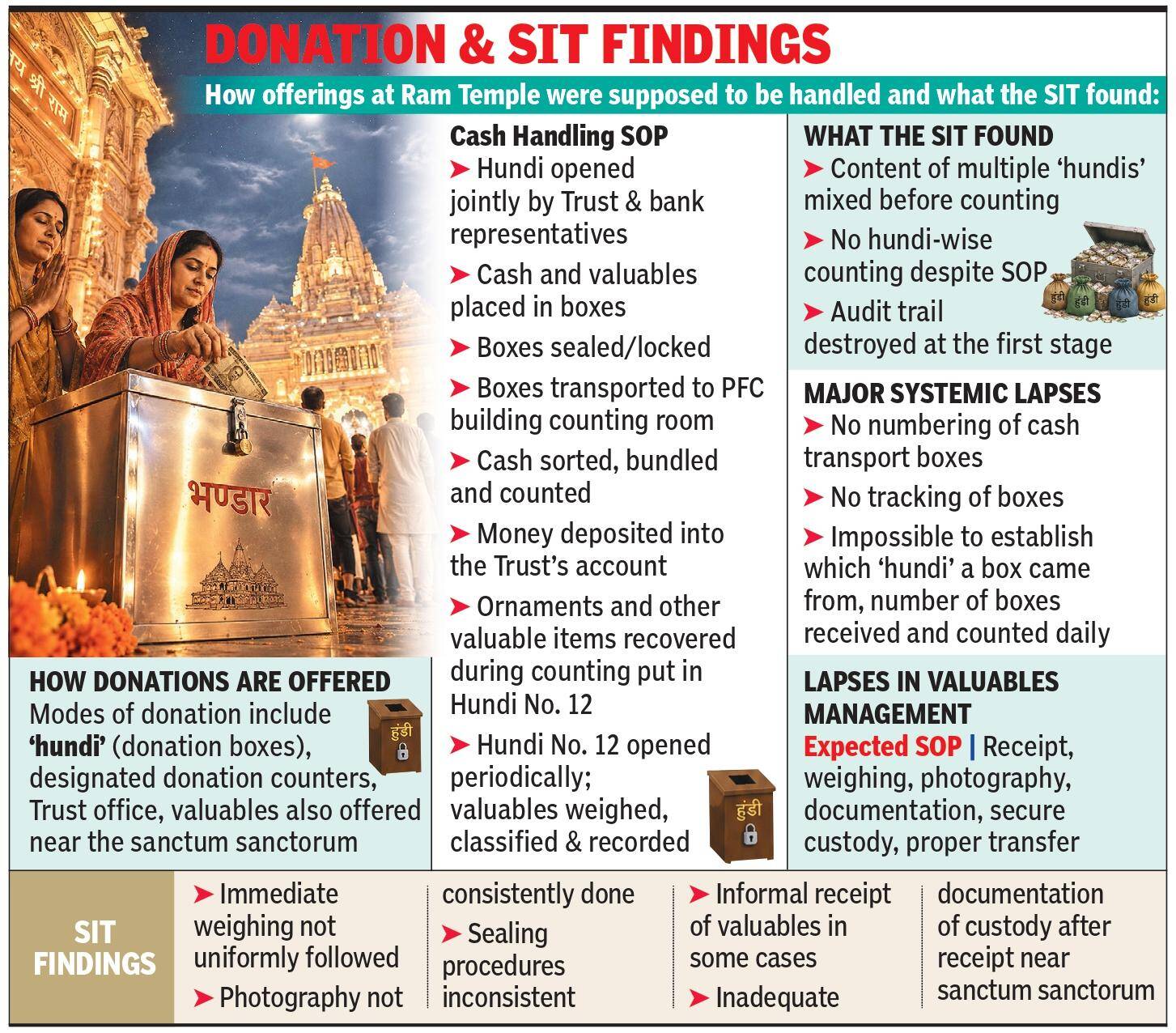
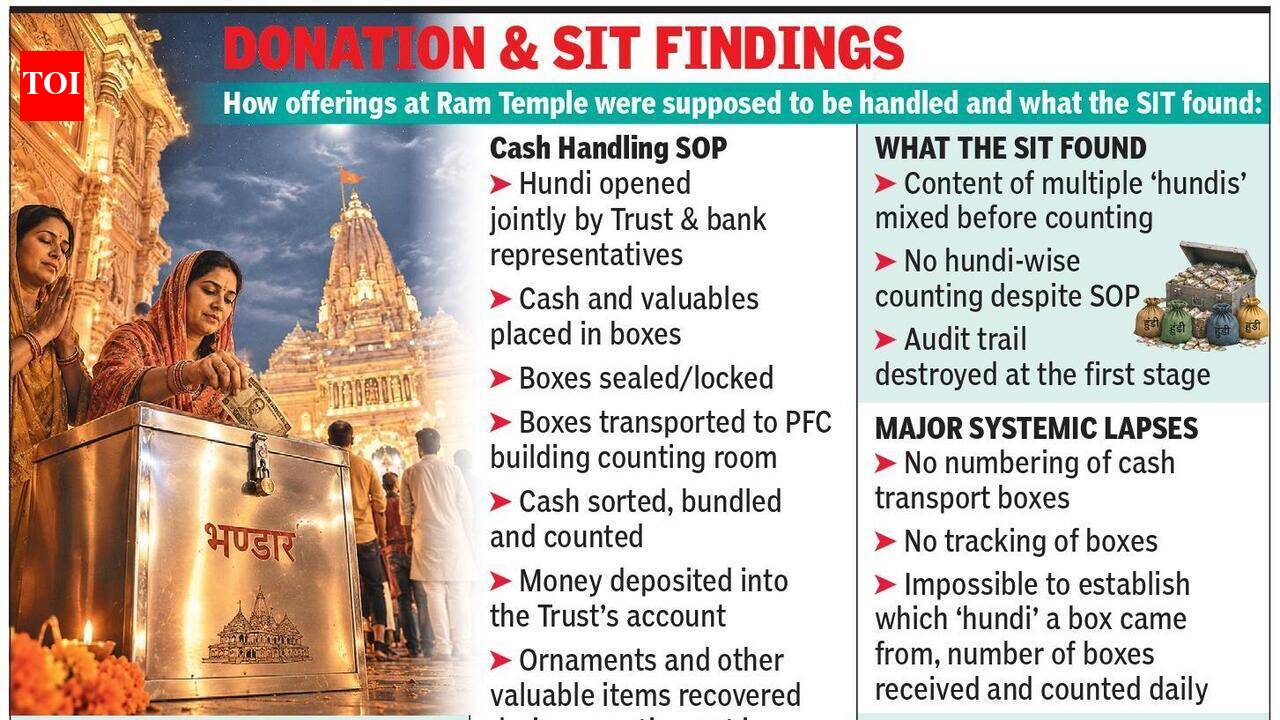
Lucknow: The SIT has identified major procedural deficiencies in the handling of cash donations and valuable offerings at Ram temple and claims that loopholes existed from the first stage of the collection process.According to the SIT report, devotees offer donations through three channels—cash and valuables deposited in hundis (donation boxes) installed on the temple premises, designated donation counters, and the Trust office.Under the prescribed system, cash collected from the hundis was to pass through a chain of custody. The SIT report states that the hundis were to be opened jointly by representatives of the Trust and SBI, after which the cash and other articles were placed in boxes, sealed or locked, and transported to the counting room located in the Pilgrim Facilitation Centre building.There, the cash was to be sorted, bundled and counted before being deposited into the Trust’s bank account.The SIT noted that any valuable items recovered during cash counting were required to be deposited in Hundi No. 12, which was to be opened jointly at regular intervals. The valuables were then to be weighed, classified and recorded with details of their type and weight.However, the investigation found serious shortcomings in the implementation of this process. Although the prescribed procedure required hundi-wise documentation and separate counting, investigators found that, in practice, the contents of multiple hundis were mixed before counting began, effectively eliminating the audit trail.The report also pointed to the absence of a proper numbering and tracking system for the cash boxes used to transport donations.Investigators found there was no mechanism to establish which boxes came from which hundi, how many boxes arrived on a particular day, how many were counted, or whether any remained unaccounted for.The SIT described this as a major weakness from the perspective of auditability and accountability, particularly considering the large volume of public donations received by the temple.The probe further found that systemic deficiencies extended beyond cash handling to the management of valuable offerings such as gold, silver and other precious articles.According to the report, devotees offer valuables through three routes—by depositing them in hundis, submitting them at designated counters, or offering them near the sanctum sanctorum. Each mode was expected to follow clearly defined procedures involving issuance of receipts, documentation, weighing, photography, secure custody and transfer.For valuables recovered from hundis, investigators were informed that a register was maintained. However, the SIT found that immediate weighing, photography and sealing of the articles at the initial stage were not uniformly followed.Similarly, while a receipt system existed for valuables deposited at designated counters, investigators found discrepancies in cases where devotees were brought through informal channels or where valuable items were received outside the prescribed procedure.The SIT found that records existed for offerings made near the sanctum sanctorum, but part of the process remained informal, with inadequate documentation of the custody and transfer of such offerings after their receipt.Investigators were informed that gold, silver and other valuable articles are stored in a locker located near the sanctum sanctorum, with entries maintained in a dedicated register.As part of the investigation, the SIT conducted a random physical verification of 11 valuable items recorded in the locker register and found them to be consistent with receipts generated through the Trust’s computerised system. However, the report noted that the investigation into the overall management of valuable offerings is still underway.
