



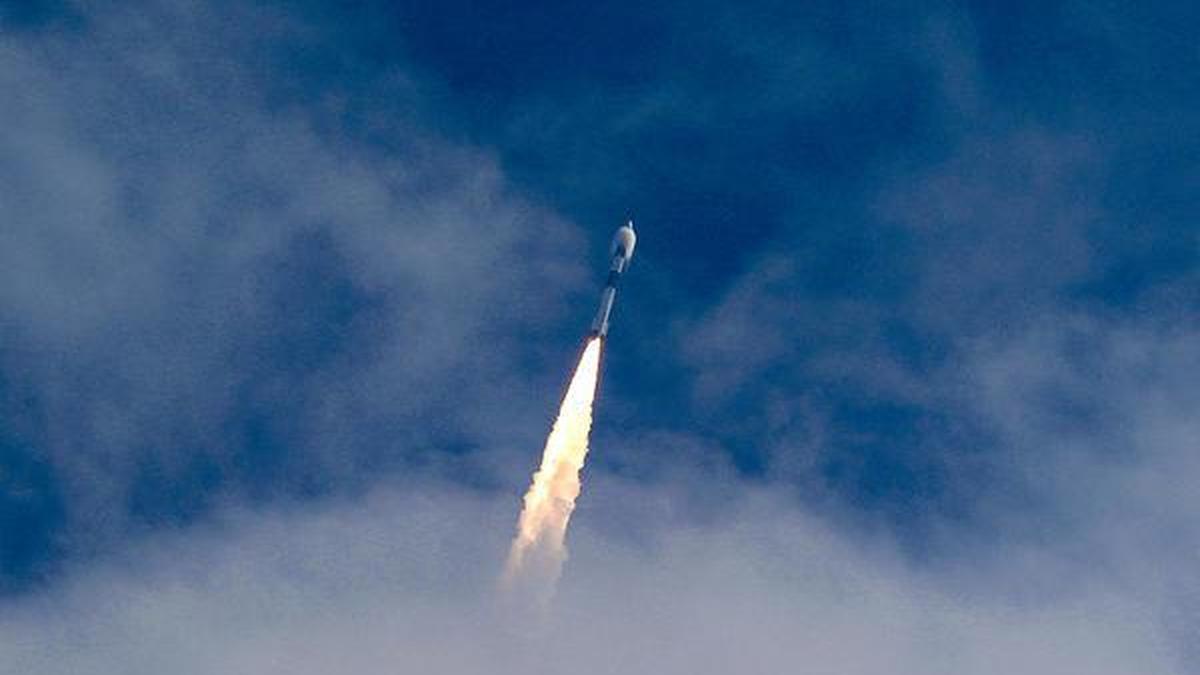

ISRO’s PSLV-C62 carrying the EOS-N1 lifts off from the Satish Dhawan Space Centre in Sriharikota, Andhra Pradesh. Photo: PTI
| Photo Credit: R SENTHILKUMAR
Launch Vehicle
A launch vehicle, commonly known as a rocket, is the powerful vehicle that carries a spacecraft from Earth into space. Its primary job is to generate enough thrust to overcome Earth’s gravity and place the mission on the correct path. Once it has completed this task, the rocket’s role ends.
What does it do?
-
Produces the enormous thrust needed for liftoff.
-
Carries the spacecraft and its payload through Earth’s atmosphere.
-
Places the payload into its planned orbit or trajectory before separating.

Photo: Wikimedia Commons
Examples
-
Polar Satellite Launch Vehicle (PSLV) – India’s reliable workhorse for launching satellites.
-
Launch Vehicle Mark-3 (LVM3, formerly GSLV Mk III) – Used for heavier payloads and India’s human spaceflight programme.
-
Falcon 9 – A reusable rocket that has significantly reduced the cost of space launches.
Did you know?
A rocket uses most of its fuel within the first few minutes after liftoff. To become lighter and more efficient as it climbs, many launch vehicles are built in stages, with empty sections separating and falling away once their fuel is exhausted.
Payload: Main purpose
The payload is the object that a space mission is designed to carry into space. In simple terms, it is the reason the rocket is launched. While the launch vehicle provides the ride, the payload performs the mission. Whether that’s studying Earth, exploring another planet, carrying astronauts, or conducting scientific experiments.
What can be a payload?
-
Depending on the mission, a payload can be:
-
A communication, weather or navigation satellite
-
A space probe sent to explore the Solar System
-
An orbiter that studies a planet or moon from above
-
A lander designed to touch down on a celestial body
-
A rover that moves across the surface
-
A crew capsule carrying astronauts
-
Scientific instruments or experiments

Indian Space Research Organisation (ISRO) releases an image of Chandrayaan-3 Vikram Lander clicked around 11 a.m. IST from about 15 m through a Pragyan rover’s navigation camera, hours after the release of its first image, which shows the lander resting on the moon’s surface.
| Photo Credit:
ANI
Examples
-
Chandrayaan-3 carried a payload consisting of the Vikram lander and Pragyan rover to the Moon.
-
James Webb Space Telescope is itself the payload launched aboard a rocket to observe the universe.
Did you know?
Two rockets may look almost identical on the outside, but they can carry completely different payloads. A single launch vehicle could send up a weather satellite on one mission, a Mars probe on another, or even astronauts on the next, depending on the mission’s objective.
Orbiter: The eye in the sky
An orbiter is a spacecraft designed to travel around a planet, moon or another celestial body without landing on its surface. After reaching its destination, it enters orbit and continuously circles the object, collecting valuable scientific data from above.
What does it do?
-
Maps the surface in great detail.
-
Studies the atmosphere, climate and magnetic field.
-
Captures high-resolution images of the terrain.
-
Searches for minerals, water or ice deposits.
-
Relays data and commands between Earth and landers or rovers when direct communication isn’t possible.

Mangalyaan
Examples
-
Mars Orbiter Mission (Mangalyaan) studied Mars’ surface features, atmosphere and mineral composition while orbiting the Red Planet.
-
Lunar Reconnaissance Orbiter has been mapping the Moon since 2009, helping scientists identify potential landing sites and study its surface in unprecedented detail.
-
Chandrayaan-2 Orbiter continues to circle the Moon, collecting scientific data years after its launch.
Did you know?
Orbiters often outlive the rest of a mission. While a lander or rover may operate for weeks or months, an orbiter can continue circling its destination for years, building a long-term picture of how a planet or moon changes over time.
Lander: First to touch down
A lander is a spacecraft designed to make a controlled, soft landing on the surface of another celestial body, such as the Moon, Mars or an asteroid. Unlike an orbiter, which remains in space, a lander reaches the surface and operates from a fixed location to carry out scientific investigations.
What does it do?
-
Makes a safe landing on the target surface.
-
Studies the local environment using onboard scientific instruments.
-
Collects data on rocks, soil, temperature and, where possible, the atmosphere.
-
Sends its findings directly to Earth or through an orbiter acting as a communication relay.
-
In some missions, deploys a rover to continue exploration beyond the landing site.

Philae
Examples
-
Vikram successfully achieved India’s first soft landing on the Moon in 2023 and carried out experiments near the lunar south polar region.
-
InSight studied the interior of Mars by measuring marsquakes and monitoring the planet’s heat flow.
-
Philae became the first spacecraft to land on the surface of a comet in 2014.
Did you know?
Landing on another world is one of the most challenging phases of any space mission. Spacecraft must slow down from thousands of kilometres per hour and touch down safely using engines, parachutes, airbags or other landing systems–often without any real-time control from Earth because of the communication delay.
Rover: The surface explorer
A rover is a robotic vehicle designed to move across the surface of another planet, moon or other celestial body after being deployed by a lander. Unlike a lander, which stays in one place, a rover can travel to different locations, allowing scientists to study a much larger area and investigate features that cannot be reached from a single landing site.
What does it do?
-
Travels across the surface using wheels or other mobility systems.
-
Studies rocks, soil and the surrounding environment.
-
Collects images, measurements and scientific data.
-
Searches for clues about water, minerals or signs that a planet may once have supported life.
-
Sends its findings back to Earth, either directly or through an orbiter.

This NASA photo released June 7, 2018 shows a low-angle self-portrait of NASA’s Curiosity Mars rover vehicle at the site from which it reached down to drill into a rock target called “Buckskin” on lower Mount Sharp. Photo: AFP
| Photo Credit:
HANDOUT
Examples
-
Pragyan explored the lunar surface near the Moon’s south pole, analysing the composition of rocks and soil after India’s historic soft landing.
-
Perseverance is searching for signs of ancient microbial life on Mars and collecting rock samples that could one day be returned to Earth.
-
Curiosity has been exploring Mars since 2012, studying its geology and gathering evidence that the planet once had conditions suitable for life.
Did you know?
Mars rovers are not driven like remote-controlled cars because radio signals can take several minutes to travel between Earth and Mars. Instead, scientists send a set of instructions, and the rover carries them out on its own using onboard computers to navigate safely around rocks, slopes and other obstacles.
Every mission is like a well-coordinated team, with each part playing a vital role in expanding our understanding of the universe. That’s what World Space Exploration Day celebrates.
Published – July 20, 2026 10:38 am IST
