



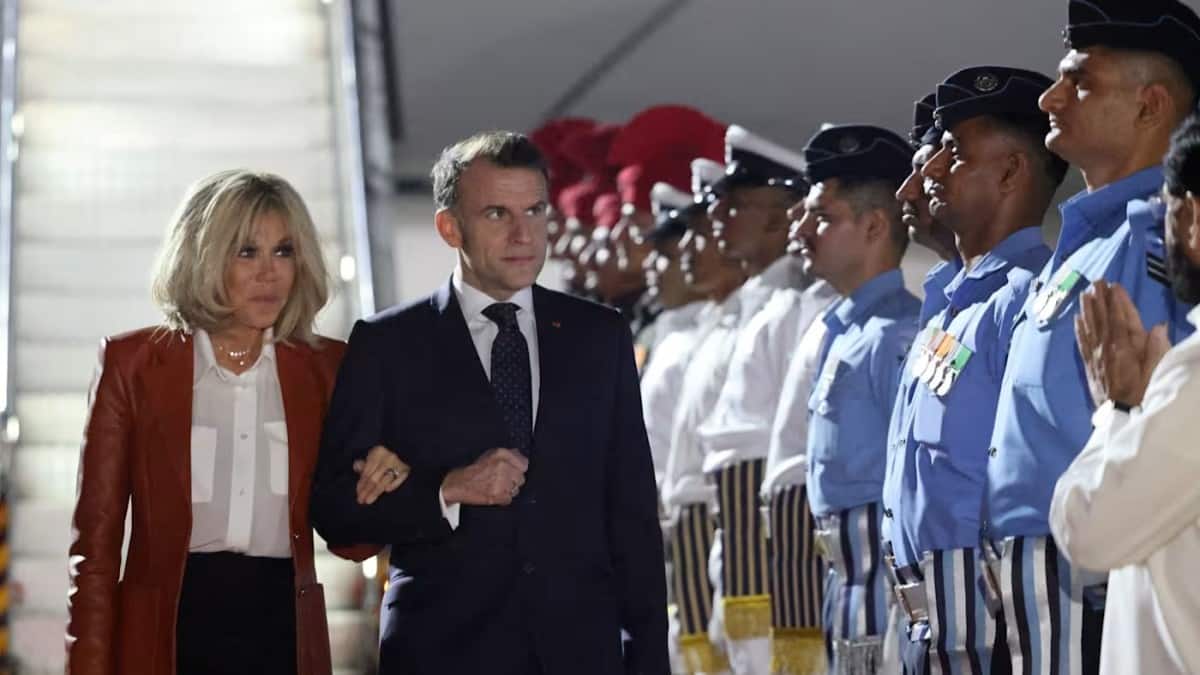
French President Emmanuel Macron has landed in India for his official visit from February 17 to 19. During the visit, Macron and PM Narendra Modi will hold discussions on strengthening bilateral cooperation across a wide spectrum of areas as enshrined in the Horizon 2047 Roadmap. In addition, the leaders will discuss regional and global issues of mutual interest, including cooperation in the Indo-Pacific. The two leaders will also be in Mumbai to jointly inaugurate the India-France Year of Innovation, which will be celebrated throughout 2026 in both countries. On February 19, President Macron will participate in the AI Impact Summit in New Delhi. These events and interactions will further strengthen the great bonhomie between the two friendly nations and strategic partners and the chemistry between the leaders.
Macron’s visit, though coinciding with the AI Summit, will focus on military-industrial cooperation, with France expected to further enhance India’s defence capacities and capabilities. There are plans to move forward in many areas of cooperation, ranging from defence and security to energy. There will be emphasis on making aircraft engines, as well as cooperation in space. The loudest buzz is about the aviation deals.
The visit comes on the back of the Indian Ministry of Defence (MoD) clearing a proposal to buy and make-in-India 114 Rafale fighter jets from France’s Dassault Aviation for 3.25 trillion Indian rupees ($28 billion) on February 12. This reflects growing strategic cooperation between India and France, creating jobs, boosting indigenous capabilities, and reducing dependence on imports. It marks another step towards self-reliance in the defence sector while enhancing India’s global manufacturing profile. Having granted the Acceptance of Necessity (AoN), the project moves to the crucial stage of issuing the Request for Proposal (RFP), followed by technical evaluation and commercial negotiations. As a major acquisition, final approval will be by the Cabinet Committee on Security (CCS), headed by the PM.
The new induction is aimed at arresting the steady decline in the Indian Air Force’s (IAF) fighter squadron strength. More recently, there have been reports that India may order an additional 31 Rafale Marine fighter jets for the Indian Navy, over and above the 26 already contracted in April 2025 in a $7.4 billion agreement.
Horizon 2047 India-France Document
The Horizon 2047 document for the India-France Strategic Partnership has spelt out many core partnership areas. The development of a self-reliant defence industrial technological base, with special emphasis on aeronautics, is a high priority. Collaboration between naval dockyards is being driven. Cooperation in space is at the heart of the strategic relationship, and the two will continue to engage through the recently institutionalised bilateral strategic space dialogue. In view of the French territories of New Caledonia and French Polynesia, close cooperation in the Indo-Pacific will be important. India and France have always stood together with each other in the fight against terrorism.
The two recognise the importance of reinforcing their strategic partnership in the scientific field. Critical technology cooperation includes cyber security and advanced digital technologies such as artificial intelligence and quantum. Progress related to the Jaitapur Nuclear Power Project (JNPP) will be reviewed. Establishing a partnership on low- and medium-power modular nuclear reactors is being worked out. Strengthening energy security to meet climate objectives has been flagged. Supporting urban and ecological transitions in India, as well as social inclusion, is on the joint agenda. India and France are committed to strengthening their academic ties and fostering exchanges of students.
The Time-Tested Military Aviation Connection
In the mid-1950s, India acquired over 100 French Dassault Ouragans (Indian name: Toofani). In 1957, India ordered over 100 Dassault Mystere IVAs and used them extensively in the Indo-Pakistani War of 1965. Twelve Breguet Alize, French carrier-based anti-submarine warfare aircraft, were acquired by the Indian Navy and operated from the aircraft carrier Vikrant. The Aerospatiale Alouette III, a single-engine, French light utility helicopter, was manufactured under licence by HAL as ‘Chetak’. Two more versions, the lighter ‘Cheetah’ and the re-engined ‘Cheetal’, were later developed for high-altitude operations, including at the Siachen Glacier.
IAF purchased the British-led, Anglo-French Jaguar Deep Penetration Strike Aircraft (DPSA) in the late seventies. The IAF later bought Mirage 2000s in the 1980s. The Mirage 2000 was the first fly-by-wire-controlled aircraft of the IAF. Its weapon-integrated multi-mode radar gave the IAF look-down/shoot-down capabilities. The aircraft also brought the IAF’s first Beyond Visual Range (BVR) and all-aspect close-combat-capable missiles. IAF also got the first comprehensive EW suite with the aircraft.
The Mirage 2000 performed exceedingly well in the 1999 Kargil conflict. The battle took place over some of the highest terrain in the world, where both the aircraft and weapons were pushed to the edges of their envelope. Laser-guided bombs were used against reinforced targets. Over the years, a very high sortie generation rate made the Mirage 2000 one of the most efficient fighters of the IAF. The aircraft was later upgraded to the Mirage 2000-5 Mk 2 standard and received improved avionics, a glass cockpit, and smarter weapons. The Mirage 2000 was the platform of choice for the Balakot Strike in 2019, where it hit targets with the Spice-2000 precision glide bombs.
India’s Current Fighter Aircraft Urgency
As of now, the IAF has only 29 fighter aircraft squadrons against an authorised strength of 42.5, a gap aggravated by delays in indigenous programmes. The IAF thus needs additional fighter aircraft. Meanwhile, the US has recently cleared a $686 million upgrade package for Pakistani F-16 fighter jets, which will extend the life of the Pakistani F-16 fleet until 2040. China already has nearly 400 J-20 fifth-generation fighters. Pakistan is operating J-10C fighters armed with PL-15 long-range beyond-visual-range (LR-BVR) missiles. The Pakistan Air Force (PAF) has sought to acquire the Chinese J-35 fifth-generation aircraft. With China and Pakistan working in collusion, and by adding and modernising their fighter fleets, regional military balances are undergoing significant transformation.
The IAF’s Multi-Role Fighter Aircraft (MRFA) programme is meant to acquire 114 advanced fighter jets to replace ageing fleets and bolster squadron strength. There were eight contenders who responded to the Request for Information (RFI) that was formally sent out in April 2018. Any detailed selection process would require time. The Rafale has been tried and tested in various exercises and more recently on “Op Sindoor”. Rafale would allow continuity and avoid adding another fleet. A government-to-government (G2G) deal could be signed quickly, as the price identification already exists. Adding 114 aircraft to the 26 Rafale-Marine (M) for the Indian Navy and the additional 31 being contemplated would make a viable figure for ‘Make in India’ and establish a full assembly line.
The Rafale has been used in combat over Afghanistan, Libya, Mali, Iraq, and Syria. The aircraft supports India’s dominance in both the Himalayas and the Indian Ocean Region (IOR). They have recently flown extended-range deep-sea missions and are regularly operating over the Himalayas.
Broad Rafale Deal Contours
The IAF already has 36 Rafale jets. The Rafale-M has 95 per cent commonality with IAF fighters, ensuring a very high degree of interoperability. The proposed 114 aircraft deal will include 88 single-seat and 26 twin-seat variants. The deal is likely to include 18 jets in fly-away condition, with the remaining 96 to be manufactured domestically, boosting India’s defence manufacturing under the Make-in-India initiative with up to 60 per cent indigenous content. The jets will likely be assembled at a final assembly line expected to be established in Nagpur. The IAF’s current Rafales are F3R standard. Ninety of the new aircraft will be Rafale F4 multi-role fighters, with the remaining 24 likely to be next-generation Rafale F5 variants. The deal will include Scalp and advanced variants of Meteor missiles.
Rafale F4/5: A Big Leap Forward
The Rafale is considered a 4.5-generation fighter. The IAF currently operates the F3R customised for the Indian aircraft standard. The 36 Rafale jets cost €7.87 billion ($8.5 billion) in the 2016 deal. It was a G2G contract prioritising speed and political assurance. The platform combined air superiority, deep strike, nuclear delivery, and electronic warfare roles. During Op Sindoor, the Rafale’s survivability and the integration of long-range stand-off munitions, electronic attack, and real-time data fusion were demonstrated and appreciated.
The F4 standard brings improved onboard processing, external connectivity, and an upgrade of the Thales Spectra self-defence system. The radar and sensor upgrades facilitate the detection of airborne stealth targets at long range. It is more effective in network-centric warfare. The first F4-standard aircraft was delivered to the French Air and Space Force (FASF) in 2023. The UAE is the first foreign customer of the F4. The F4 will give enhanced survivability and sensor-fusion-based dominance in highly contested environments. The aircraft will be able to integrate Indian systems and weapons such as the Astra Mk-2 BVR AAM. The Indian proposal envisages 90 Rafale F4 aircraft, with deliveries beginning around 2029.
Dassault and its partners are already working on the F5 standard, which will be ready around 2030. The F5 will share some features with the next-generation European aircraft. The F5 standard will have new sensors, armaments, and a faster and more secure ability to communicate and collaborate. The aircraft will have a much better electronic-warfare suite, with advanced capability for Suppression or Destruction of Enemy Defences (Sead/Dead), using the latest jamming systems and anti-radiation weapons. All this will greatly improve penetration in contested environments. The Rafale F5 will also act as a sensor truck with data fusion and processing abilities, allowing it to serve a tactical flying command post role. The F5 is envisioned to bridge fifth- and sixth-generation capabilities. The “Super Rafale” will also be modified to carry hypersonic, nuclear-capable, guided missiles.
F5 deliveries were initially planned to start in 2029, but discussions are underway to deliver them starting in 2027. France continues to see a market for the Rafale F5 for countries unable to acquire the F-35 due to geopolitical reasons. The Rafale is distinct from other European fighters because it is almost entirely built by one country, with Dassault (airframe), Thales (avionics and EW), and Safran (aero-engine) covering all the major systems. The Rafale also has a carrier-based maritime variant. French officials had reportedly also considered equipping the Rafale to launch small satellites.
The likely Indian deal envisages 24 Rafale F5 jets, with deliveries starting around 2030. The F4 aircraft may also be upgraded later. The Rafale would become a cornerstone of India’s operational credibility and deterrence. The Rafale is planned to be the FASF’s primary combat aircraft until at least 2040.
Make in India: Fuselage and Aero-Engine
Tata Advanced Systems Limited (TASL) and Dassault Aviation are partnering to manufacture Rafale fighter jet fuselages in India, marking the first time this critical component is produced outside France. The production facility, located in Hyderabad, is expected to start producing fuselages by the 2027–28 financial year. This initiative supports the “Make in India” programme, with the capacity to manufacture up to 24 fuselages annually.
India already has experience in the manufacture, overhaul, and maintenance of the French Turbomeca Artouste IIIB and the HAL/Turbomecca TM 333-2M2 Shakti engines for helicopters. The Mirage 2000 was initially powered by the M53-5 and later with the more powerful M53-P2. These are being fully maintained and overhauled in India.
France’s Safran is establishing a dedicated facility in Hyderabad, India, for the maintenance, repair, and overhaul (MRO) of the M88 engines used in the Rafale fighter jets. India’s future fighter fleet will not only be a military asset but also a central pillar of the country’s operational capabilities and national strategy. French aerospace company Safran and India’s DRDO have joined forces to develop India’s first jet engine with Indian intellectual property rights (IPR). Safran will transfer 100 per cent of the technology to DRDO, including that for crystal blades. The joint project between Safran and India’s Gas Turbine Research Establishment (GTRE), a DRDO lab, will develop and produce a 120-kilonewton (kN) engine, which will power India’s Advanced Medium Combat Aircraft (AMCA). Later engine variants will have up to 140 kN.
Safhal Helicopter Engines, a joint venture between Safran Helicopter Engines and Hindustan Aeronautics Limited (HAL) based in Bangalore, focuses on designing, developing, producing, and supporting new-generation helicopter engines in India. The partnership primarily aims to power the 13-ton Indian Multi-Role Helicopter (IMRH) and the 12.5-ton Deck-Based Multi-Role Helicopter (DBMRH) with the new Aravalli engine.
Rafale Current Production Rate
In 10/2025, Dassault hailed the production of its 300th Rafale. As of late 2025, there have been 533 firm orders for the Rafale, with France and export customers, including India, Egypt, Qatar, Greece, Croatia, the UAE, Serbia, and Indonesia. Of these, 233 are still to be delivered. There are more countries showing interest. When the 114 and 31 Rafale-M aircraft deals go through, the numbers will be even more significant.
Until a year ago, the Rafale production rate was 2 aircraft a month (24 per year). It has now been increased to 3 per month (36 per year), with a plan to increase to 4 per month (48 per year) to handle a growing backlog of orders. This is a significant increase from previous years and is supported by expansion at the Mérignac factory and new facilities in Cergy-Pontoise. Dassault has already planned to make Rafale fuselages in India. With an increased Indian order, a full assembly line can be created in India. This would give a great boost to total production and lower costs. Dassault could thus source and supply India-made Rafale jets for global customers. Such a plant would also expand India-France options for future aircraft.
Indo-French Air Exercises
The Exercise ‘Garuda’ series with the FASF began in 2003 at an IAF airbase in Jodhpur. Subsequently, exercises were held in 2005, 2006, 2010, 2014, 2019, and 2022. The other locations included Istres and Mont-de-Marsan in France and Kalaikunda in India. Both sides fielded top-end combat assets. The joint exercises were meant to augment “operational capability and interoperability, while also sharing best practices.” In August 2022, a contingent of the FASF made a strategically important stop at the IAF’s Sulur base in Tamil Nadu on their way to Exercise Pitch Black 2022 in Australia.
The 8th edition of Exercise Garuda (Garuda 25) concluded on November 27, 2025, at Mont-de-Marsan, France, featuring intensive joint operations between the IAF and the French Air and Space Force (FASF). The exercise focused on advanced air-to-air engagements, air defence, and complex strike missions to enhance interoperability, featuring IAF Su-30MKI fighters alongside French Rafale and Mirage 2000 jets.
Airbus in India
France is a major stakeholder in Airbus Industries. Airbus’ relationship with India is 50 years old, with the delivery of the first Airbus A300 twin-aisle aircraft to Air India. The A320 Family is flying with many airlines, with Delhi being the world’s busiest A320 airport. About 500 aircraft are on order. Air India has ordered the acquisition of 40 next-generation A350 aircraft. Airbus Helicopters has had a 35-year partnership with Pawan Hans Limited (PHL), which inducted the first AS365N/N3 Dauphin in its fleet in 1987. It is the largest civil customer in the world for Airbus Dauphin helicopters. Airbus’ India Engineering Centre was established in 2007 in Bengaluru and now has a strength of more than 700 engineers.
To Summarise
India’s capability to make world-class aero-structures has been proven with cabins for the Apache AH-64, the Sikorsky S-92 helicopter, and the Lockheed Martin C-130J Super Hercules aircraft. India also makes Lockheed Martin F-16 wings. India manufactures the entire indigenous LCA. Making the Rafale in India will work out much cheaper for France.
Made in India, F4 and F5 will help India’s AMCA programme, which will also imbibe sixth-generation technologies. India will insist on achieving over 60 per cent indigenous content at the earliest. The same will be possible, as the fuselage and many subsystems and components will be made in India. Dassault Aviation has already partnered with Tata Advanced Systems Limited to manufacture Rafale fuselage sections in Hyderabad, with a targeted production of up to 24 airframes annually. The proposed Maintenance, Repair, and Overhaul (MRO) facility in India would substantially reduce lifecycle costs, improve tarmac availability, and mitigate supply chain complexities.
Traditionally, India and France have enjoyed an exceptionally warm relationship, which is the fruit of deep affinities and the unwavering trust between the two countries since India’s independence. France is considered the most reliable Western “friend”. It will make better operational and economic sense for India to acquire the latest variants, F4 and F5, in a G2G deal and make them in India. A lot of time has been lost. The time to act is now, lest we get “OBE” (overtaken by events) in our neighbourhood.
(The writer is former Director General, Centre for Air Power Studies. Views expressed in the above piece are personal and solely those of the author. They do not necessarily reflect Firstpost’s views.)
End of Article
