



Every year, when school gates open to a new academic session, India witnesses one of its most profound acts of collective resolve. Across mountains and coasts, in cities and remote villages, millions of children — sometimes in spite of challenging personal circumstances — step into their classrooms with fresh vigour, new aspirations and immense possibilities. It is a quiet yet powerful national moment. This year, too, nearly 2 crore children have enrolled in Class I, which carries both hope and a shared national responsibility.
The National Education Policy, 2020 has placed curiosity, understanding and holistic development at the centre of learning, moving beyond rote memorisation. Every academic year is a meaningful step forward in realising that vision.

With the implementation of Balvatika, early childhood learning is now integrated into the formal school system, ensuring children enter Grade I with better readiness and strong foundational skills. A child’s entry into school marks the beginning of a lifelong relationship with knowledge and society; schools must ensure this journey is rooted in joyful learning, well-being and a strong sense of belonging.
The first day of school is seldom uneventful. It carries a mix of hesitation and joys of new beginnings. Tiny hands hold big emotions and curious eyes capture a whole new world. When children feel safe and valued, they begin to open up. They participate more. Their curiosity begins to flourish. Confidence grows slowly, but steadily. The early years must centre on play, exploration and discovery, and define the beginning of a lifelong journey.
Relationships matter deeply. A caring teacher can change a child’s path. A supportive classroom can turn silence into participation, and participation into confidence. When a child feels truly seen and heard, curiosity turns into courage. A child who feels a sense of belonging begins to find her voice.
At the heart of these early years lies a strong national commitment to foundational literacy and numeracy. Through the NIPUN Bharat Mission, India has set a clear goal: Every child should be able to read with understanding and perform basic arithmetic by the end of Grade II. The focus shifts from memorising answers to understanding concepts. Classrooms must inspire children to ask questions, not just reproduce answers.
This vision goes beyond academics. Arts, sports and values are essential parts of the learning process. Education must shape the “whole child” — not just the mind, but also the body and the heart. Physical activity and nutrition are integral to everyday school life. A healthy child learns better, participates more and grows with a healthy sense of confidence.
Globally, the lifestyles of children have shifted significantly. Changing dietary habits and reduced physical activity have become a concern across nations. India is responding proactively to this challenge. Measures such as mandatory physical education, “oil boards” and “sugar boards” in schools to address obesity and a strengthened PM-POSHAN scheme with a sharper focus on nutritional quality are reorienting schools toward health and active living. These efforts aim to build a generation that values health as central to overall development.
While technology is a powerful enabler for access and learning, growing exposure to social media raises concerns around screen time, attention and mental well-being. Again, this is a global concern and not unique to India. Schools and families must ensure it is used as a tool for learning, not distraction.
Equally central to this vision is the mental and emotional well-being of our children. The school curriculum and pedagogy have integrated socio-emotional learning to support the child’s journey in an age when children are navigating a more complex and stimulating world than any previous generation. Creating safe, stress-free environments requires a shared effort by schools, parents, teachers and communities.
Reform does not reach children merely through policy documents; it is implemented through teachers. They are the true architects of educational transformation, bridging the gap between vision and classroom reality. Teachers must teach in a multilingual setting and also ensure that a child’s mother tongue is respected and used as a powerful tool for learning. By valuing this, we ensure that the transition to formal education is seamless, confident, and rooted in their own identity.
I call upon our teachers to prioritise competency-based learning while respecting each child’s pace and personality and remaining attentive to the emotional and mental well-being of every student under their care.
Education does not begin or end at the school gate. The home is the first classroom, and parents are the first teachers. What children experience at home shapes how they learn in school.
Promoting reading habits and patient engagement with a child’s questions are subtle acts to nurture the quest for knowledge. I urge parents to ensure that children get balanced nutrition and adequate sleep; that they get enough daily physical activity and outdoor exposure. Parents must engage actively with the school and measure the child’s success not only in grades, but in confidence, kindness and a sustained interest in learning. The greatest gift the parents can give a child is the belief that learning itself is truly joyful.
Education is a shared responsibility. It belongs to governments, schools, teachers, parents and communities. Every stakeholder has a role to play.
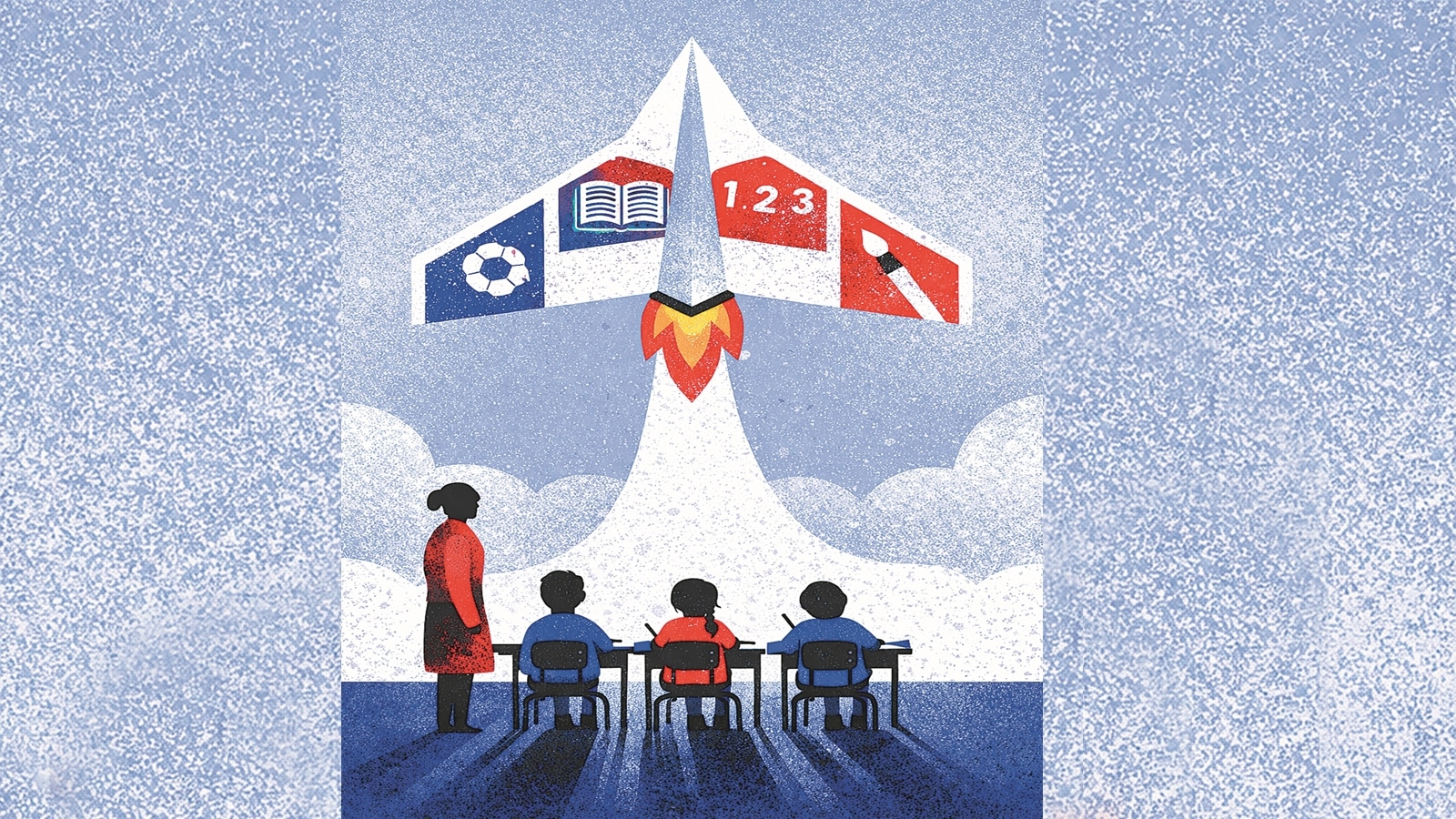
Every child deserves to be seen, heard and gently guided in their learning journey. The true measure of our education system is not a few high achievers but whether every child regardless of background, learns with confidence and joy. Let us reaffirm our national commitment to building an education system that is inclusive, innovative and future-ready. Together, we can ensure that every classroom becomes a place where dreams take flight and where the leaders of tomorrow are shaped. The harbingers of a Viksit Bharat by 2047 are in our classrooms today. Let us give them the golden wings to soar.
The writer is Minister of Education, Government of India. Views are personal

