



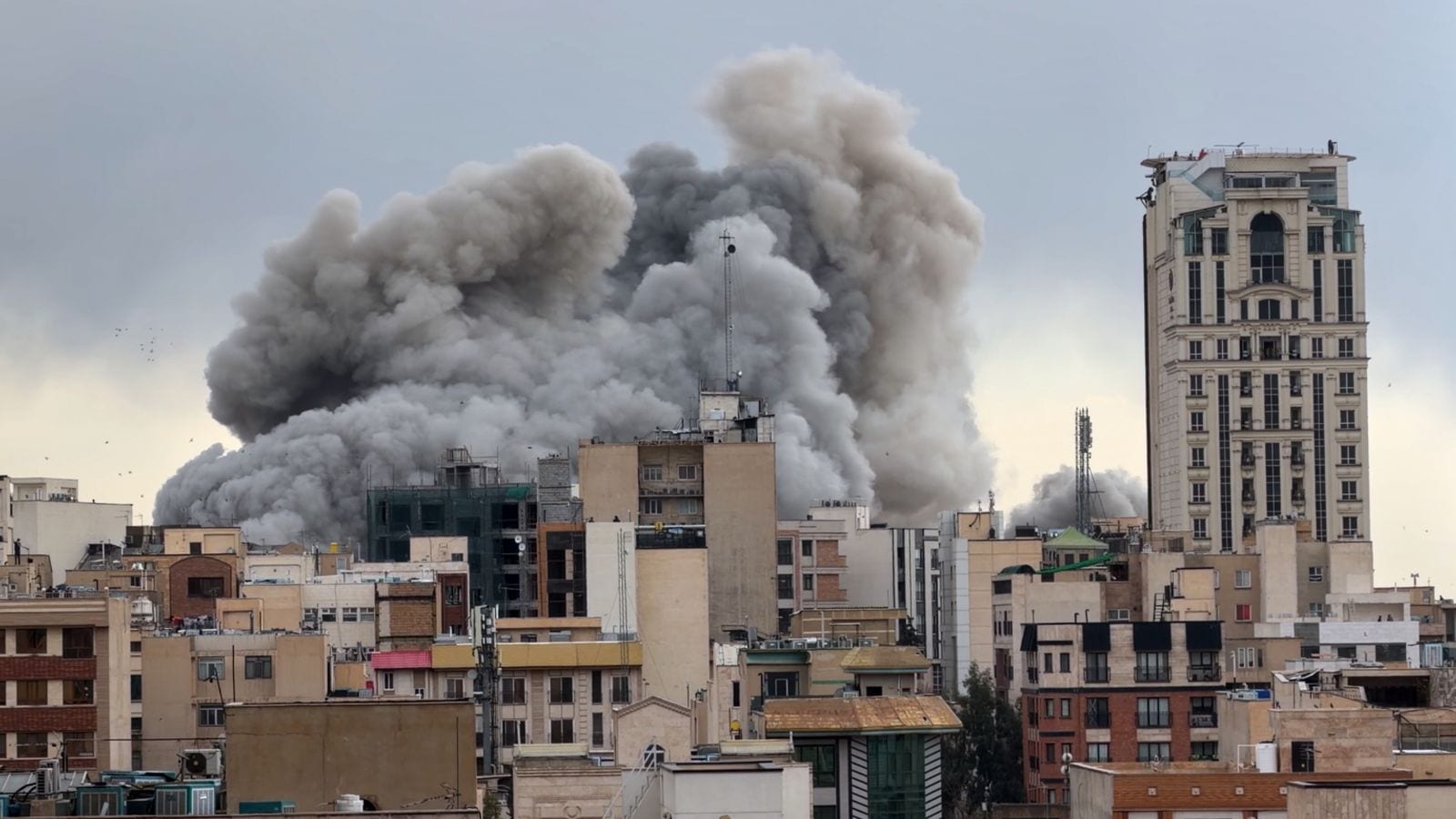
The order to send troops into battle is the gravest, most consequential decision any national leader can take. It is inevitably a death sentence: for one’s own soldiers, for those of the enemy, and for all the civilians caught in the crossfire. The first question in any war is the most important one: Why? Twelve days after launching the latest Middle East conflict, America’s president doesn’t seem even to have asked. The answer will determine whether the US/Israeli assault on Iran will turn out to be a brief fit of pointless destruction, or another generation-devouring disaster for the region, for America, and for the world.
“War,” said Carl von Clausewitz, “is the continuation of politics by other means.” So what political goals are being advanced by the deluge of Tomahawk missiles and JDAM-guided bombs? Donald Trump has offered an array of explanations, which change by the hour and with the mood. None of them makes the least bit of sense.

Regime change? If so, we should expect an invasion and occupation that would make the Iraq War look like a schoolyard scuffle. Air strikes have never ousted a regime like Iran’s, let alone put a successor in place. Iran’s theocracy suffered a decapitation strike with the killing of Supreme Leader Ali Khamenei on the first day, and yet there are no signs of the regime tumbling. In any case, the US administration swears that (as Secretary of Defence Pete Hegseth put it) “this is not a so-called regime-change war”. Trump would be happy if a pro-American order arose by magic, but he’s not doing anything to bring one about.
Destruction of Iran’s nuclear capability? Eight months ago, after his prior bombing spree, Trump declared the program “obliterated”. Iran never had the ability to field even one nuclear weapon, let alone an array that could threaten America. Tehran agreed to the most ironclad limits possible on its (legal and NPT-permissible) civilian nuclear programme, and Trump reneged on that deal in his first term.
Support for Iran’s people, most of whom bitterly resent the clerical order? In early January, as millions clogged the streets of the capital and other cities, Trump assured them that “help is on the way”. The regime cracked down brutally, killing thousands, and Trump took no action. Now, nearly two months later, he declared, “What we did in Venezuela, I think, is the perfect, the perfect scenario” for Iran. That scenario, which unfolded at precisely the same time as the Iranian protests, consisted of the removal of the nation’s president and no change whatsoever for the Venezuelan people. The leader of the popular movement, who had won the nation’s last election, was granted a White House visit, where she gave Trump her Nobel Prize medallion as a gift, in return for nothing.
The degradation of Iran’s ballistic missile program? This is a key war aim for Israel, which lies within the range of Iran’s Shahab 3 missiles, and has been subjected to them in this and prior conflicts. There is no such threat, however, to even an inch of American territory, the closest bits of which lie 7,000 kilometres beyond the Shahab’s reach. Trump has claimed that Iran is on the cusp of developing intercontinental ballistic missile capability, but his own intelligence agencies see no prospect of this happening for at least a decade (if ever).
The most recent rationale, presented by US Secretary of State Marco Rubio, is an argument for self-defence so convoluted that he himself is unlikely to actually believe it: Israel was intent on launching a strike, to which Iran might have responded by striking American military bases in the Gulf of Arabia. And so the US decided to strike Iran before it could respond to an attack that had not yet happened. Of course, the easier option would have been for the US (Israel’s main arms supplier) to have simply told its ally to forgo the gratuitous assault.
These and so many other unconvincing excuses do nothing to answer that fundamental question: Why?
What is the cause for which American troops are being asked to risk their lives? The killing of an 86-year-old man, and nearly a thousand (so far) other Iranians? The destruction of a nuclear programme that doesn’t exist, and missiles that can’t even fly far enough to crash into the Atlantic Ocean? Is any of that worth the billions of dollars already spent, and the hundreds of billions that will be wasted if the war keeps grinding on? As Gen David Petraeus, commander of US forces in Iraq, once demanded of his civilian bosses, “Tell me how this ends”.
There is an answer to the question of “why”, but it’s not a good one: Because Trump wants it. That’s the answer to most questions in American politics these days. Why have we slapped tariffs on every nation in the world? Why are armed thugs throwing nannies into prison warehouses? Why have we started an out-of-the-blue war against a nation of 90 million? It’s always the same answer.
Because for Trump, everything is a dominance play. His entire life has been an exercise in satisfying his own ego, and his hunger to subordinate others just grows and grows the more he feeds it. Now he controls more raw power than anyone on the planet, and he’s increasingly eager to use it. When the families of the seven American servicemembers killed so far, or of the 170-odd schoolgirls killed in Minab, ask “why”, that’s the only honest answer anyone could give them: To make Trump feel strong.
The writer is author of Arrow of the Blue-Skinned God: Retracing the Ramayana Through India and Mullahs on the Mainframe: Islam and Modernity Among the Daudi Bohras

