



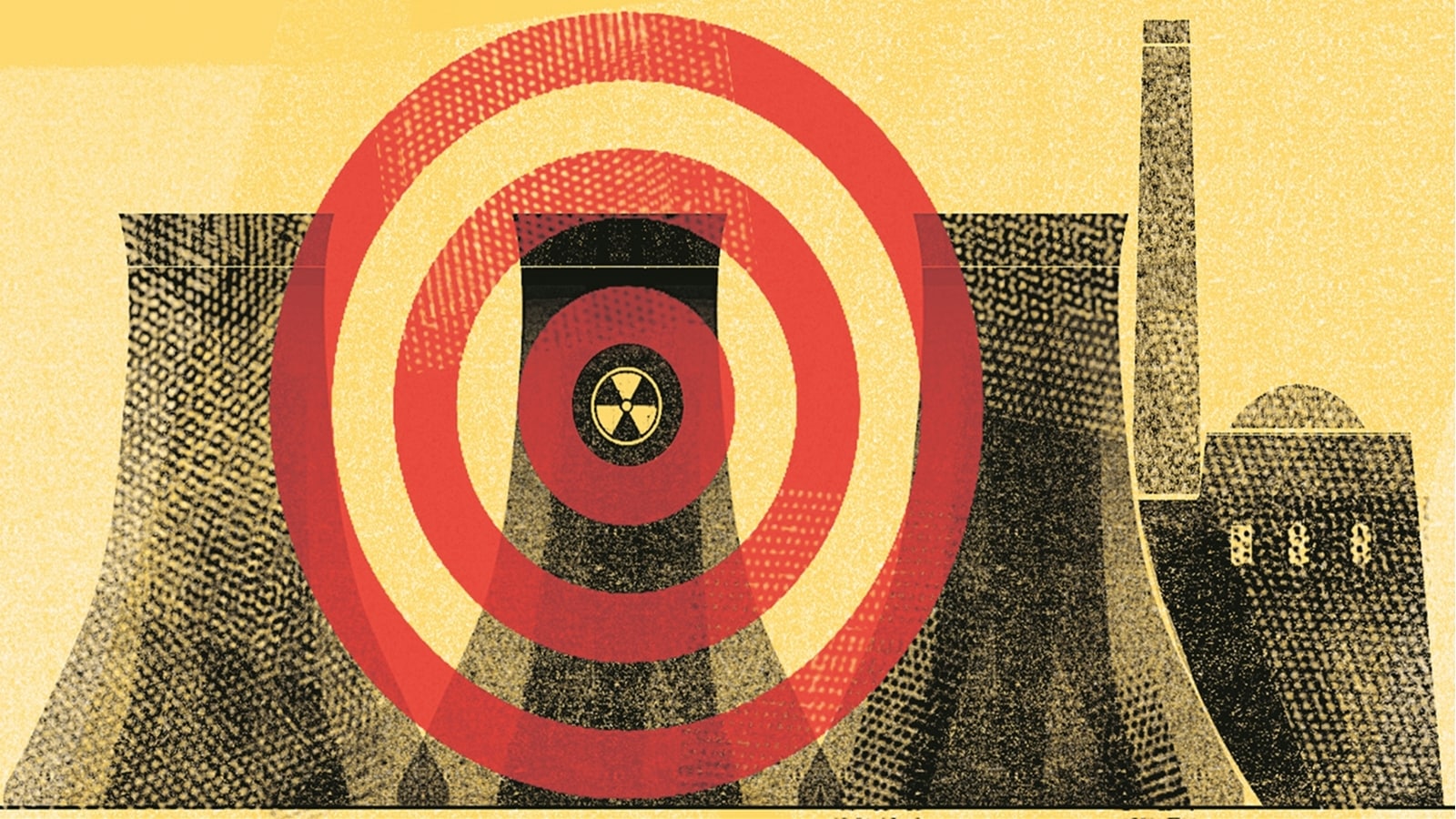
Donald Trump’s menacing threat to Iran that “A whole civilisation will die tonight, never to be brought back again” has unintentionally brought to light Rajiv Gandhi’s genius in anticipating that India and Pakistan might do just this to each other unless protected from such an eventuality in times of tension and war.
After the unspeakable horrors of World War II, the international community decided to newly codify humanitarian law through four conventions adopted in August 1949 in Geneva, including the fourth relating to the “protection of civilian persons in time of war,” because casualties were no longer confined to combatants on battlefields. It was hugely destructive and damaging to civilians caught up in war.

However, as the realisation grew that it was more proxy wars, civil wars and terrorism than openly declared inter-state wars that were causing asymmetric death and injury to civilian life and property, it became apparent that the Fourth Geneva Convention was not adequate to meet the catastrophic humanitarian consequences of these new kinds of inhuman war — labelled “indiscriminate” wars.
Accordingly, additional protocols relating to “civilian persons and objects” in all types of armed conflict were adopted in 1977, but not before the nuclear weapons powers, particularly the United States, had leached these “protections” of practical significance by inserting codas into the text and interpretations to legitimise their right to attack civil nuclear facilities, whatever might be the damage caused. Thus, for example, Ronald Reagan denounced the humanitarian provisions of the additional protocols as “unacceptable and thoroughly distasteful”. Meanwhile, India under Indira Gandhi refused to accede to these dodgy additional protocols.
It was at this time of crisis in the prospects of the survival of the planet and humanity itself that Rajiv Gandhi became India’s prime minister in 1984-85. As his speechwriter, I was deeply involved in the exposition of his views on the nuclear threat. As we were working on his magnum opus — his address to the UN General Assembly at its Third Special Session on Disarmament, June 1988 — he looked at me quizzically and said, “You know, Mani, Pakistan and we already have the bomb.” I was stunned — and puzzled. How, I asked? Rajiv replied, “Because the Canadians have gifted both of us nuclear reactors. A single Pakistani kamikaze pilot can blow up the Bhabha Atomic Research Centre outside Bombay, as easily as an Indian kamikaze pilot can blow up the CANDU reactor outside Karachi, causing as deadly damage to both cities as a nuclear bomb.”
This conversation, however idle, signalled the process by which India, distancing itself from the ambiguous additional protocols, insulated its civil nuclear facilities from Pakistani attacks by reciprocally promising similar protection to Pakistani civil nuclear facilities (remember, we were then not openly declared NWPs). Contemplating the prospect of becoming the first Indian PM to visit Pakistan in 28 years, Rajiv decided that to make the historic breakthrough meaningful, he needed to bring back from the Islamabad SAARC meeting in December 1988 a signed bilateral agreement that would protect each country’s nuclear facilities even if war were to break out between them. The key point was that there should be no ambiguity about the purpose of the agreement as had overtaken the Additional Protocols of 1977.
So, behind-the-scenes moves were initiated which led to the “Agreement between India and Pakistan on the Prohibition of Attack against Nuclear Installations and Facilities” signed in Islamabad by the two foreign secretaries in the presence of both prime ministers on the last day of the 1988 calendar year. The agreement binds both countries to “refrain from undertaking” any action causing “destruction” or “damage” to “any nuclear installation or facility”. Moreover, such installations or facilities are explicitly deemed to include nuclear reactors, fuel fabrication, uranium enrichment, separation of isotopes, reprocessing and “storage” of “radioactive materials”.
Further, the contracting parties are obligated to inform each other on the first day of January every year of the “longitude and latitude” of their respective “nuclear installations and facilities”. Straightforward, with all ambiguity excised, this bilateral agreement freed the India-Pakistan nuclear relationship from the ambiguities of the Geneva Additional Protocols that are currently being exploited by President Donald Trump in his wholly illegal participation in Israel’s wholly illegal war against its perceived existential enemy, Iran.
The threat against the Bushehr VVER light water 915 MW reactor, and the multiple high voltage lines connecting it to the off-site grid, which are critical to the plant’s safety, and the grave threats to the facilities at Minzadehei and the Shahid Khondab heavy water reactor at Arak, besides the Ardakan yellowcake production facility in Iran, strip Additional Protocols’ civilian protection from these installations and facilities, notwithstanding Trump’s facile claim that his 2025 attack on Iran’s nuclear facilities at Natanz, Fordow, Isfahan and Parchin Taleghan 2, had “obliterated” Iran’s nuclear weapons ambitions.
Massively escalating the danger of uninhibited nuclear destruction in the region, with all its long-term, and perhaps perpetual consequences, Iran reacted to Israel’s attack on Bushehr’s surroundings by attacking the surroundings of Israel’s nuclear war installations at Dimona. Further, given the US military involvement in the Gulf States threatening Iran’s security, Iran has warned that, in retaliation, it might take out the four units of the Barakah nuclear plants in the United Arab Emirates, underlining that while this will not affect Tehran, it will render “life impossible” in the capitals of the Gulf’s Arab states. This frightful prospect has been legitimised by the Additional Protocols detracting from absolute immunity to civil nuclear installations and facilities by allowing such dehumanising acts if the “civil facility” supports “the enemy’s war efforts” and provided there is no “massive radiation leak”, little realising that these supplementary “protections” will become operational only after immense and indefinite human suffering has been inflicted and irreparable environmental damage caused.
So, what inspired Rajiv to recuse himself from the conundrums of international law to insulate Indo-Pak nuclear relations from such ambiguities? Perhaps (Trump to please note) it was Mahatma Gandhi’s reply to a question, “What do you think of Western civilisation?” Gandhiji paused for a moment and gently replied, “I think that might be a good idea!”
The writer is former cabinet minister with four portfolios, including petroleum and natural gas, 2004-09
