



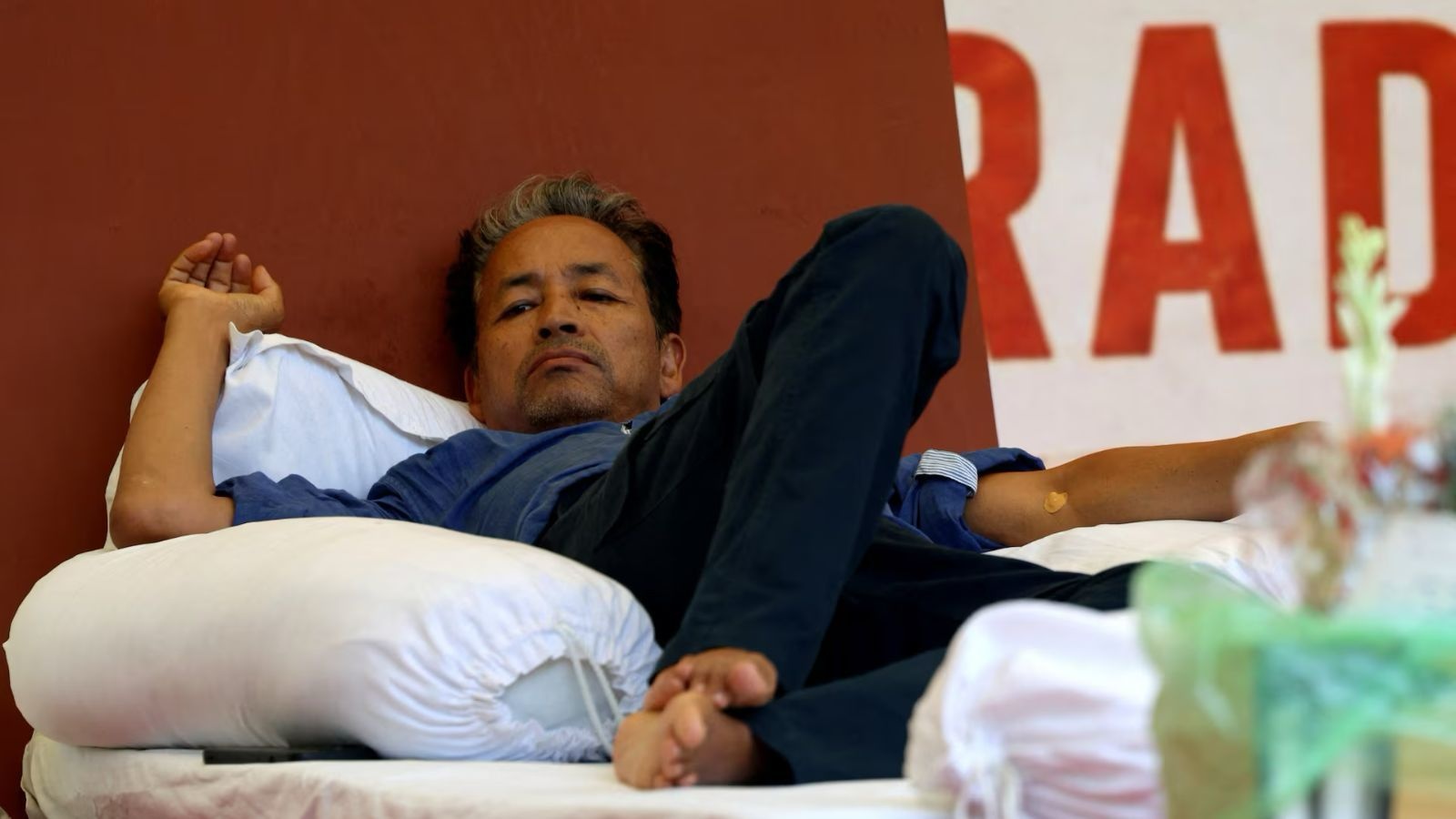
Sonam Wangchuk has been moved from Jantar Mantar to a hospital bed. He is still not eating. He has offered the state three ways to make him stop, which is either the most stubborn negotiation in Indian public life this year or the most honest one. Nobody has yet worked out which. The country has, predictably, arranged itself into its two familiar camps: Those who find this moving and those who find it theatre. Both are asking the wrong question.
They assume the fast is a message requiring interpretation, a symbol standing for something else, as a flag stands for a nation. But a hunger strike is not that kind of sign. It is closer to what Charles Peirce called an index: Smoke indicating fire, a physical trace of an unseen force. Nobody asks whether smoke is sincere.

The index does double duty: The body is also where the state does its own writing. Modern power, Foucault argued, inscribes itself onto bodies through the prison timetable, the uniform, the cell, the queue — disciplining by repetition until obedience feels like instinct. The hunger striker seizes that same instrument and runs it backward. If discipline writes compliance onto the body over years, starvation erases it in weeks — an act of pure loss, destroying the one asset every rational bargain assumes protected. That refusal to be useful, even to one’s own survival, is what makes the fast unreadable to a state that thinks only in outcomes.
Bobby Sands did both moves at once. Denied sanctioned speech, he smuggled words out of prison on scraps of paper while his body carried the larger, wordless text underneath. The state disciplined through the body. Sands made the body discipline the state back, by spending the very thing discipline exists to preserve.
It was poetic justice, except poetry usually has the decency not to kill its author.
To ask whether this “works” is already to misunderstand its grammar. No state, however patient, can file a man’s refusal to eat under the correct administrative heading. Delhi Police can impose Section 144. It cannot subpoena an appetite.
Yet that same refusal degrades the moment it becomes routine — waste reads as sacred only while it stays rare. A public rite electrifies precisely because it interrupts ordinary time; repeat it enough and the interruption becomes the timetable it was meant to break. Crisis starts to resemble liturgy — and liturgy, however devout, is attended without letting the pulse change.
Wangchuk has fasted before, for different causes and different forms. Each return may strengthen the record of commitment, but it can also weaken the shock. The body is still suffering. The cause may remain just. Public attention, however, is a brutal economy, and it consumes rarity first.
Irom Sharmila discovered this over 16 years and through a feeding tube. Her sacrifice did not become smaller. Society’s capacity to remain disturbed by it did. A protest can outlast the conscience it was meant to awaken.
But rarity alone cannot explain why the same act moves a nation in one mouth and a district in another — the rite’s charge depends on who performs it. Starving bodies do not enter politics at equal value; a fast converts suffering into moral authority at a rate set by capital the striker already holds. Gandhi could miss a meal and shake an empire because decades of moral authority stood behind the empty plate — his fasts were withdrawals from an account already overflowing, not deposits into an empty one.
Wangchuk — engineer, innovator, Magsaysay laureate, the man popular cinema taught India to admire before it met the real one — carries considerable capital of his own. But reputations fluctuate. They accrue, fragment, and are repriced by politics.
This produces the hunger strike’s central paradox. It must be strategic to matter, yet must not appear strategic. The audience must experience calculation as spontaneity, planning as sacrifice. The moment it looks like a communication device, its moral voltage drops — though it was always both. We prefer our sacrifices pure because purity saves us the trouble of understanding politics.
Foucault’s inscription, though, only covers the living body. States make a further claim over nothing but its ending — the darker question: Whose body is a state afraid to lose? The force-feeding chair is never merely an instrument of medicine. It is sovereignty declaring that even the prisoner’s death belongs to it — he may be confined, silenced, and broken, but he may not choose the terms of his own ending. Elsewhere, governments have simply let strikers die, or answered them with violence — proof some bodies were never worth negotiating with. The fast measures the state’s arithmetic as precisely as it measures the striker’s conviction: Some bodies become national emergencies, others become paperwork.
Gandhi’s fasts resist even this frame, and suffer when flattened into the founding case study for every strike that followed. René Girard’s scapegoat mechanism fits better — societies resolve their own violence by concentrating it, mostly unconsciously, on a single chosen victim. The mechanism’s power depends on that unconsciousness; a crowd that knows it is scapegoating stops believing in the sacrifice. Gandhi’s fast breaks the mechanism rather than inverting it: By nominating himself as victim before Punjab or Bengal could nominate someone else, he dragged the ritual into daylight and drained it of the blindness it needed to work.
What armies could not achieve by force in Punjab, one old man’s refusal to eat achieved in Bengal within days — he interrupted the machinery of communal violence by placing his own body inside it, before anyone else’s blood had to answer for it. That required more than courage. It required a society still capable of shame.
And so we return to the hospital bed, to a man whose diminishing body is speaking in every one of these registers at once: Index and inscription, waste and ritual, capital and sovereignty, sacrifice offered before it can be extracted by force. Nobody watching him can honestly separate which one is doing the work today.
We have merely watched, as audiences do — debated his motives, assessed his relevance, mistaken attention for participation.
Then, eventually, we have gone to eat lunch.
The writer is a senior advisory professional
