



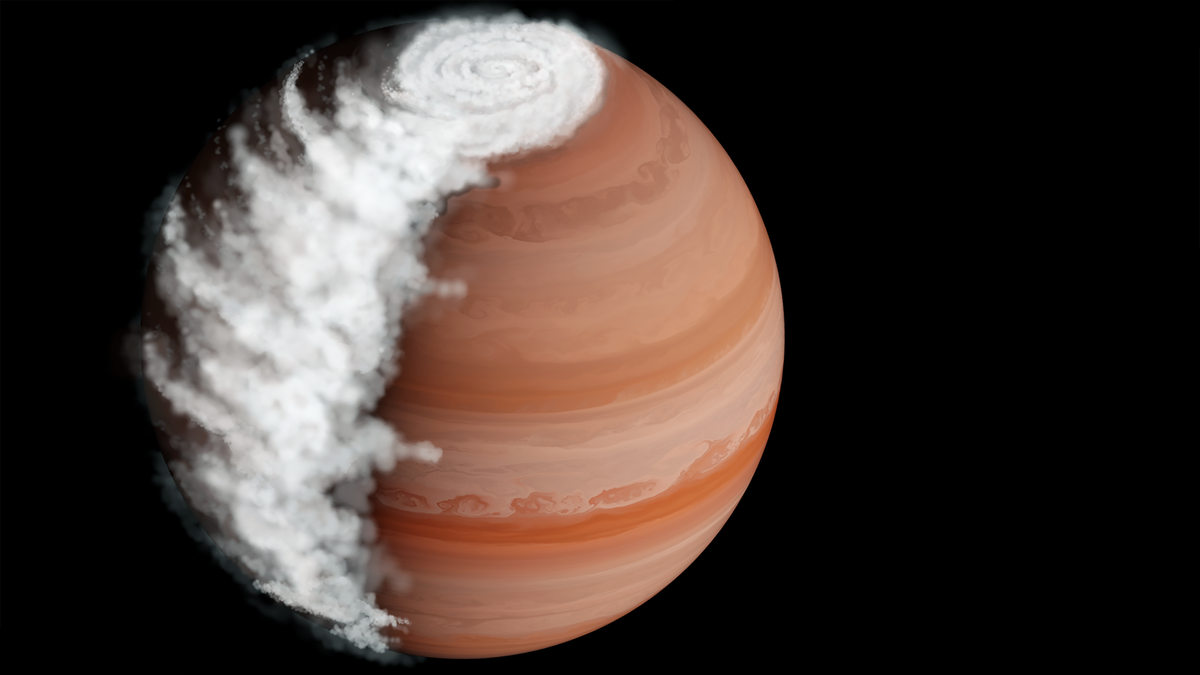
“Cloudy with a chance of rain” — imagine astronomers turning into meteorologists and issuing weather reports like this, but for alien planets.
According to a new study published in Science on May 21, scientists were able to use the NASA James Webb Space Telescope (JWST) to peer closely at an exoplanet nearly 700 lightyears away, and deciphered the weather patterns on it.
Named WASP-94A b, this exoplanet is almost twice as large as Jupiter but with only half the mass. It orbits very close to its parent star — so close that it takes just four days to complete a whole revolution.
Extreme worlds
Gas giants like WASP-94A b with scorching atmospheric temperatures are called ‘hot Jupiters’ and have their orbits tidally locked, meaning their rotation is synchronised with their revolution. As a result, the same side of the planet always faces the host star, much like the moon’s tidally locked orbit keeps one side always facing the earth.
WASP-94A b’s dayside is thus a sweltering desert with temperatures hot enough to melt rock while its nightside is perennially dark and frozen as temperatures dip to nearly absolute zero.
Astronomers have always been intrigued by the bizarre weather patterns on the 6,000 or so exoplanets they have found so far. But in the absence of a sufficiently powerful telescope, they have had no way to study these far-flung bodies.
NASA’s launch of the James Webb Space Telescope (JWST) in December 2021 was the gamechanger. The unprecedented sensitivity of its instruments — which allow the telescope to discern the details on a small coin from a distance of 50 km — has helped scientists study exoplanets’ atmospheres like never before.
Many of these worlds have turned out to be rocky; some are even almost earth-like. But on some other exoplanets, scientists have found extreme temperatures and pressures producing rain of molten metal and vaporised rock. Still others have downpours of molten glass pushed by supersonic winds. Some gaseous exoplanets even have crystallised carbon raining down as diamonds.
‘A world far beyond’
Hot Jupiters though are the most studied exoplanets. The latest JWST discovery has found that WASP-94A b in particular has a dynamic weather system: its mornings are blanketed in clouds of magnesium silicate, iron, and magnesium sulphide while the evenings sport clear skies.
“The clouds appear to form on the cooler night side of the planet, sweep across the globe with extremely fast winds, and then disappear as they reach the hotter dayside,” Sagnick Mukherjee, lead author of the study and a postdoctoral fellow at Arizona State University, said. “This is a direct measurement of an extreme weather cycle unfolding on a world far beyond our Solar System.”
Astronomers characterise the atmospheres of distant exoplanets using spectroscopy: light is split up into its various wavelengths, followed by measuring the intensity of each one. If the planet has an atmosphere, it will absorb some of the light. This will create a gap in the set of wavelengths arriving at the spectrometer.
Since each molecule absorbs light of fixed wavelengths, it is easy to identify the compounds present in the atmosphere.
Slow transit
“To do that, we need some way to distinguish the planet’s light from the stars,” Bruce Macintosh, director of the University of California Observatories and professor of astronomy and astrophysics, said.
Prof. Macintosh, who was not part of the research team, said the astronomers used the transit method for their discovery.
“As the planet passes in front of the star, its atmosphere absorbs starlight. By studying exactly how that absorption changes with time, you can see the evidence that one side is cloudy and not the other. And by studying different wavelengths you can understand composition,” he explained.
According to University of Göttingen astrophysicist Lisa Nortmann, the researchers seemed to have studied the transit when the exoplanet passed slowly in front of its star.
“Therefore, at different times of observation, different parts of the planet are in front of the star. This effect was used in this study to ‘scan’ the planet’s atmosphere at different locations and this revealed that the atmospheric signal was different for morning and evening sides,” Dr. Nortmann, who was also not part of the study, said.
A major challenge in studying exoplanets, according to Dr. Mukherjee, is that clouds can obscure what their atmospheres are really made of.
“By separating the cloudy and clear sides of WASP-94A b, we show that earlier estimates of its composition can be strongly biased,” he said. “More broadly, the study demonstrates that understanding weather patterns on distant worlds is essential for learning how planets across a wide range of sizes (from earth-like rocky planets to Neptune-like gas worlds and gas giants) form, evolve, and differ from planets in our own solar system.”
History of formation
Research like this could help astronomers learn about the planetary architectures of 4.6 billion years ago when the protoplanetary disk of gas and dust around the Sun started evolving into this Solar System.
“The discs of material around a young star form planets. Different parts of that disc have different compositions — ice, gas, dust particles, etc.,” Prof. Macintosh said. By measuring the composition, you can tell something about the history of the formation (did it form out of solid material first or gas?) and even the location (did it form somewhere too hot for ice?). And then you can try and understand if the same process that made a big hot Jupiter like this could also make a smaller planet like the earth.”
As state-of-the-art instruments like the Extremely Large Telescope, which Europe is currently building in northern Chile, become operational, astronomers could discover many exoplanet nurseries around distant stars, increasing manifold the possibility of finding more extra-solar earth-like planets and, who knows, even a true earth twin.
Prakash Chandra is a science writer.
Published – May 26, 2026 08:00 am IST

