



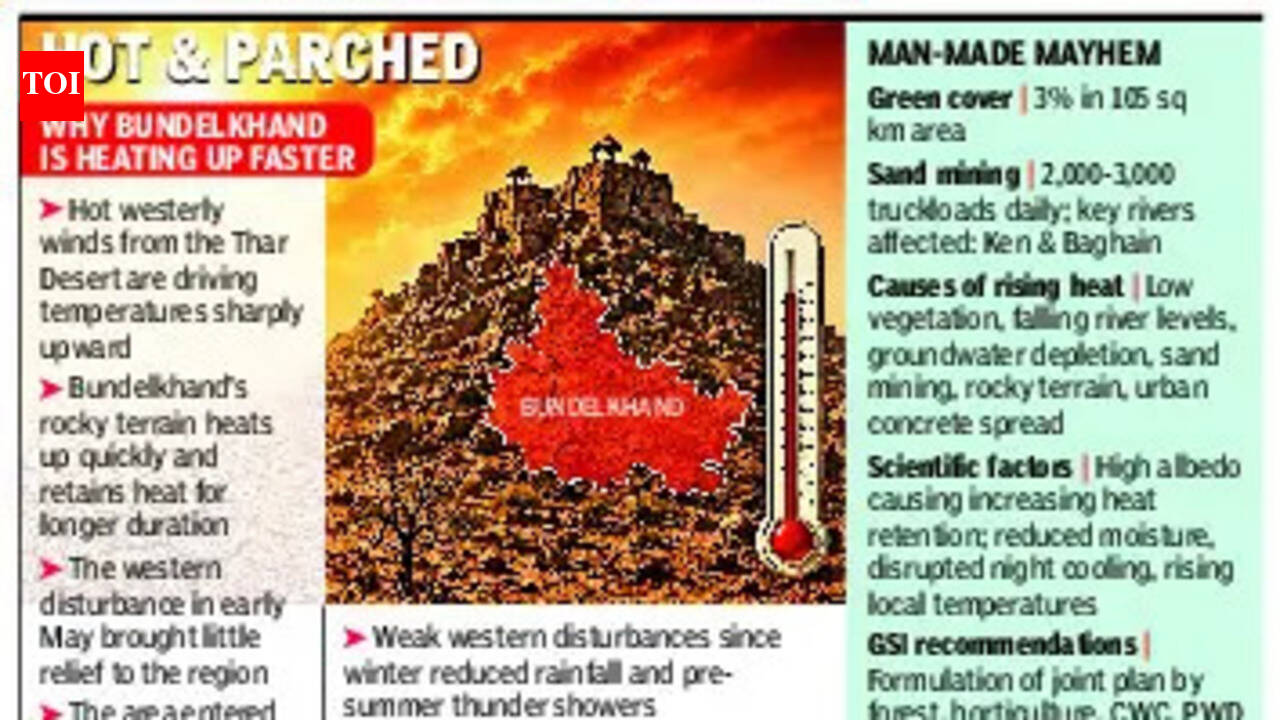
weatherLucknow: As Uttar Pradesh continues to reel under a spell of scorching summer heat, one district in Bundelkhand region stands out for a grimmer reason — emerging as the hottest city in the world twice and in Asia thrice in the past one month.Bundelkhand’s Banda district not only emerged as the hottest place in India on Monday but also recorded the world’s highest daytime temperature at 47.6 degrees Celsius, its hottest May day in 75 years.Earlier on April 27, the district topped the world’s heat chart with 47.6 degrees Celsius.Banda also recorded the highest temperatures in Asia on three occasions — May 19 (48.2 degrees Celsius), May 17 (46.4 degrees Celsius), and April 17 (45.4 degrees Celsius).However, Banda’s all-time highest temperature remains 49.2 degrees Celsius, recorded on June 10, 2019. But what’s new is that the town is hitting 47s and 48s quite frequently.Meteorologists and geologists say that this is not just a weather phenomenon.From barren rocky terrain and vanishing green cover to relentless sand mining and drying rivers, Banda is rapidly turning into a man-made heat island, trapped in what experts describe as a “vicious circle of heat”.WHY IS BANDA SIZZLINGAccording to officials at the India Meteorological Department (IMD), the sharp rise in temperature across Uttar Pradesh is being driven by dry and harsh westerly winds originating from the Thar Desert.With clear skies and uninterrupted solar radiation, the effect has been particularly severe over southern districts, especially the Bundelkhand region, where the rocky terrain heats up rapidly during the day and retains heat for longer periods.Senior scientist at IMD’s Lucknow centre, Mohammad Danish, said: “The impact is more intense in southern Uttar Pradesh because the western disturbances that bring a temporary change in weather to many parts of the state during the first 10 days of May had little impact on Bundelkhand. As a result, districts such as Banda did not cool down sufficiently during that period and entered a hot spell with already elevated temperatures, causing mercury levels to rise faster than elsewhere.”“The hard and stony surface of the Bundelkhand region has further aggravated the situation. The exposed rocky terrain absorbs heat quickly under direct sunlight and releases it slowly, making districts like Banda prone to extreme temperatures,” he added.Danish pointed out that long-term weather patterns were also contributing to the current conditions.“Weak and fewer western disturbances between Dec and April led to below-normal winter rainfall, and the absence of thundershowers that usually occur in March and April aggravated the situation. These systems typically help moderate temperatures before peak summer sets in, but their limited activity this year allowed heat to build up early, particularly across Bundelkhand,” he added.A MAN-MADE ‘HEAT ISLAND’?Banda has turned into a heat island due to a mix of geological conditions and human activity, as experts point to extremely low green cover, falling river water levels, large-scale sand mining, and expanding concrete surfaces as the main causes.According to geologists, Banda is caught in a “vicious circle of heat” because it lacks both vegetation and moisture.The district has only 3% green cover in an area of 105 sq km, far lower than other parts of Bundelkhand.According to officials at the northern region office of the Geological Survey of India, Lucknow, Banda is among the hottest places in the country because it falls in the Tropic of Cancer belt and receives intense solar radiation.Sparse vegetation, poor tree density, and declining groundwater have worsened the situation.Experts said there have been inadequate policies and practical efforts to restore fertility and greenery in the district.Geology professor at Lucknow University, Dhruv Sen Singh, said, “Banda’s albedo is high, which means much of the sunlight falling on the surface is reflected rather than balanced by moisture and vegetation. This has increased because river water levels have dropped and rocky terrain has expanded after vegetation loss.”“Environmental assessments indicate that around 2,000-3,000 trucks of sand and ‘morang’ (coarse sand) are extracted daily from the Ken river region. Sand mining increases local temperature by removing vegetation, altering surface reflectivity, and disturbing hydrology, turning cooler areas into heat-absorbing zones,” Singh explained.He added that the district was facing a local greenhouse effect, with drying rivers and the absence of natural cooling factors like water and vegetation.“Night-time cooling has also weakened due to rock cutting, crushing, and sand loading,” he said.Geologists at GSI have recommended that departments like horticulture, forest, irrigation, Central Water Commission, and public works department prepare and implement a practical plan to protect Banda from extreme heat and drying.They also urged public representatives to intensify efforts to restore greenery, conserve water, and improve the environment.Founder-convenor, Ground Water Action Group, RS Sinha, said, “Chitrakoot has 18% forest cover while Lalitpur and Jhansi have 11.5% and 6%, respectively. Banda has the lowest green cover of 3%, directly affecting temperature patterns.”“For over two decades, I have been conducting research on land mining in the Bundelkhand region. The biggest problem in cities like Banda is the overexploitation of land and riverbed mining. Vegetation cover is being removed and there is no re-vegetation,” said Prof Amit Pal from the department of environmental science, Bundelkhand University, in Jhansi.“Even areas where plantation is being done are not according to norms laid down by the National Green Tribunal,” he said.

