



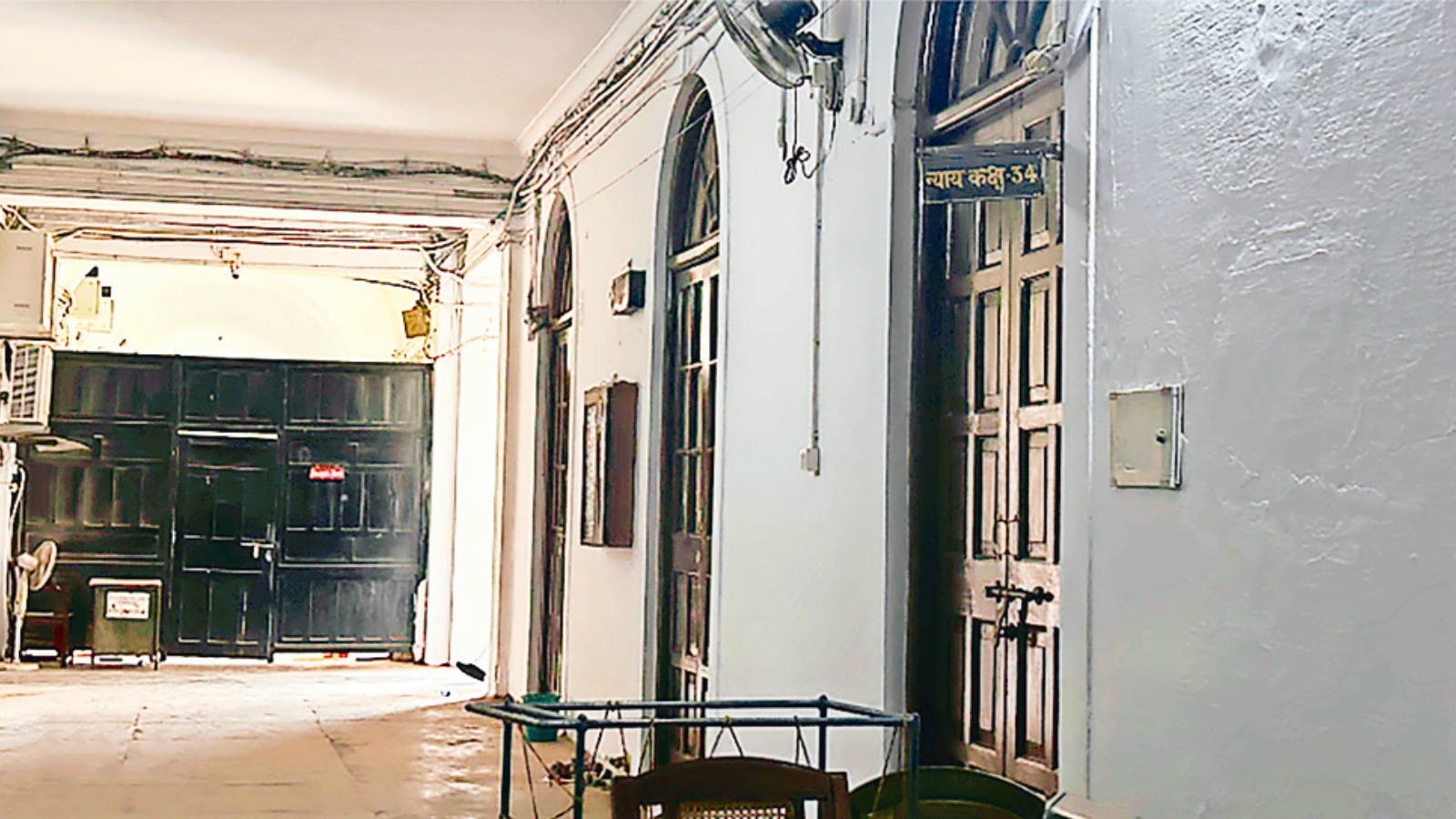
Before the Emergency became a midnight story, it had a courtroom preface. On the night of 25-26 June 1975, Opposition leaders were arrested, the presses were censored, and freedoms began to shrink. But the political chain of events that led to that night had been triggered two weeks earlier through a judge’s verdict in Allahabad. The Emergency is remembered through Delhi’s darkness. Its legal pre-history unfolded in daylight.
That daylight can be traced to two rooms of the Allahabad High Court. Justice Jagmohanlal Sinha sat in Court No. 5. When Indira Gandhi came to give evidence in the election petition filed by Raj Narain, challenging the then-PM’s Rae Bareli victory, the proceedings were held in Court No. 24. It stood at one end of the building — easier to secure without disrupting other courts.

The story began in the 1971 general elections. After the Congress split of 1969 and the early dissolution of the Lok Sabha in December 1970, the Opposition tried “Indira Hatao” and she answered with “Garibi Hatao”. In Rae Bareli, Indira Gandhi polled 1,83,309 votes, Raj Narain received 71,499.
For most candidates, that margin would have closed the matter. Raj Narain carried it to court. In April 1971, he filed an election petition under the Representation of the People Act, 1951, alleging misuse of official machinery, campaign expenditure, and the role of Yashpal Kapoor, who had worked in the PM’s Secretariat before joining Indira Gandhi’s campaign. Over time, the case narrowed around Kapoor and a set of dates. Kapoor had resigned from government service in January 1971. The court had to decide when that resignation took effect, whether he had begun election work before leaving service, and when Indira Gandhi had begun her Rae Bareli run. Election law treats assistance from government servants, deployed to advance a candidate’s prospects, as a corrupt practice. Officials, police, and public facilities belong to the Republic, not to a ruling party’s campaign. In Rae Bareli, this ordinary rule had become historic because the candidate under scrutiny was also the PM.
For three years, the case moved slowly until Justice Sinha took charge after the 1974 summer vacation and pushed it forward. In March 1975, Indira Gandhi’s appearance as a witness enlivened the case. The arrangements outside Court No. 24 were an Emergency-like rehearsal before the Emergency. Police guarded the gates. Entry was restricted to lawyers, reporters, and pass-holders. A metal detector stood in the passage. There, a briefcase incident, involving an allegedly unlicensed country-made pistol, caused a stir in Parliament.
By the time Justice Sinha entered, the courtroom was packed. Raj Narain was present after he assured his counsel Shanti Bhushan that he would remain silent. Bhushan didn’t want Raj Narain because he was known to be temperamental and outspoken. Rajiv and Sonia Gandhi were also there. Justice Sinha announced that court convention did not require anyone to rise when a witness entered. Outside the courtroom, Indira Gandhi was the PM. Inside, she was a witness. When she entered, some still rose, as the habits of power and the discipline of law stood face to face.
The court accommodated the dignity of office. She was not made to stand in the witness box. After consultation with Shanti Bhushan, Justice Sinha allowed her to sit on a chair placed on a raised platform to the right of the judge. Her counsel, S C Khare, examined her first. Then Shanti Bhushan cross-examined her.
On 12 June 1975, Justice Sinha set aside Indira Gandhi’s election and found her guilty of corrupt practices on limited grounds, connected with Yashpal Kapoor and official arrangements. The court granted a short stay for appeal. But the political crisis had begun. Congress rallied behind her. The Opposition treated the verdict as a crisis of legitimacy.
On 24 June, Justice V R Krishna Iyer of the Supreme Court allowed her to continue as PM but restricted her rights as an MP. The next day, Jayaprakash Narayan and other leaders demanded her resignation at a Delhi rally. That evening, Indira Gandhi advised the President to proclaim a state of emergency. On the night of 25 June 1975, just before midnight, President Fakhruddin Ali Ahmed signed the proclamation.
The Rae Bareli case still did not disappear. Parliament changed the election law retrospectively. The 39th Amendment attempted to place the election of the PM beyond judicial challenge. In November 1975, a Constitution Bench upheld several election-law changes but struck down the attempt to immunise the PM’s election from judicial review, applying the basic structure doctrine articulated in Kesavananda Bharati.
Fifty-one years later, Indira Gandhi v. Raj Narain remains the courtroom preface to the Emergency. Court No. 24 reminds us that constitutional crises do not always begin with a proclamation. Sometimes they begin when ordinary legal rules finally attain extraordinary political power.
The author is a lawyer with a specialisation in public law
