



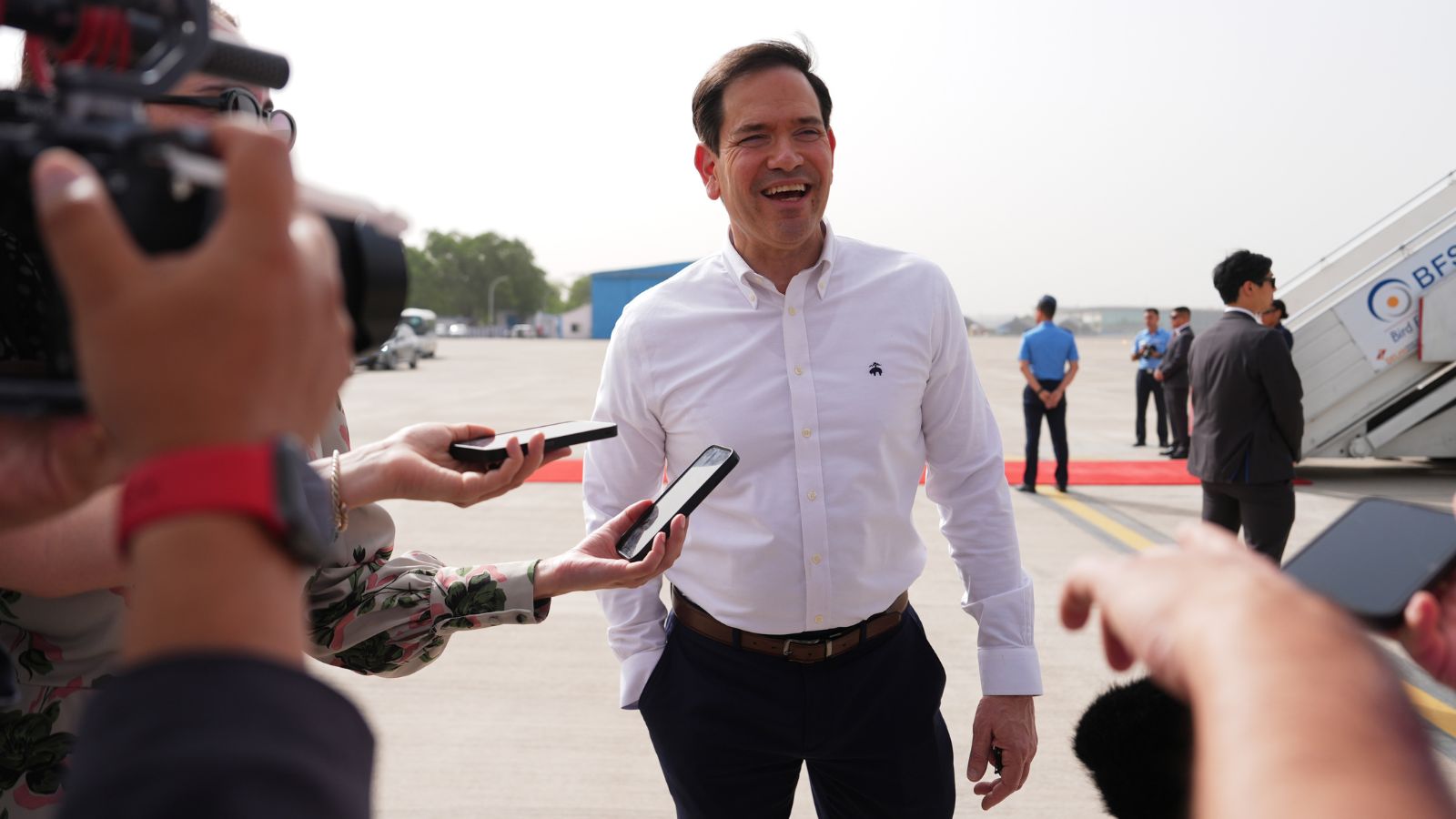
Love it or hate it, the media frenzy and political frisson that American leaders generate in Delhi remains unrivalled. Why do visits by the Russian foreign minister, Sergey Lavrov, or his Chinese counterpart, Wang Yi, not provoke the same excitement and anxiety as the just-concluded four-day sojourn of US Secretary of State Marco Rubio? To be sure, the US is India’s most weighty partner, and the 2025 turbulence in ties explains some of the hype surrounding Rubio’s visit.
There is more to it. While Russia may be India’s “best friend forever” and China its most consequential neighbour, neither relationship carries the emotional intensity that simultaneously binds and strains India’s engagement with America. Unlike the US, the Indian elite has little social intimacy or political familiarity with Russia or China. There is only the G-to-G relationship and the coded diplo-speak associated with it. In an earlier era, India’s communists engaged with and argued about the Soviet and Chinese polities. That bridge has collapsed.

In contrast, America looms large over Indian society. The Indian elite’s social links, mobility plans, cultural aspirations, intellectual networks, and technological connections with the US deepened steadily even during the bitterest phases of the Cold War, and have grown by leaps and bounds since. There is a huge business dimension today that did not exist earlier. Even our English has changed: British spellings survive, barely, but “blokes” have become “bros” and “doing fine” has yielded to “all good”.
India is not alone in adopting American culture. Even many critics of Washington across the world continue to seek access to the opportunities and prestige that America uniquely offers. American soft power still rules the world. Despite the negative effects of US President Donald Trump, the US will continue to outrank Europe, Russia and China in any index of attractiveness.
Anti-American public posturing has had a long political provenance in India, on the left and right alike. There is a historical parallel here: In the late 19th century, American elites sought British approval even as they bristled at every perceived slight from London. Rising powers often oscillate between attraction to and resentment of the hegemon. Delhi reflected some of that ambivalence last week amid the torrent of criticism directed at American policies and the excessive anxiety over the durability of the India-US partnership.
On the surface, not much appears to have changed since the early 1990s, when India and the US began reconstructing ties. Every visit by even relatively junior American officials became headline news, accompanied by fears about US mediation on Kashmir, pressure on India’s nuclear programme, and concerns over sovereignty. Agreements with Washington routinely invited accusations of “arm-twisting” and “capitulation”.
But the relationship today is very different. The US is now India’s largest economic partner across trade, investment, technology and higher education. Washington has steadily de-hyphenated India from Pakistan. Successive administrations came to view India as an important element in balancing China in Asia. The long disputes over nuclear non-proliferation and technology denial regimes have been addressed to a large extent.
India’s foreign policy establishment gradually moved beyond its inherited anti-American reflexes in the 21st century. Yet the first year of Trump’s second term has revived old anxieties. Sweeping tariff threats against Indian exports, pressure over Russian oil imports, and uncertainty about Washington’s future approach to China and Pakistan have resurrected familiar fears.
Rubio’s visit was an effort at reassurance; the Indian establishment will wait to see how this plays out in practice. The Quad foreign ministers’ meeting also reaffirmed the continuing importance of minilateral cooperation in the Indo-Pacific. Repairing public sentiment, however, will take longer.
Looking beyond Rubio’s visit, three considerations stand out.
First, Delhi must honestly assess whether it fully utilised the opportunities opened by America’s strategic rethinking of Asia over the last two decades. Persistent political hesitation, ideological confusion, and bureaucratic caution prevented India from fully leveraging the geopolitical openings that the US created since the turn of the century. Too much debate and too little action in Delhi contrasts with the boldness with which Deng’s China seized the US embrace to lift itself to great-power status. The mistaken sense that America needs India more than Delhi needs Washington has fostered strategic complacency.
Second, we are dealing with a very different US than the one that went out of its way to befriend India 25 years ago. India must come to terms with the structural shifts underway in American foreign policy under Trump, especially regarding the Eurasian balance of power. Traditionally, the US relied on alliances to manage both Russia and China. Trump is more sceptical about the value of partnerships, with an apparent belief that Washington can unilaterally manage both. India has felt the effects of this shift. There is understandable concern in some Indian quarters about a potential American accommodation with China and Pakistan. But objectively speaking, India today is far stronger than during earlier phases of strategic divergence with Washington — periods when the US was far closer to both Beijing and Rawalpindi than it is today.
Third, whatever direction US policy takes, Delhi has no option but to adapt. Its response must be two-fold: Continue working with the US, bilaterally and through the Quad, to sustain a favourable balance of power in Asia; and, equally, accelerate India’s own economic transformation, unleash the productive energies of Indian society, and strengthen internal unity. External partnerships can help India shape the balance in Asia, but they cannot substitute for national capability and coherence. India has the cards; the question is whether Delhi can play them with confidence.
The writer is a contributing editor on international affairs for The Indian Express. He is a distinguished professor at the Motwani Jadeja Institute of American Studies, Jindal Global University, and the Korea Foundation Chair on Asian Geopolitics at the Council on Strategic and Defense Research
