



4 min readJun 4, 2026 04:05 PM IST
First published on: Jun 4, 2026 at 04:05 PM IST
By Ro Ding
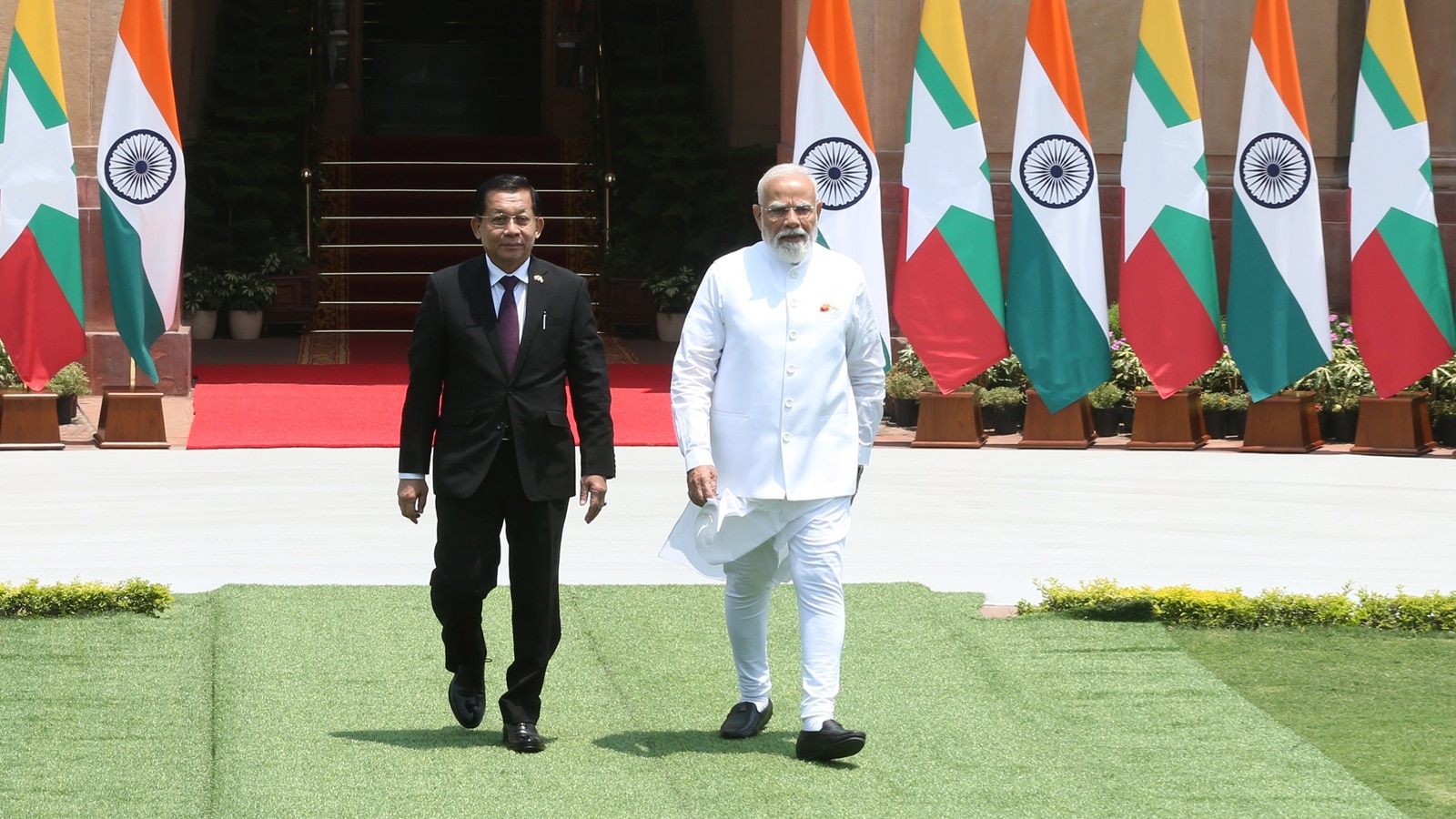
India received General Min Aung Hlaing with the honours of a head of state. He came to New Delhi seeking legitimacy, and he left after giving almost nothing in return. He repeated the assurance that Myanmar’s territory would not be permitted to be used against India’s security interests. That is a promise the junta has already broken by making common cause with anti-India insurgents to fight the people of Myanmar.

Min Aung Hlaing is not the country’s legitimate leader in any sense. The election he organised earlier this year was held in less than half the country. The parties that won the 2020 election in a landslide were barred from contesting, and the leaders who won it, including Aung San Suu Kyi, remain in prison or have been killed. This is why the United Nations lists U Win Myint and Daw Aung San Suu Kyi, not Min Aung Hlaing, as Myanmar’s head of state and foreign minister. Recent efforts by the junta regime to feign reform are hollow. Aung San Suu Kyi was reportedly moved from prison to “house arrest” last month, but the regime has done nothing to address concerns raised by her son about whether she is still alive. Just four days after the junta took power, it bombed a Buddhist monastery. Min Aung Hlaing’s new “civilian” cabinet is composed of 24 former generals. These are not signs of reform.
India shares a 1,643-km border with Myanmar across four northeastern states, and it must be pragmatic. But legitimising the military junta is self-harm. A government partner is only as useful to India as its ability to deliver, and the junta fails that test in three ways. It enjoys little public support and governs a small share of the country. Any arrangement reached with it rests on a weak foundation. And its survival now depends on Beijing, which drives many of the junta’s choices. In New Delhi, the general pledged to do “everything” to finish the long-stalled Kaladan project and the Trilateral Highway. He cannot. As Foreign Secretary Vikram Misri acknowledged, both are frozen in territory the junta does not control. The mass displacement that burdens India is a central objective of the military’s “four cuts” strategy. Finally, a regime kept alive by Beijing’s funding, weapons and diplomatic cover is not an instrument with which India can balance China.
The resistance is more unified than it has been at any point since the coup, offering India its most coherent alternative to Naypyidaw. Major resistance forces and the National Unity Government (NUG) recently established a single political and military body, the Steering Council for the Emergence of a Federal Democratic Union (SCEF). It brings together forces fielding well over 100,000 fighters, controls or contests close to half the country, and is fast becoming the actor most likely to shape Myanmar’s future. India’s interests are better served by engaging it now. The NUG and its allies do not ask India to break relations with Naypyidaw. The distinction India should draw is between formal recognition and functional partnership. The actors that can deliver results on border security, counter-narcotics, and infrastructure protection increasingly sit within the resistance.
India has spent decades building goodwill among its neighbours. It should not spend that capital on a regime that the Myanmar people are determined to remove.
The writer is representative to India of Myanmar’s National Unity Government
