



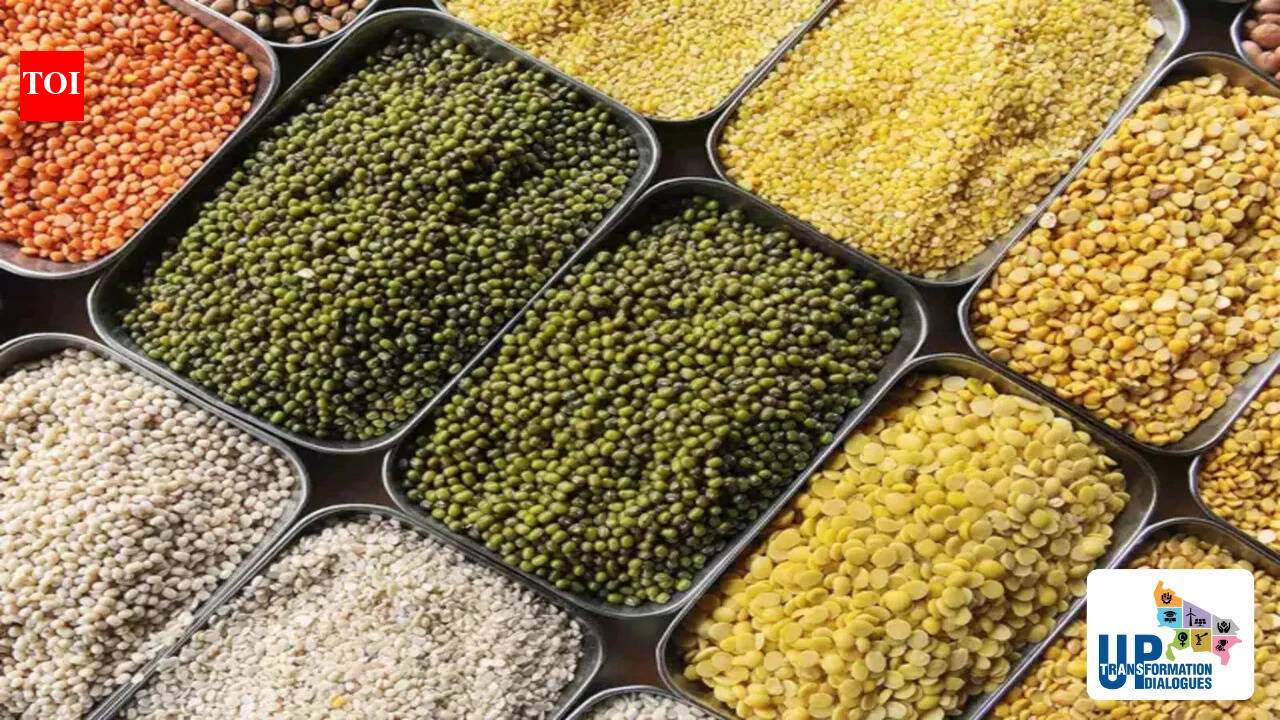
Banda district, situated in the heart of Uttar Pradesh’s Bundelkhand region, has long been recognized as one of the state’s major pulse-producing areas. Chickpea (gram), pigeon pea (arhar), lentil (masoor), black gram (urad), and green gram (moong) are cultivated extensively across the district’s rain-fed farmlands.Despite this rich agricultural base, for many decades the greatest share of profits from pulse cultivation remained outside the villages. Farmers, particularly women engaged in agriculture, were largely confined to harvesting, cleaning, and manual post-harvest activities, while processing, branding, packaging, and marketing were controlled by traders and large dal mills located in urban centres. As a result, rural households received only limited returns from their produce, and women continued to remain low-paid agricultural labourers with little participation in the higher-value segments of the agricultural economy.During the past few years, this pattern has gradually begun to change, thanks to forward-looking thinking of Yogi government in the state. During the last nine years, the Uttar Pradesh government, through the National Rural Livelihood Mission (NRLM), Mission Shakti, the Uttar Pradesh State Rural Livelihood Mission (UPSRLM), and convergence with schemes of the Agriculture and Food Processing Departments, has encouraged women Self-Help Groups (SHGs) and Farmer Producer Organisations (FPOs) to move beyond savings and credit activities into enterprise development. Banda has emerged as one of the districts where women-led agri-processing has shown encouraging results, particularly in pulse processing and packaging.Women Self-Help Groups become rural entrepreneursThe transformation began with the formation and strengthening of thousands of women Self-Help Groups across Banda district. Under UPSRLM, women from economically weaker households were organised into SHGs, provided financial literacy training, and linked with banks for credit. Initially, these groups focused on thrift and small livelihood activities. Gradually, many SHGs diversified into food processing, seed production, packaging, and collective marketing.Recognising Banda’s comparative advantage in pulse cultivation, district authorities encouraged SHGs to establish small-scale dal processing units wherever economically feasible. These enterprises were supported through convergence of government schemes, institutional credit, technical guidance, and entrepreneurship development programmes.Instead of selling harvested pulses to middlemen immediately after harvest, women-led groups increasingly began processing the produce locally. This simple shift—from selling raw produce to marketing cleaned, graded, and packaged dal—substantially increased the value retained within rural communities.
Creating value through local processing
Traditional pulse marketing offered limited returns because farmers sold unprocessed produce soon after harvest when prices were generally low. Processing and branding took place elsewhere, where much of the profit was generated. Women-led processing enterprises changed this model by introducing local value addition.The value chain gradually evolved as follows:Pulse Cultivation → SHG Collection → Cleaning & Grading → Dal Milling → Packaging → Branding → Retail MarketingSmall processing units equipped with cleaning machines, graders, de-husking equipment, and packaging facilities enabled women to produce market-ready consumer products. Proper packaging improved shelf life and quality, allowing locally processed pulses to compete in organized retail markets.Several SHGs have also begun marketing products under locally developed brands through exhibitions, fairs, government-organised trade events, and online marketing platforms supported by government agencies.
Financial empowerment of rural women
The most visible impact has been the increase in women’s income and financial independence. Women who earlier depended almost entirely on seasonal agricultural wages now earn additional income from processing, packaging, bookkeeping, quality control, transportation management, and marketing.Regular enterprise income has enabled many SHG members to:·contribute significantly to household income;·invest in children’s education;·improve nutrition and healthcare spending;·repay institutional loans;·purchase agricultural equipment;·create savings for emergencies; and·expand their business activities.Direct linkage with banking institutions and digital payment systems has further strengthened women’s financial inclusion. Most transactions are now routed through formal banking channels, reducing dependence on informal moneylenders and enhancing transparency.
Institutional support and capacity building
One of the major strengths of the programme has been continuous capacity building.Women entrepreneurs receive training in:·scientific pulse cleaning and grading;·operation and maintenance of processing machinery;·food safety and hygiene;·packaging and labelling standards;·bookkeeping and digital accounting;·GST and business registration procedures;·branding and marketing; and·quality control.These interventions have transformed SHG members from wage labourers into enterprise managers capable of handling production, finance, procurement, and sales. District-level officials, UPSRLM functionaries, agriculture experts, and banking institutions have played an important role in mentoring these enterprises during their initial stages.
Market linkages improve profitability
Processing alone cannot ensure success without reliable markets.Accordingly, government agencies have worked to establish stronger market linkages for SHG products through:·district-level exhibitions;·ODOP promotional events;·Saras Mela exhibitions;·state-organised trade fairs;·institutional procurement opportunities;·local retail outlets; and·e-commerce initiatives supported by rural livelihood missions.Collective marketing has improved bargaining power and enabled women entrepreneurs to negotiate better prices compared to individual farmers selling raw produce.
Beneficiaries across Banda district
According to Uttar Pradesh State Rural Livelihood Mission (UPSRLM) data, Banda district has thousands of women organised into Self-Help Groups under the rural livelihoods mission, with many engaged in agriculture and allied livelihood activities. Through various livelihood interventions—including food processing, pulse value addition, dairy, goat rearing, nutrition gardens, and micro-enterprises—these SHGs have become an important source of supplementary household income.Several SHG federations in blocks such as Baberu, Naraini, Badokhar Khurd, Mahua, Bisanda, Jaspura, Tindwari, and Kamasin have participated in livelihood and enterprise promotion initiatives. While official figures specifically for women-managed pulse-processing units are not available in the public domain, the district has witnessed growing participation of SHGs in agricultural value addition and food-processing activities through UPSRLM and convergence programmes.Across Uttar Pradesh, the State Rural Livelihood Mission has mobilised more than 80 lakh rural women into over 7 lakh Self-Help Groups, making it one of the country’s largest women-led livelihood movements. Banda’s initiatives represent an important component of this broader transformation.
Beyond income: Social transformation
The benefits extend well beyond higher earnings. Women managing SHG enterprises have become more active participants in Gram Sabha meetings, village development planning, and local governance. Increased financial literacy has enhanced their confidence in interacting with banks, government departments, and markets.Many women who had never previously travelled outside their villages now participate in district exhibitions, buyer-seller meets, entrepreneurship workshops, and training programmes. Families increasingly view women not merely as contributors to household labour but as successful entrepreneurs and decision-makers.This shift has also encouraged younger girls to pursue education and vocational training, as they witness new economic opportunities emerging within their own communities.
A sustainable rural development model
The Banda experience demonstrates that rural prosperity can be achieved not merely by increasing agricultural production but by retaining greater value within villages through local processing. Women-led enterprises help create employment close to home, reduce distress migration, strengthen local supply chains, and improve household resilience against agricultural uncertainties.As Uttar Pradesh continues to promote food processing, Farmer Producer Organisations, Self-Help Groups, and ODOP-based value chains, Banda’s women-led pulse processing initiatives offer a promising model for inclusive rural industrialisation. By combining community organisation, entrepreneurship training, financial inclusion, and market access, these initiatives are gradually transforming women from agricultural labourers into entrepreneurs, employers, and leaders of the rural economy.
