



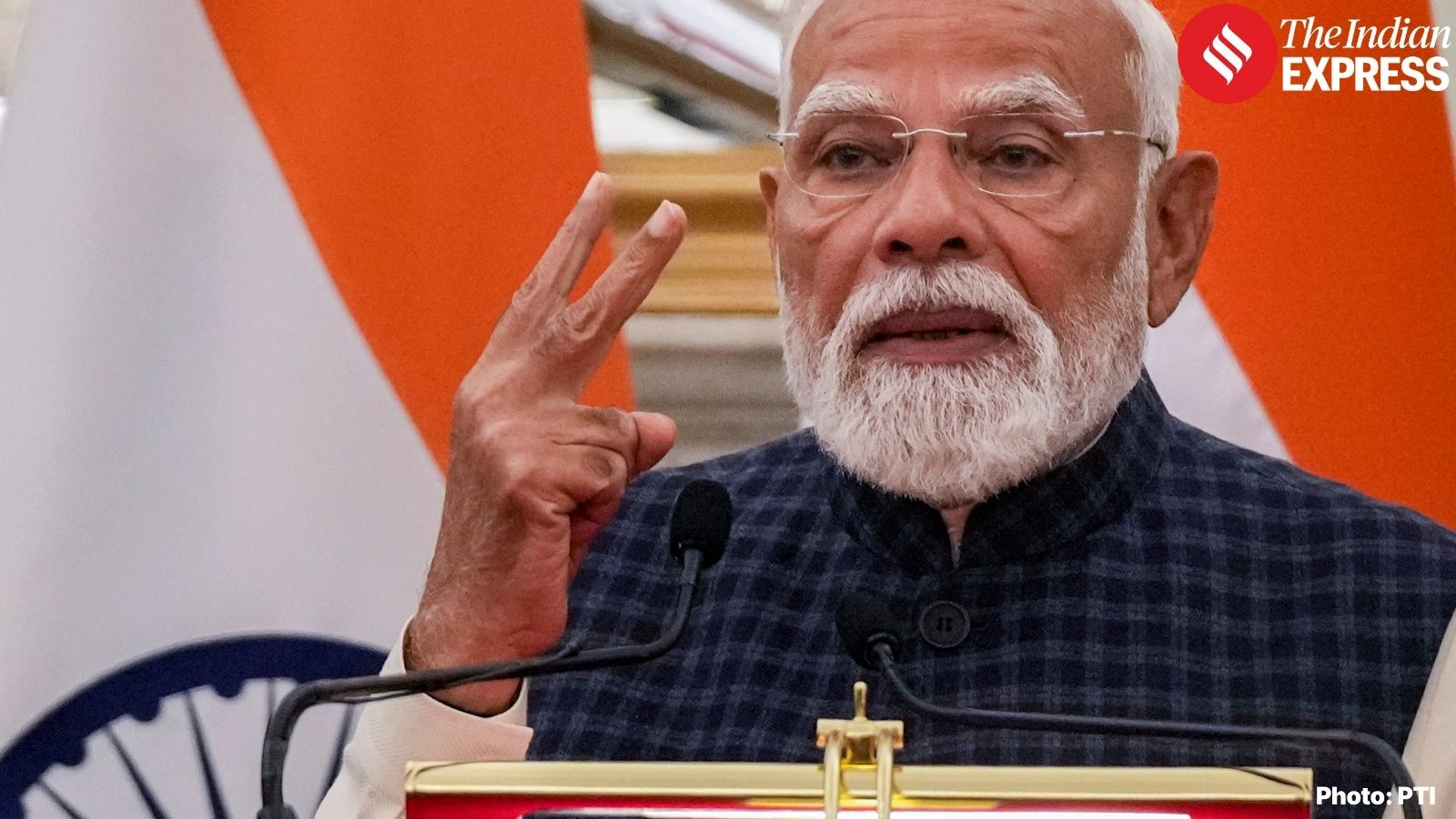
Prime Minister Narendra Modi completed 4,399 days in office on June 10, surpassing Jawaharlal Nehru as the longest continuously serving elected Prime Minister of India. More than the record, there are outstanding features that define his time in office.
First, Modi became the Prime Minister after an uninterrupted run as the longest-serving Chief Minister of Gujarat of over 13 years. Of the six people who were chief ministers before becoming prime minister, Morarji Desai was the Chief Minister of the erstwhile Bombay State for four and a half years. H D Deve Gowda, the only other one who transitioned straight from chief minister to prime minister, had clocked about two years.

Second, Modi has truly humble origins. Jawaharlal Nehru, Indira Gandhi and Rajiv Gandhi were born into affluence. Charan Singh, Gowda and Atal Bihari Vajpayee had modest backgrounds in middle-class or farming communities.
Like Modi, Lal Bahadur Shastri and Dr Manmohan Singh had difficult childhoods. All three faced extreme hardship and deprivation in their formative years. However, Modi led a hard life well into his adulthood as a grassroots-level RSS pracharak. Modi stands out for sacrificing his private life. When he became the PM, he donated his personal savings to create a corpus for the welfare and education of the daughters of Class IV government employees (primarily drivers and peons) of the Secretariat in Gandhinagar.
The Ethics of Public Office and Personal Detachment
Third, Modi’s detachment from personal wealth has extended to his official life. The gifts received by him as the head of government are auctioned. He has extended this norm to domestic mementoes, personal honours and sports memorabilia, channelising them to an annual national fundraising event.
Since 2019, the Union Ministry of Culture has conducted successive web e-auctions through the official portal – PM Mementoes. The proceeds are funnelled into the Namami Gange Fund, a central government initiative dedicated to cleaning and conserving the holy river Ganges. The cumulative proceeds from these specific e-auctions over the years have crossed Rs 50 crore. This is a continuation of the blueprint he created as Chief Minister of Gujarat, where gift items received by him raised over Rs 89 crore at public auctions to fund girl child education via the Kanya Kelavani initiative.
Fourth, Modi’s internationalism is aimed at making India more relevant amidst global flux. His policies and initiatives are centred on promoting trade, investment and technology flows, the welfare of the diaspora, and the leadership, values and vision that India can provide for peace and development as an important voice of the Global South. This is clearly reflected in path-breaking initiatives over the past decade, such as the International Day of Yoga (IDY), the Coalition for Disaster Resilient Infrastructure (CDRI), the International Solar Alliance (ISA), the One Sun One World One Grid (OSOWOG), the IRIS (Infrastructure for Resilient Island States), LiFE (Lifestyle for Environment), the Global Biofuels Alliance (GBA) and the International Big Cat Alliance (IBCA).
In the early years after Independence, Nehru played a major role in promoting Afro-Asian solidarity at global fora such as the Asian Relations Conference and the Bandung Conference. Modi has interpreted early concepts like non-alignment and Afro-Asian solidarity in a more dynamic manner, imbued with a more expansive vision about strategic autonomy, atmanirbharta and vasudhaiva kutumbakam (the world as a family) at the global level. Balancing ties with major powers, issue-based alignments and ensuring India’s interests are defining features.
Strategic Autonomy and the Global South Leadership
India’s leadership during the Covid pandemic, G20 presidency (during which the African Union was admitted) and the Artificial Intelligence summits point to a record on promoting global healthcare, environmental protection, climate change, green transitions, as well as technological inclusivity and data sovereignty for the Global South.
Setting goals for the nation and providing impetus at regular intervals through personal interventions is Modi’s hallmark. He has encouraged 1.4 billion Indians, especially the youth, to aspire to and strive for a better life, prioritising education, sanitation, healthcare, gender equality and inclusive economic growth. Modi has awakened India to the prospects of realising the goal of Viksit Bharat by 2047.
Modi’s drive, energy and personal relationships around the world have facilitated economic cooperation and collaboration in defence, security and intelligence-sharing. His leitmotif – advocacy of a peaceful resolution of the conflicts in Ukraine, Gaza and the Strait of Hormuz has been well received.
Fifth, Modi has supported a robust defence posture. It is during his 12 years as prime minister that the defence budget has seen major hikes. The armed forces have been increasingly equipped with the latest modern arms and equipment. His time in office is replete with examples of granting greater operational autonomy to the armed forces and security agencies in evolving appropriate responses to national security threats. Threats to territorial integrity have been met with robust action.
The Architecture of National Security and Governance Reform
The Modi government has reversed the historical policy of leaving the border regions underdeveloped. The construction of key roads and the Atal and Sela tunnels has vastly improved connectivity and reduced the response time to deal with threats on the northern frontiers. The Zojila Tunnel achieved its final structural breakthrough on June 9, 2026. Tourism in border regions is growing rapidly, forging a new connection between the people and territorial integrity.
Modi’s policy of zero tolerance for terrorism is complemented by resolute decisions to impose high costs on Pakistan through multi-domain strikes. Operation Sindoor stands out in particular. Moreover, Modi has taken bold decisions for reforms such as the creation of the office of the Chief of Defence Staff (CDS), the Department of Military Affairs, the Agniveer scheme and the proposed Theatre Commands. The military industrial complex is being strengthened, and private sector participation is encouraged. On the domestic front, the elimination of the long-festering Naxal challenge is a major achievement.
Sixth, Modi has held the bureaucracy responsible for its actions by promoting transparency and accountability. Simplification of administration and elimination of red tape have remained key objectives, keeping Gandhi’s antyodaya in mind, for the sake of the marginalised and underprivileged who suffer corruption and exploitation. The India Stack and JAM (the trinity of Jan Dhan, Aadhaar and Mobile) are core digital governance initiatives. More relevantly, bureaucrats, including diplomatic staff in overseas missions, have been encouraged to eschew pelf and privilege in favour of seva (service) and kartavya (duty).
Longevity alone does not make a leader consequential. Yet, when longevity is accompanied by a distinct vision, relentless energy and transformative ambition, it becomes more than a record. It becomes an era.
The writer is the Director General of the Manohar Parrikar Institute for Defence Studies and Analyses. Views are personal
