



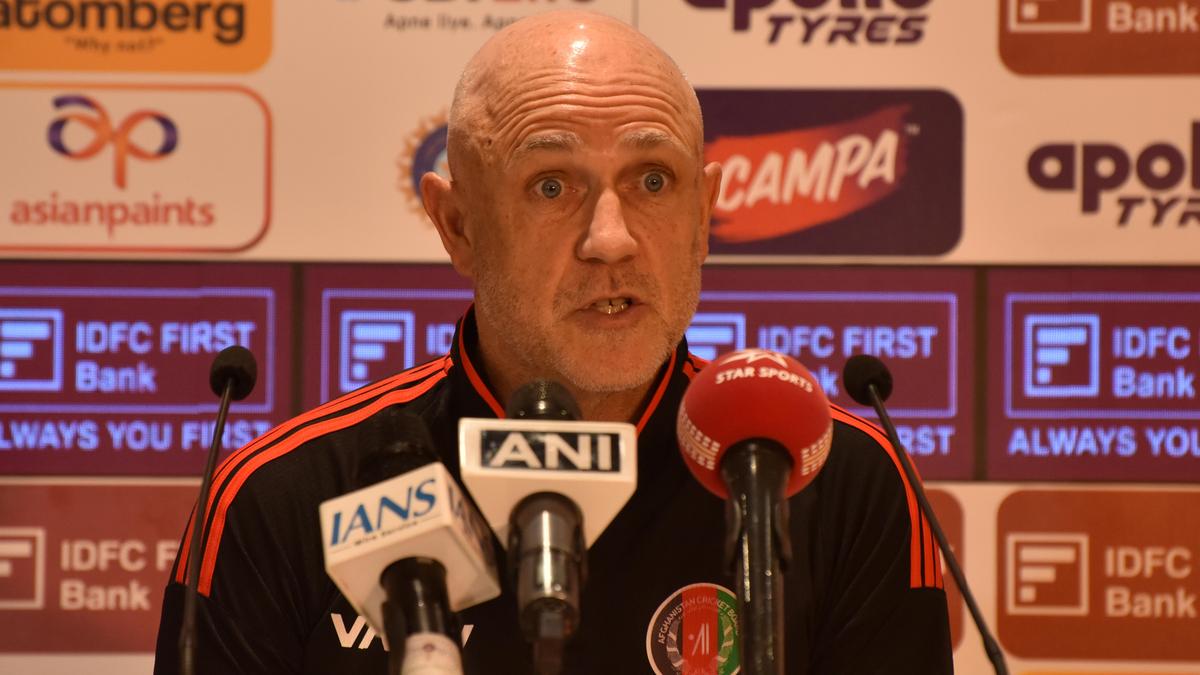

Afghanistan cricket team coach Richard Pybus addressing the media on the eve of the India- Afghansitan Test Match at the New Chandigarh Stadium on June 5, 2026.
| Photo Credit: R.V. Moorthy
By the conclusion of the one-off Test between India and Afghanistan at the Maharaja Yadavindra Singh Stadium, the presence of Richard Pybus in his team’s media commitments had become run-of-the-mill. The 61-year-old Afghanistan coach fronted up to questions on the eve of his maiden assignment as well as on all three days after play.
Through his repeated appearances, Pybus’ messaging about what ails Afghanistan’s Test team was consistent. A pithy encapsulation boiled down to the Asian side simply needing more games in the five-day version. It is hard to dispute that assessment when Afghanistan has got no more than 13 Tests in eight years.
The lack of regular game-time, of course, is a hard reality not restricted to Hashmatullah Shahidi & Co. Other teams like Zimbabwe and Ireland sail in the same boat, and often look out of depth when they come up against the big boys in the odd Test. A couple of weeks ago, the Irish were thumped by an innings and 79 runs by New Zealand inside three days in Belfast.
Such one-sided results are part of the vicious cycle that hinder these outfits from getting more Tests at a time when the format’s viability beyond the top teams is on shaky ground. However, Pybus pointed to how far Afghanistan’s cricket has travelled in the shorter formats to call for a similar leap of faith in whites.
“In the same way that the white-ball side has developed, you can only develop through fixtures. That’s it. There are no two ways about it,” Pybus said.
While that is for the ICC to mull over, Afghanistan has to address some of its own shortcomings. Among them is the structure of the First Class competition in the strife-torn nation.
“There aren’t that many First Class sides and it is not a long fixture list. There are some structural questions. I will have some feedback for the cricket board when I go back,” he conceded.
The other major challenge, stemming from the financial clout of T20 leagues, is the waning commitment of the country’s white-ball stars to the longer format.
“The board has allowed two leagues for every player. It has restricted the amount of leagues that can be played to protect the integrity of the domestic game. I don’t think the board is in a situation different from any of the other associations,” Pybus stated. “There are economic decisions that players are going to make. That is the challenge. It is about getting that balance right.”
Published – June 10, 2026 11:14 pm IST

