



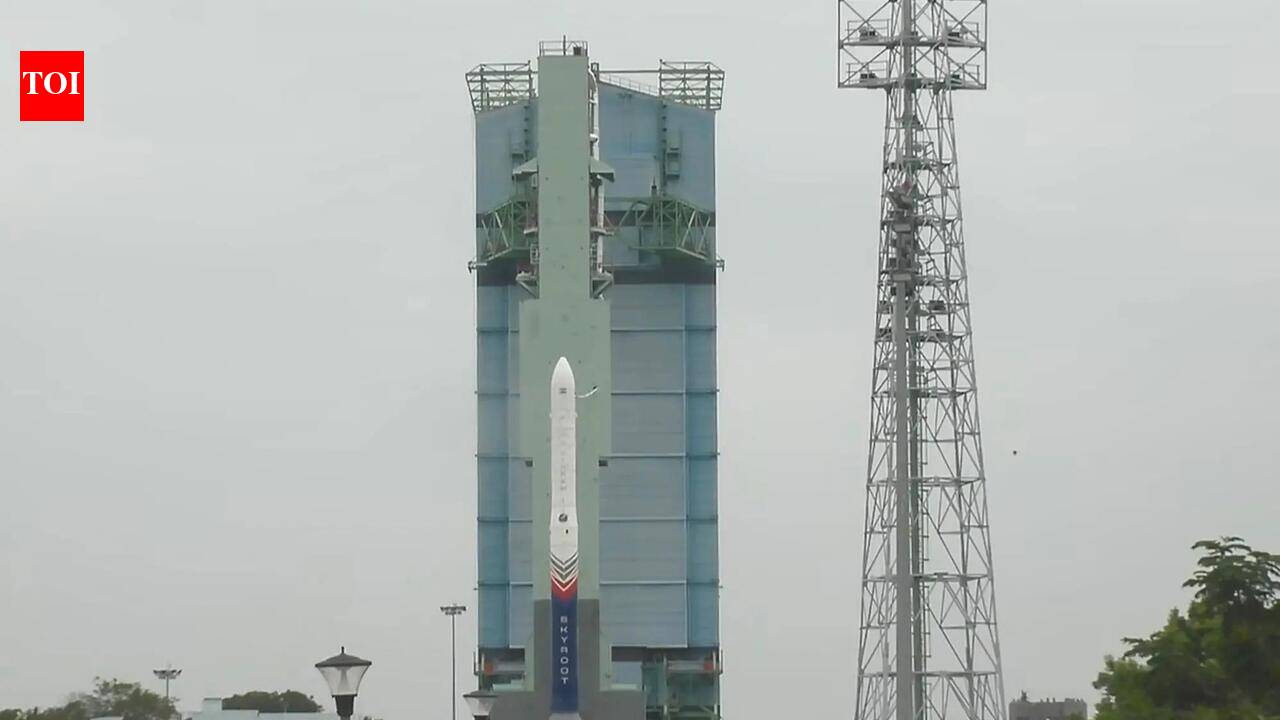
BENGALURU: Somewhere inside the payload bay of the rocket that lifted off from the First Launch Pad at the Satish Dhawan Space Centre (SDSC) on Saturday morning, tucked among satellites and sensors, rode an 18-karat gold rocket no bigger than a matchbox. It carried tiny sculpted likenesses of three men who never lived to see this day — Vikram Sarabhai, CV Raman and APJ Abdul Kalam — the scientists whose names Skyroot Aerospace has spent years borrowing for its engines and rockets. It was a strange kind of cargo for a company attempting one of engineering’s hardest feats: reaching orbit on the very first flight of an all-new rocket. By the time the countdown reached zero, Skyroot didn’t need luck. It needed nine years of it having already been spent — on carbon-composite layup rooms, 3D-printing labs, and hundreds of static-fire tests most of India never heard about. Mission Aagaman — Sanskrit for “arrival” — ended that anonymity. Vikram-1 flew a nominal profile to its target Low Earth Orbit of roughly 450km at a 60° inclination, deploying its own SCOPE satellite and Grahaa Space’s Solaras satellite alongside Cosmoserve Space’s EMBRACE payload and a cluster of in-orbit experiments. In doing so, Skyroot became the first private company anywhere in India to design, build and fly a rocket to orbit, and did it on the maiden attempt, a feat that has eluded far better-funded startups elsewhere in the world. Carbon not steel Vikram-1 doesn’t resemble the launch vehicles India has flown for six decades. It is a seven-storey, multi-stage orbital rocket built around an all-carbon-composite airframe, a material Skyroot says is roughly five times lighter and stronger than the steel traditionally used in rocket bodies. Its stages are powered by propulsion the company built in-house from scratch, including 3D-printed engines and high-thrust solid motors, and it carries what the company describes as India’s longest monolithic carbon-composite rocket stage. Designed to carry small satellites of up to 350kg to Low Earth Orbit, Vikram-1 also flies with ultra-low-shock, ground-testable separation systems engineered specifically to protect the delicate spacecraft riding inside it — the kind of unglamorous engineering that rarely makes headlines but is often what separates a successful orbital insertion from an expensive failure. On Saturday, that engineering carried more than satellites. Alongside SCOPE, Solaras and EMBRACE, the rocket flew technology-demonstration payloads from Cosmoserve and the German firm DCubed, an artistic lab-grown diamond called “Cosmic Bloom” from Cosmos Diamonds, and that miniature gold rocket — a small, almost sentimental reminder, in a mission full of hard numbers, of what access to space can carry along with it. ‘This isn’t the destination. It’s the beginning’ For the two engineers who founded Skyroot in 2018, the flight was the resolution of a bet made years before anyone believed India’s private sector could build an orbital rocket at all. “We are immensely proud to stand here today,” said Pawan Kumar Chandana, co-founder and CEO of Skyroot Aerospace, after confirmation that Vikram-1 had reached its designated orbit and deployed its payloads. “What the world witnessed today is the result of years of work by our team, our partners and suppliers across the country. It proves that India has the talent, the technology and the industrial strength to build launch vehicles that meet the world’s standards and to serve the world from here.” He was unambiguous about what comes next. “Our mission has always been to open space for all. Today we opened that door a little wider. This is not the destination. It is the beginning. From here, we leap.” Naga Bharath Daka, Skyroot’s co-founder and COO, framed the launch as the product of relentless, largely invisible labour. “Mission Aagaman is the culmination of years of engineering, rigorous testing and an unwavering commitment to solving some of the hardest problems in Space. Every milestone today reflects the dedication of hundreds of engineers, technicians and mission specialists who believed in pushing the boundaries of what was possible,” he said. He added that the company was already looking past the celebration. “Even as we celebrate, we are already applying today’s learnings to the next chapter of the Vikram series and to building a world-class launch capability from India, for the world.” That next chapter is already sketched out. Skyroot’s roadmap includes Vikram-2, a larger vehicle capable of carrying up to 1,000 kg to Low Earth Orbit, with a maiden flight targeted for 2027, and a fully reusable launch vehicle — booster and upper stage both engineered for recovery — aimed at driving the cost of reaching orbit down further still. The weight of a 1,000 people Numbers rarely capture what a first orbital launch actually costs a company. Vikram-1’s success drew on the work of more than a thousand people inside Skyroot and close to four hundred external suppliers across the country — a supply chain that, three years ago, largely didn’t exist for a rocket like this. During the flight itself, Vikram-1 hit every principal milestone in its mission plan, validating the performance of its propulsion, avionics, and guidance, navigation and control systems under real flight conditions rather than in a lab. The vehicle successfully deployed its customer payloads and, Skyroot says, generated a wealth of in-flight data that will directly shape the design of future Vikram missions. For a company that built its first sub-orbital rocket, Vikram-S, in 2022, Saturday’s flight marks the leap from proving a concept. Skyroot, of course, will need a few more test missions before declaring the rocket commercially viable, but every satellite operator now watching Vikram-1’s telemetry data understands that there’s a new, homegrown option for getting small satellites into orbit. What officials said Prime Minister Narendra Modi personally called the Skyroot team to congratulate them, and had earlier sent a handwritten postcard inscribed with “Vande Mataram” to fly aboard Vikram-1, along with hundreds of messages from well-wishers around the world. Isro chairman V Narayanan, said: “I extend my heartfelt congratulations to Team Skyroot on the successful accomplishment of the Vikram-1 mission. This achievement is the outcome of years of innovation, perseverance and engineering excellence, and reflects the growing maturity of India’s private space sector. It is encouraging to see Indian industry translating technological capability into launch capability, complementing our national space programme. Isro and IN-SPACe remain committed to working closely with industry partners to build a vibrant, globally competitive space ecosystem that advances India’s space ambitions.” Pawan Goenka, chairman, IN-SPACe, called it a milestone for the country as a whole: “This is a proud day, not just for Skyroot but for the whole country. Only a handful of nations can reach space on their own, and today a private Indian company joined that exclusive club. What lifted off today is the culmination of years of work, a team of over a thousand people, and efforts of close to four hundred suppliers with it. Congratulations to team Skyroot. You have given us an India moment.”
