



4 min readMay 19, 2026 12:26 PM IST
First published on: May 19, 2026 at 12:26 PM IST
Written by Saina Ismailee
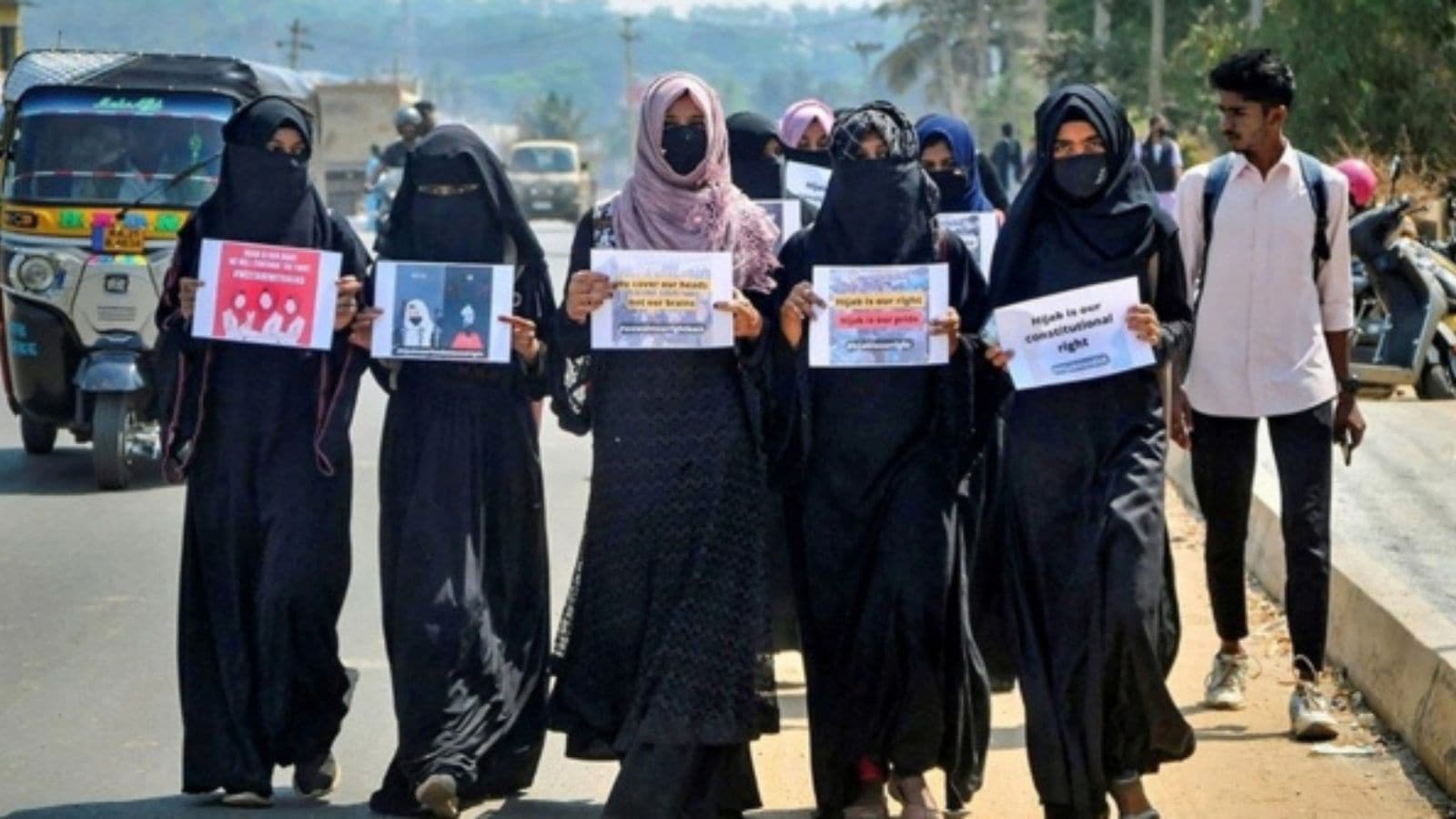
On May 15, The Indian Express reported stories of four women — Aliya, Almas, Resham, and Muskan — who challenged the Karnataka Government Order of 2022, which banned hijab in classrooms. While Aliya and Almas managed to continue their education through open learning, Resham and Muskan dropped out. Several others dropped out. Some got married.
On May 13, the Karnataka government withdrew its 2022 Order, effectively reversing the hijab ban. BJP national spokesperson Shehzad Poonawalla called it Muslim appeasement and demanded to know why saffron shawls were not given the same treatment. Notably, the new order allows limited religious symbols of multiple faiths, including hijab, turban, sacred thread (janeu), shivdhara, and rudraksha. Yet, Poonawalla’s question on the parity of hijab and saffron shawls deserves attention. It assumes a blanket prohibition on both is comparable. They are not, and the reason has nothing to do with who constitutes the majority or minority.

A neutral-looking law that prohibits all religious symbols in classrooms does not equally impact everyone. It disproportionately burdens some more than others, leading to unequal costs. In the Karnataka case, the cost for hijab-wearing Muslim girls was education.
The saffron shawl became a specific symbol of political counter-protest to resist hijab in 2022. Consider what a student loses when she cannot wear a saffron shawl to college. She loses a form of expression or cultural preference. She can still enter the building, appear for her exams, and collect her degree. The restriction stings, but it does not take away her education. That is because the saffron shawl is not constitutive of her identity. Removing the garment at the gate does not cost her education. It can be removed and set aside without any loss to the person wearing it. This, however, is not the case for a hijab-wearing Muslim woman.
Hijab is a manifestation of one’s deeply held religious way of life, not merely a cultural preference. For a hijab-wearing woman, it is constitutive of her identity. Removing the hijab and entering the classroom are not two separable acts. They constitute a single forced choice between her faith and her future. The ban makes religious identity and education mutually exclusive. It forces a hijab wearing woman to surrender her identity to access education.
In 2022, the state removed an option that these women actually had: Accessing education while practising their faith. Unlike someone who wore a saffron shawl during protests, the same ban cost a hijab-wearing Muslim woman her education. The unequal impact is so different that it cannot be equated. In other contexts, like France, studies demonstrate how the hijab ban negatively impacted Muslim women’s educational attainment and life outcomes, reducing their economic independence.
The People’s Union for Civil Liberties-Karnataka’s 2023 report Closing the Gates to Education cites the Karnataka government’s own figures, which show that 1,010 Muslim women aged 16-18 dropped out of college following the ban. On January 8, 2023, The Indian Express reported that enrolment of Muslim students in government colleges in Karnataka had dropped by half since 2022. The broader national picture explains why this matters.
The ‘Rethinking Affirmative Action for Muslims in Contemporary India report’ (Ahmed, Alam, Parveen, 2025) finds that Muslim girls have the lowest educational participation rate of all socio-religious groups in India. In the 18-25 age group, only 12.7 per cent of Muslim girls are in education, as opposed to 27.6 per cent for Hindu Forward Castes. At the age of 14-17, only 64.3 per cent of Muslim girls are currently in education, as opposed to 91.7 per cent for Hindu Forward Castes. A study based on the AISHE 2021-22 report showed that Muslims account for just 4.87 per cent of higher education enrolments against a population share of over 14 per cent. It declined from 5.5 per cent in 2020. Adding a hijab ban on top of this compounds an existing disadvantage.
Recognising that identical rules can produce unequal burdens and costs is the basic condition of treating people equally, not special treatment for a community. It is the state’s responsibility to ensure that those disproportionately burdened don’t drop out.
The writer is an Assistant Professor at the School of Law, BML Munjal University. She is an upcoming ICLRS Young Scholar Fellow on Religion and the Rule of Law
