



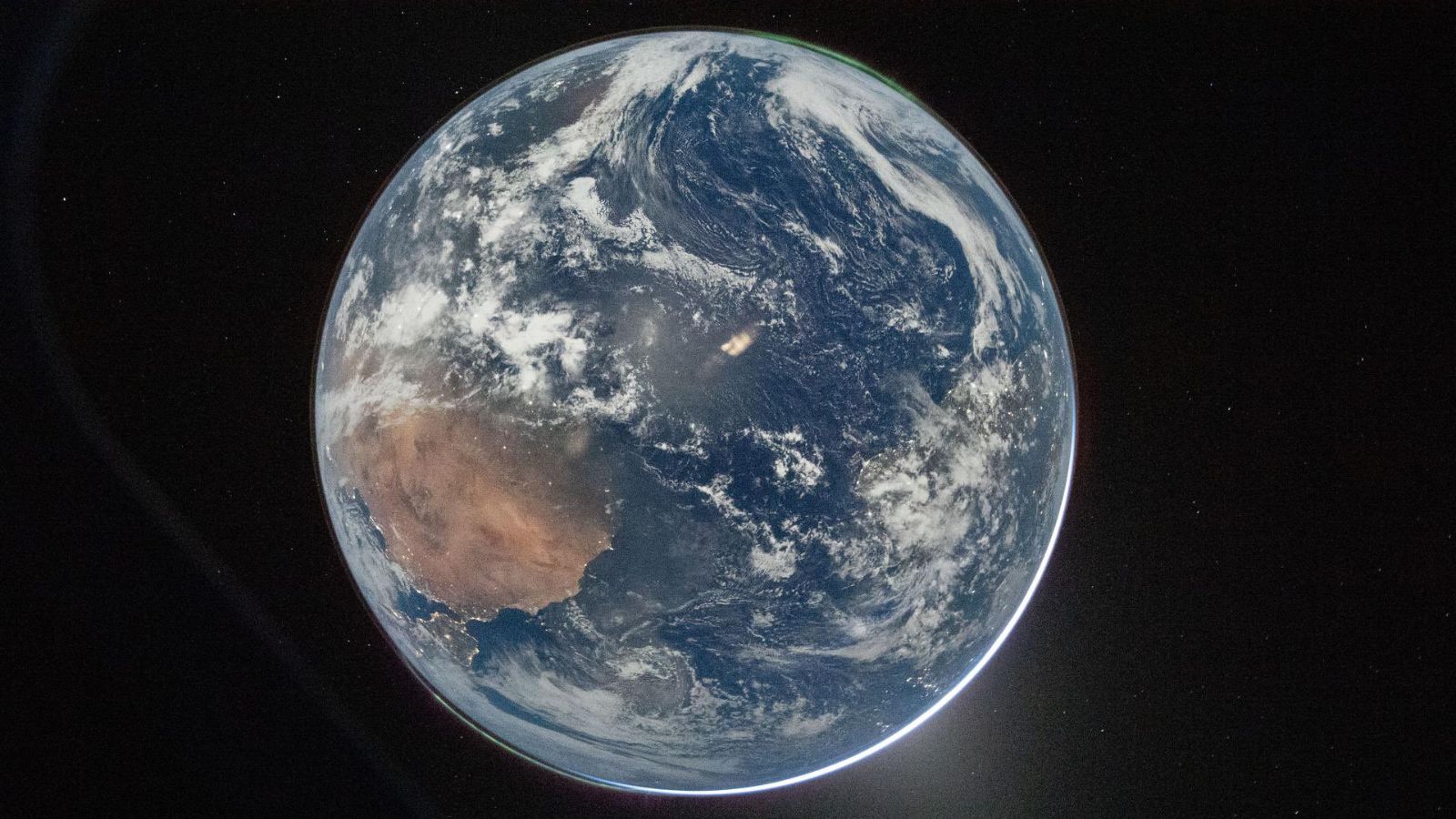
The irony is so bitter it makes pure vinegar seem palatable in comparison. Artemis II sent us pictures of our achingly beautiful planet from space, while here on earth, murderous madmen are hellbent on bombing us into oblivion.
Carl Sagan’s unforgettable words, on the last photograph of Earth taken by Voyager-1 from a distance of over 6 billion kilometres — our planet a barely visible dot in the infinity of space, “a mote of dust suspended in a sunbeam” — have never felt more resonant. He wrote, “The Earth is a very small stage in a vast cosmic arena. Think of the rivers of blood spilled by all those generals and emperors so that, in glory and triumph, they could become the momentary masters of a fraction of a dot. Think of the endless cruelties visited by the inhabitants of one corner of this pixel on the scarcely distinguishable inhabitants of some other corner, how frequent their misunderstandings, how eager they are to kill one another, how fervent their hatreds… Our planet is a lonely speck in the great enveloping cosmic dark. In our obscurity, in all this vastness, there is no hint that help will come from elsewhere to save us from ourselves.”

In this latest iteration of human insanity, Western hegemonic hubris, victims-of-genocide-turned-perpetrators and murderous authoritarian clerics have come together to bring us to the brink of Armageddon. Words have lost all contextual meaning. The terms “terrorists”, “murderers”, “rogue states”, “war criminals”, “despots”, and “agents of ecocide” could apply equally to all parties involved. Economic warfare in one narrow corner of the planet is creating even more pain for the poorest people all across the world. “Globalisation”, once a word that signified abundance and prosperity, has now been weaponised to create scarcity and despair.
In her luminous novel Orbital, Samantha Harvey describes the experiences and emotions of six astronauts as they view our planet from space. “When we’re on that planet, we look up and think heaven is elsewhere, but here is what the astronauts and cosmonauts sometimes think: Maybe all of us born to it have already died and are in an afterlife. If we must go to an improbable, hard-to-believe-in place when we die, that glassy, distant orb with its beautiful, lonely light shows could well be it.”
If we are, in fact, living in an afterlife, then from down here, there is no doubt that humans are solely responsible for destroying our heaven-like planet. Certainly, no civilians in Gaza or Tehran or Lebanon, no prisoners in Delhi or Cairo or Beijing, are experiencing this earth as jannat or heaven. Many have never experienced life as anything but suffering for the entirety of their existence. You just have to look out of your air-conditioned car at the vast number of human beings existing without running water, electricity, nutrition, and sanitation in the slums and encampments of Mumbai or Nairobi or San Francisco, to know that man-made, market- and policy-induced hell is very much a place on earth.
But to be alive on this third rock from the sun is to be hyper-aware that we are surrounded constantly by the possibility of happiness, beauty, and pleasure, no matter how momentary — a possibility that makes life unbearably precious. Despite the chaos and pain that mankind cruelly inflicts on our lonely planet and the myriad life forms that it sustains, we live in a state of perpetual enchantment. Every day we are ambushed by moments of joy and beauty: Music, art, dawn, dusk, plants, trees, the use of our miraculous bodies, chai, samosas, a kiss, a joke, a smile, the sound of laughter, an act of kindness, and most of all the incomparable embrace of nature and the love of our fellow living beings.
The only hope we have to overcome the “folly of human conceits” exposed by images of our microscopically tiny world from space is, as Sagan said, “to deal more kindly with one another, and to preserve and cherish the pale blue dot, the only home we’ve ever known.”
The writer works in the social sector
