



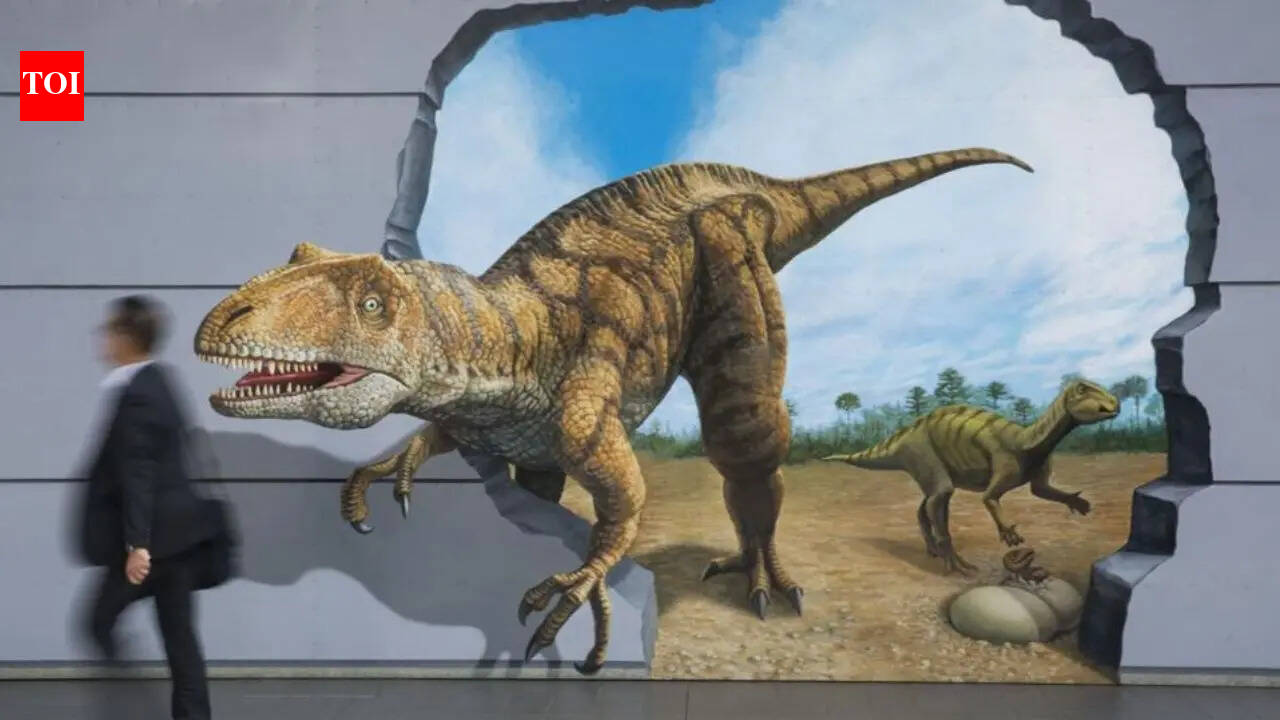
There is a growing idea in evolutionary biology that human ageing might not just be a modern biological process. Instead, it may be rooted in a very ancient survival strategy shaped millions of years ago. According to microbiologist João Pedro de Magalhães from the University of Birmingham, early mammals lived in a world dominated by dinosaurs, where survival was extremely difficult. In that environment, long life may not have been important at all. What mattered more was staying alive long enough to reproduce quickly. This perspective suggests that the way humans age today might still carry traces of that prehistoric pressure, even though the world around us has changed completely.
How dinosaur-era survival shaped early mammal life
During the Mesozoic Era, mammals were small and mostly hidden from large predators like dinosaurs. They did not dominate ecosystems the way they do now. Instead, they lived in constant risk, often active at night and forced into survival mode at all times. In such conditions, longevity was not a priority trait for evolution. Experts suggest that natural selection likely favoured animals that reproduced quickly rather than those that lived longer. A short but successful reproductive life was more valuable than a long one that might never reach adulthood.This constant pressure may have shaped mammalian biology in a lasting way. It is possible that many traits linked to long life simply never developed fully because they were not needed for survival.
The idea behind the longevity bottleneck theory
According to the study published in BioEssays Online Library, titled, ‘The longevity bottleneck hypothesis: Could dinosaurs have shaped ageing in present-day mammals?’, João Pedro de Magalhães describes this idea as the “longevity bottleneck hypothesis.” It suggests that early mammals may have gone through a long evolutionary phase where survival depended on rapid reproduction rather than body maintenance or long-term repair systems.Over millions of years, this could have led to the weakening or loss of certain genes associated with long lifespan. Once such biological pathways are reduced or switched off, they may not easily return, even when environmental conditions change later. This theory is still under scientific discussion, and it is not widely accepted as fact. However, it does offer a new way of thinking about ageing that connects modern humans to ancient evolutionary pressures.
How survival in ancient times shaped mammal limitations
One of the most interesting parts of this hypothesis is the idea that mammals may have lost certain biological abilities during their evolutionary past. Compared to some reptiles and other animals, mammals show limited regeneration in certain areas. For example, most mammals cannot regrow teeth once they are lost, while some reptiles continue growing them throughout their lives. There are also differences in how species repair DNA damage caused by environmental factors such as ultraviolet radiation.Researchers suggest that these limitations might not be accidental. Instead, they could be the result of evolutionary trade-offs where long-term maintenance systems were reduced because they were not necessary during periods of high predation and short lifespans.
How 100 million years of survival shaped mammals
With that being said, if there is any merit to this hypothesis, it means that aging in human beings may not only be a biological process that occurs currently. Rather, it could have been affected by the evolution of mammals dating back millions of years ago. According to de Magalhães, early mammals could have taken up to 100 million years to evolve under continuous danger. This is an immensely long period during which biological processes would have developed in a particular organism. Even after losing their relevance, such biological processes may continue.This may be one of the explanations of why mammals like humans are not very effective at regeneration.
Why scientists are still debating the longevity bottleneck theory
The idea is still being explored and debated within scientific circles. Not all researchers agree with the conclusions, and more evidence is needed before it can be confirmed. Still, it provides a different lens through which ageing can be viewed. Instead of seeing ageing only as a gradual breakdown of the body, this theory suggests it may also be shaped by ancient survival strategies. These strategies may have prioritised speed and reproduction over long-term repair and longevity.If that is true, then human ageing might be carrying echoes of a prehistoric world where surviving dinosaurs mattered more than living long lives. And that possibility changes the way we think about time itself inside the human body.

