



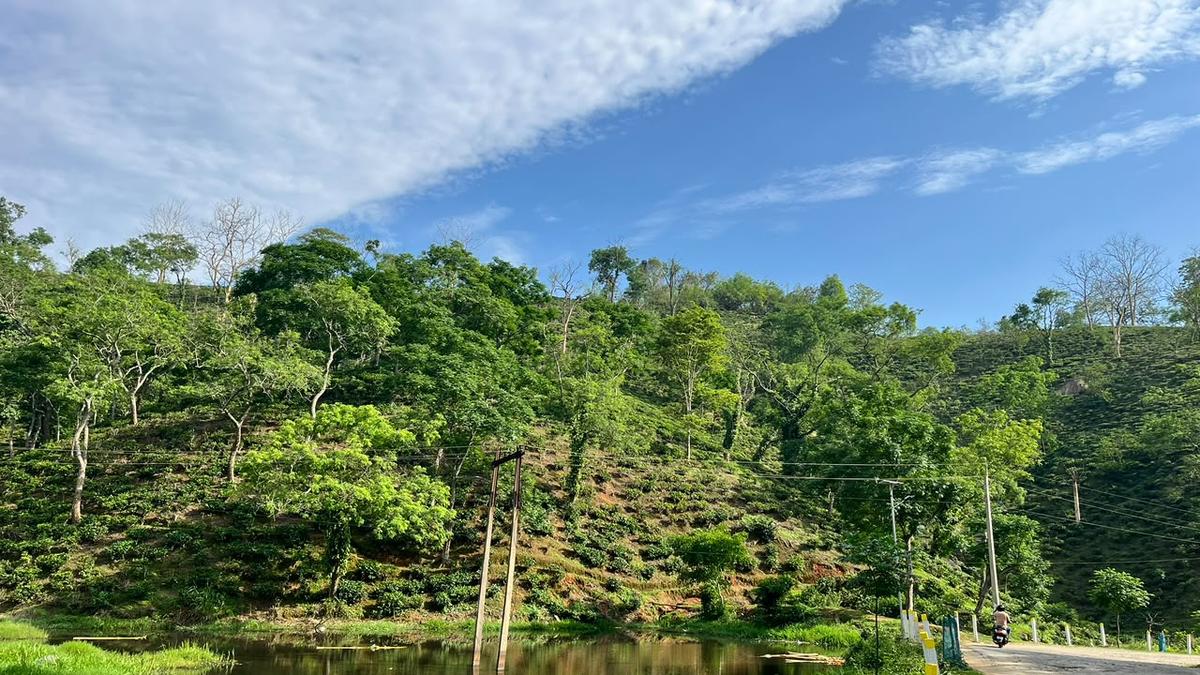
Ever tried retracing a memory from the pre-digital era, when an analogue camera was your only visual archive? As someone who grew up in Guwahati, I had spent years trying to remember the route to a picnic spot my school once visited. I remembered rolling hills, tea gardens, orange and mulberry trees, and the freedom of running through a sprawling estate. All I could recall was its name: Amsoi.
Cut to 2026, and I am driving to Amchong Tea Estate, just 40 minutes from my home in Chandmari. The closest tea estate to Guwahati, it sits on the city’s outskirts, though it feels very much like a world of its own.

VIew of the model tea factory at Amchong
| Photo Credit:
Prabalika M Borah
As we leave Guwahati behind and enter Narengi, the roads narrow, the greenery thickens and the city’s bustle gradually gives way to the unhurried rhythm of the countryside.
My chauffeur tells me Amchong which is 68 years old is among one of the oldest tea estates within the city’s limits and can also be accessed via Sonapur, around 20 kilometres from Guwahati. As I admire the tea-covered hills and glistening water bodies, he casually mentions that the estate was once known as Asmoi.

VIew of the model tea factory at Amchong
| Photo Credit:
Prabalika M Borah
“Are there orange trees inside?” I ask, almost instinctively.
Spread across 1,782 acres, Amchong is a third-generation tea estate that has expanded beyond tea cultivation. To encourage travellers to include a tea garden experience on short trips to Guwahati, the estate launched Amchong Leaf: A Tea Walkthrough Experience, an immersive programme designed to bridge traditional tea production with sensory appreciation in in February this year.

Today, the estate offers a complete leaf-to-cup journey. Alongside the tea gardens are a restaurant, Tea Leaf, an experiential centre, a viewing gallery overlooking the processing unit, and a dedicated tea tasting room.

Pizza at Steep House
| Photo Credit:
Special Arrangement
The three- to four-hour experience caters to varied interests and budgets, with packages priced from ₹599 to ₹2,499 per person. Depending on the package, visitors can try tea plucking; Blend n Sip, a guided tea tasting and blending session; T’Journ, an immersive exploration of tea’s history, culture and craft; and a factory tour tracing the journey from freshly plucked leaves to finished tea.
Other activities include gypsy safaris, guided garden walks, insights into tea cultivation, interactions with tea artisans, nursery visits and ATV rides. Guests can also enjoy lunch at Steep House, which serves a thoughtfully curated menu.
“Each package offers a different way to experience the estate and understand the journey of tea,” says Ananya Khemka, director, Bhauram Jodhraj, Amchong Tea Estate & Amchong Leaf.

Teas on dispaly Blend and Sip
| Photo Credit:
Prabalika M Borah
I chose to take a tour of the estate — one that doubled as an off-road adventure. Riding through hills and rugged terrain in a 4×4 jeep, I passed streams, dense vegetation and sweeping tea gardens. From the highest vantage point, the panoramic view of the estate made it worth the bumpy ride.
If adventure is not your thing, Tea Leaf offers a quieter start. Overlooking the hills, its spacious outdoor seating area is easily the most coveted spot. While the menu features familiar café fare, it also serves traditional Assamese dishes such as khorikat diya maas, maas pitika and til chicken, alongside wood-fired pizzas. Fragrant jasmine borders the restaurant’s gardens, adding to its relaxed charm.
The experiential centre traces tea’s remarkable journey, from its origins to the beginnings of tea cultivation in Assam. Among its more fascinating chapters are the stories behind the rise of milk tea and the smuggling of tea saplings into India.
Visitors then move to a viewing gallery, where they can watch the different stages of tea processing unfold below.
“The estate features immersive projection-mapping installations that trace the origins of tea, along with a viewing gallery overlooking the processing floor,” says Ananya. “The experience culminates in a tea tasting and blending session, where guests can pluck their own leaves and learn about different flavour profiles.”
As Assam marks 200 years of its tea industry, Ananya says the time felt right to create an experience that honours its legacy.
“Rather than simply talking about tea, we wanted visitors to walk through the gardens, see how fresh leaves are transformed into finished tea, interact with the people behind every harvest and understand what goes into producing an exceptional cup. Today’s travellers are looking for authentic, immersive experiences, and Assam — with its tea heritage, natural beauty and culture — is uniquely placed to offer them.”
Since its launch, the estate has welcomed around 10,000 visitors a month, including tourists, tea enthusiasts, corporate groups and international travellers.
Having attended several coffee cuppings and brewing workshops, this was my first hands-on tea-brewing session. The process is surprisingly precise. Once visitors select a tea, the leaves are carefully measured and brewed according to the varietal.

“One can choose from CTC, orthodox black, green and oolong teas, along with a selection of speciality and seasonal varieties, depending on availability,” says Zameer Sodhi, who heads the tea experience.
The tea house itself is elegantly designed, with warm wood and glass elements keeping the focus firmly on the teas. The brew is theatrically swirled in borosilicate kettles before being poured into cups, while the brewer explains each tea’s flavour profile and characteristics.
For anyone looking to experience Assam’s tea heritage beyond simply drinking a cup, Amchong offers one of Guwahati’s most immersive leaf-to-cup journeys.
The writer was at Amchong Tea Estate on invitation
