



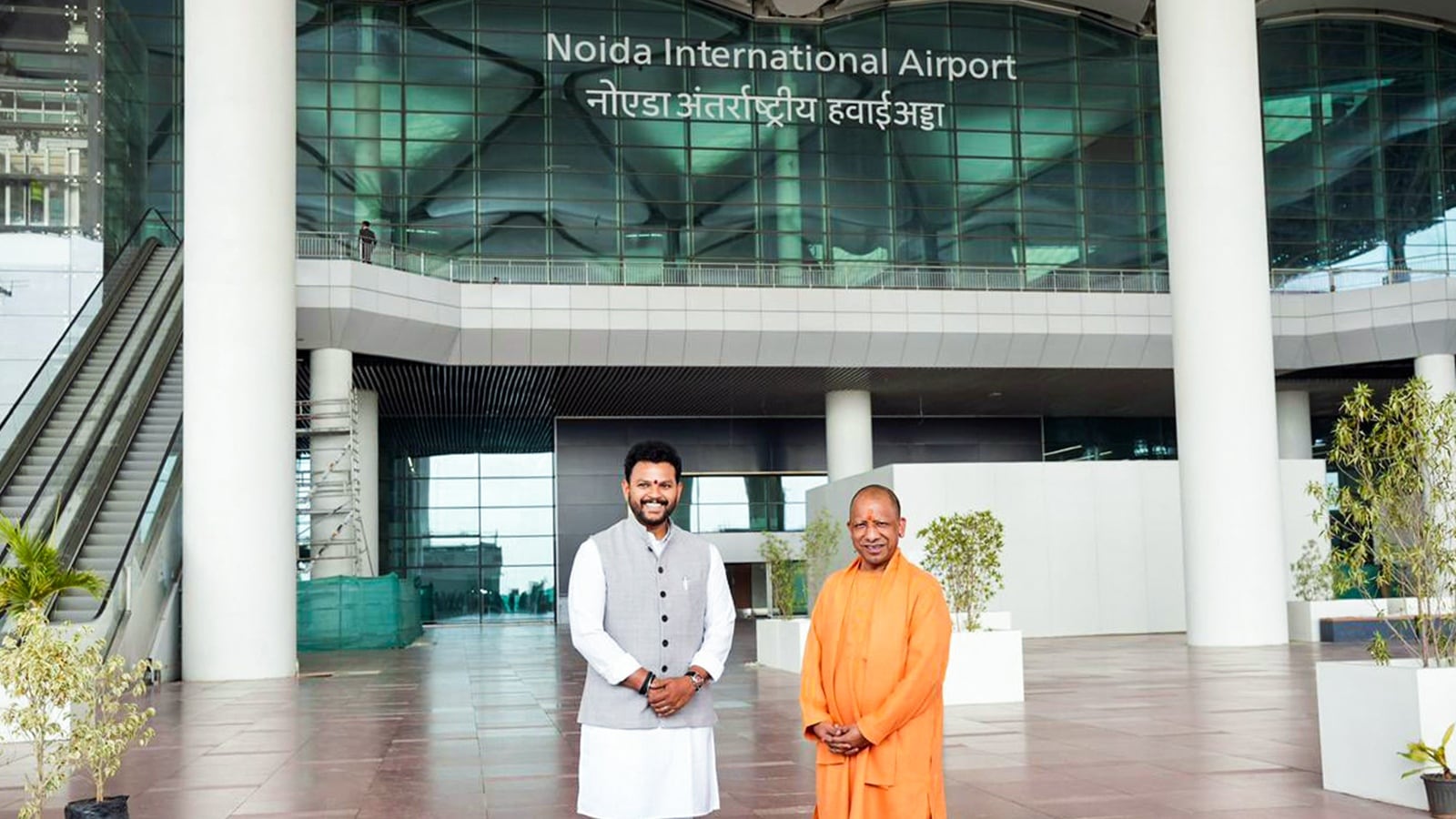
On March 28, Prime Minister Narendra Modi inaugurated Noida International Airport (NIA) in Jewar, Uttar Pradesh. Built at a cost of around Rs 11,200 crore, the airport will transform the size and character of UP’s economy. When fully developed, it will be able to handle 11.6 crore passengers, 7.3 lakh flights and 28 lakh metric tonnes of cargo each year, making it one of India’s largest airports and air-logistics hubs.
The airport will be an important piece in UP’s infrastructural and economic strategy puzzle, positively impacting the state’s economy in four ways: Increasing GSDP, creating a large number of quality jobs, generating new economic opportunities, and deepening the technology and electronics manufacturing sectors in western UP. Let us look at each of these in some detail.

India’s aviation market is estimated at Rs 1.6 lakh crore, with six Tier-1 cities accounting for 68 per cent of this market. Amongst the states, Delhi leads the pack with a 20 per cent market share. In contrast, UP’s share is barely 4 per cent. NIA will rapidly alter that reality as its annual air-passenger traffic will exceed 3 crore by 2034, more than double the current figure for the entire state of UP. Thus, the airport will enhance UP’s GSDP significantly.
Currently, India’s aviation sector generates around 3.7 lakh direct and 77 lakh indirect jobs. Given the state’s small aviation footprint, not many UP residents benefit from these jobs. NIA’s launch changes that story as well, with its developers estimating that over 1 lakh direct jobs — many of them high-quality — and many lakhs of indirect jobs will be created over the airport’s development period.
India’s air cargo sector is currently dominated by six metro hubs: Delhi, Mumbai, Bengaluru, Chennai, Hyderabad, and Kolkata. With UP aspiring to become a $1-trillion economy in the next few years, and with a population of 24 crore, it needs a large air cargo hub of its own. The facility at NIA will fill that gap, with an immediate annual capacity pegged at 2.55 lakh MT, about half that of BIAL, which will increase to 15 lakh MT over a period of time. Air cargo hubs are economic engines that facilitate over 35 per cent of global trade by value (about $8 trillion annually). They drive GDP growth, create high-value jobs and play a pivotal role in drawing FDI and generating forex for the country.
The airport is proximal to three important expressways (the Yamuna Expressway, the Delhi-Mumbai Expressway, and the Eastern Peripheral Expressway), and two railway-based dedicated freight corridors (EDFC and WDFC). These are arguably Bharat’s principal arteries as they transport over 100 million MT of freight each year. A series of multi-modal facilities will ensure seamless and speedy transfer of cargo between these arteries and the airport: An interchange connecting the Yamuna Expressway and the Eastern Peripheral Expressway; a logistics hub that will link industrial zones around the Yamuna Expressway to the Eastern DFC; and a 31-km road to connect the Delhi-Mumbai Expressway, the Eastern Peripheral Expressway, the DFC, and NIA.
Via these interchange systems, we will see the creation of a single efficient goods transport system in UP. This will enhance UP’s logistics and economic efficiencies through cost reductions, reduce transit times, improve supply-chain reliability, and enhance capacity. It will also promote green logistics via reductions in carbon footprint, and easier regulatory compliance.
Now that NIA has been inaugurated, it’s important for UP’s economy managers to ensure that the saturation curve of the airport’s utilisation reaches its peak sooner rather than later. They need to ensure the following: Seamless passenger connectivity within a radius of 100 km from the airport; superior passenger experience at the airport; a robust budget hotel industry close to the airport; financial incentives for airlines; an attractive warehousing policy; and the development of land around the airport so that it will be suited to quality living and high-tech industry. This will require a team of experienced and motivated professionals who understand the airline, airport and air cargo businesses and are adept at working with government circles. Such an approach will certainly bring a glorious shine to Jewar and benefit UP and Bharat.
Tiwari is professor at IIT Kanpur and coordinator of UP CM’s Economic Advisory Group. Pai is chairman of Aarin Capital and member of UP CM’s Economic Advisory Group
