



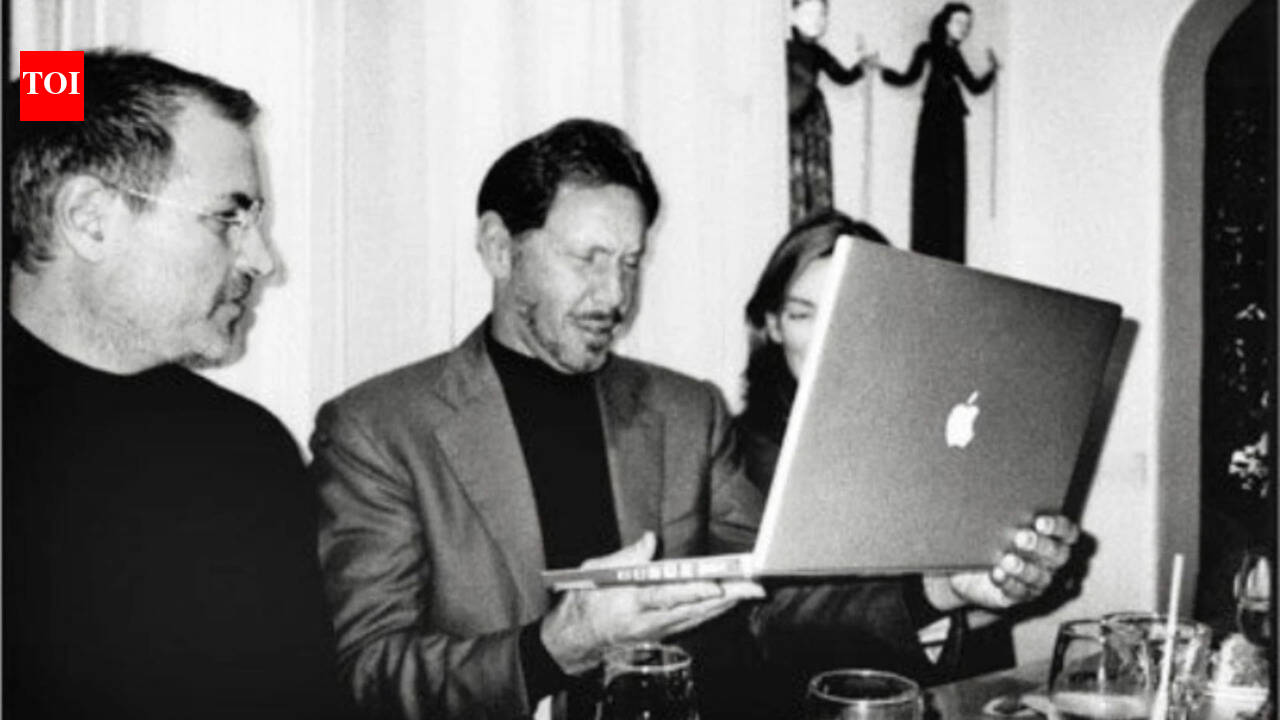
Larry Ellison once had the money, the credit, and a fully worked-out plan to buy Apple outright. What he did not have was Steve Jobs’ agreement. The Oracle co-founder revealed in a 2016 USC commencement speech that back in the mid-1990s, when Apple was worth roughly Rs 41,500 crore—about $5 billion—he had arranged to borrow every dollar needed to seize control of the struggling company and reinstall his close friend as CEO.The catch was Jobs himself. Ellison’s pitch was blunt: buy Apple, hand Jobs the top job, done. But Jobs turned it down flat, telling Ellison he did not want power handed to him through a takeover. He wanted Apple to ask him back on its own terms—and he was not interested in the payday either.
Larry Ellison had the $5 billion Apple takeover cash lined up
“My idea was simple, buy Apple, and immediately make Steve CEO,” Ellison said, recalling the plan. He pegged the price at around $5 billion and noted both men had strong credit. “I had already arranged to borrow all of the money. All Steve had to do was say yes.” At the time Apple was hemorrhaging cash, shedding staff, and watching its stock sink to decade lows under CEO Gil Amelio. Wall Street had all but written it off.Jobs, then running NeXT after his 1985 ouster from Apple, saw a cleaner route. Rather than storm the company, he wanted Apple to acquire NeXT, ease him onto the board, and let the directors arrive at the obvious conclusion themselves.
Why Steve Jobs chose the moral high ground over a hostile takeover
When Ellison pushed back with the operator’s question—if they did not buy Apple, how would they make money—Jobs’ reply became the line everyone remembers. “You don’t need any more money,” he told Ellison. “I’m not doing this for the money. I don’t want to get paid.” According to Walter Isaacson’s biography, Jobs added that returning without either of them owning a stake would give him the moral high ground with employees and the industry.Ellison’s retort was pure Ellison. He called it “the most expensive real estate on earth.” A takeover, Jobs believed, would leave him legitimacy-poor in a company he needed to rally, and legitimacy mattered more to him than a controlling share.
How Steve Jobs won control of Apple without owning it
Jobs got his way. Apple bought NeXT in December 1996 for $429 million, brought Jobs in as an advisor, and by September 1997 he was interim CEO. The turnaround that followed—the iMac, the Microsoft investment truce, and eventually the iPhone—rebuilt Apple into the most valuable company on the planet, now worth well over $3.7 trillion.Ellison never got his takeover, but he got the outcome he actually wanted: Jobs back at the helm. He would join Apple’s board that year and stay until 2002, stepping down when his schedule no longer allowed the commitment.
